Portugal's President António José Seguro has renewed his call for the European Union to break free from a "logic of subjugation" to the United States on defense matters, coinciding with Europe Day celebrations that highlighted both Portugal's 40-year journey in the bloc and urgent debates over how the EU makes strategic decisions.
Why This Matters
• Governance overhaul: Seguro wants to eliminate the unanimity rule for strategic domains, warning that consensus-based decisions ensure "Europe always arrives late."
• Defense autonomy: Portugal backs greater European military self-reliance without severing NATO ties, but rejects a standalone EU army.
• Economic legacy: Four decades after joining the European Economic Community, Portugal has received over €167B in total EU funds, with net transfers exceeding €88B, transforming infrastructure and living standards.
Unanimity Declared Obsolete
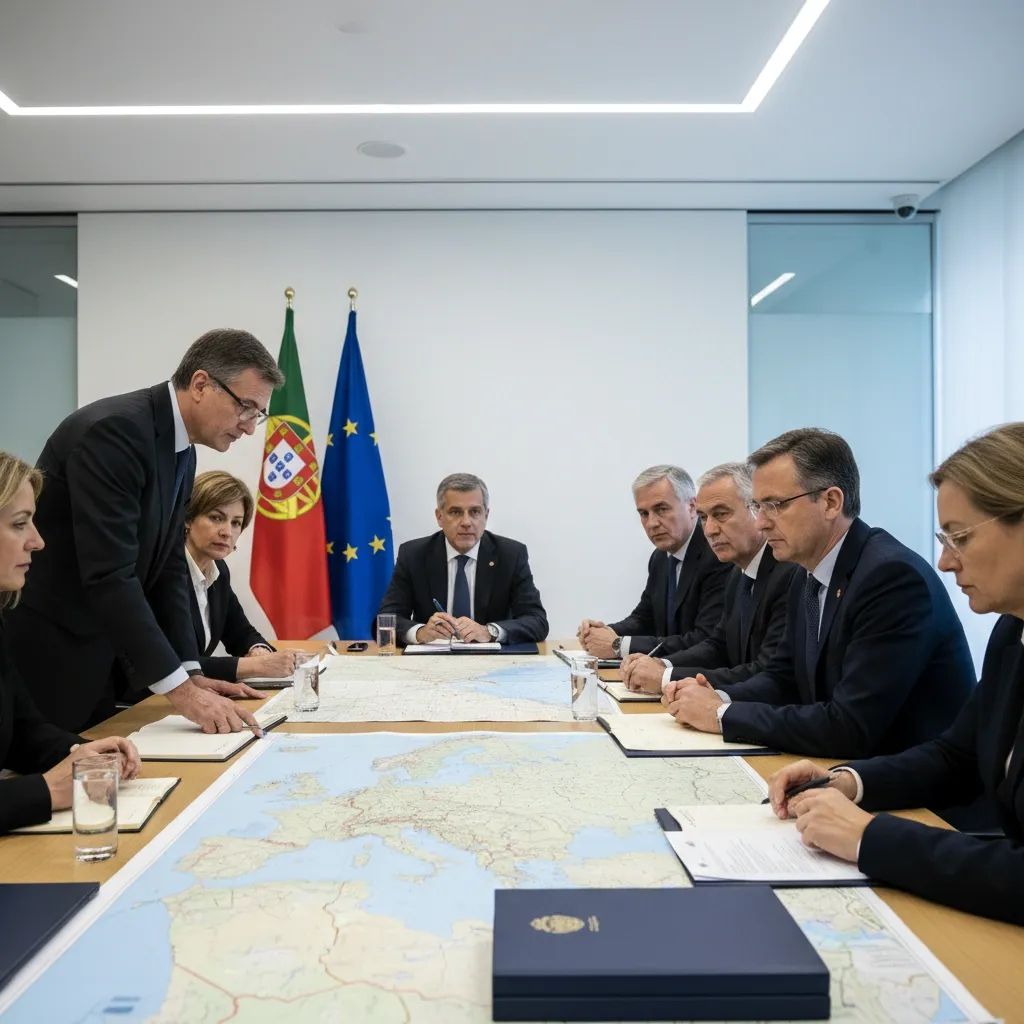
Speaking at the 50th anniversary of the European University Institute in Florence earlier this week, Seguro framed the EU's procedural gridlock as a structural threat. "The unanimity rule worked in the last century; it doesn't work in the 21st," the Portuguese head of state declared. "The world will not wait for us."
His message on social media for Europe Day reinforced that 27-nation consensus politics condemns the Union to perpetual reaction rather than proactive leadership. "Europe that depends on unanimity always arrives late," Seguro wrote, arguing for "majorities with ambition" rather than "blocking minorities." He stressed that advancement requires leaders who think beyond the immediate self-interest of individual member states.
Germany has emerged as a primary advocate for procedural reform, tabling proposals in recent weeks to replace unanimity with qualified majority voting (QMV) in foreign and security policy, even proposing an opt-out mechanism so reluctant capitals cannot paralyze the rest. German officials have characterized unanimity as an "existential danger" amid escalating global conflicts.
Polling has shown strong European public support for ending unanimity in EU decision-making, and the European Parliament has repeatedly urged use of "passerelle clauses"—treaty provisions that permit switches to QMV without full treaty revision—to accelerate reform. Portugal's previous Prime Minister, António Costa, had opposed such changes pending a broader institutional redesign, and parties including Chega and the CDU remain skeptical of ceding sovereign veto power.
Defense Without "Subjugation"
Seguro framed strategic autonomy as one of four simultaneous pathways Europe must pursue to preserve peace, alongside safeguarding democracy, deepening political integration, and building sovereignty in defense, competitiveness, and energy. Yet the President's formulation stops short of advocating a European army separate from the Atlantic Alliance.
Portugal hit the NATO 2% of GDP defense spending target in 2025, four years ahead of schedule, and has requested €5.8B in low-cost EU loans to modernize equipment by 2030. The country participates in 16 of the 57 projects selected by the European Defence Fund and leads an initiative on disruptive technologies for underwater infrastructure protection—critical given Portugal's control of the world's 11th-largest maritime zone.
Lisbon's strategic posture prioritizes the NATO framework over an independent EU military structure, viewing the United States as a "fundamental transatlantic partner" even as Washington's 2026 National Defence Strategy signals that European security is no longer America's primary obligation. The shift has turned European strategic autonomy from a political preference into a functional necessity: the EU currently sources more than 50% of defense equipment from the U.S. and depends on American satellite reconnaissance and battlefield fire control across the military effects chain.
The EU's "ReArm Europe" plan envisions investments exceeding €800B, with the Security Action for Europe (SAFE) instrument contributing €150B. Independent estimates suggest genuine defense autonomy would require €150B to €200B by 2030 and an additional €500B in the following decade.
What This Means for Residents
For anyone living in Portugal, the debate over EU governance and defense has direct consequences. Faster EU decision-making could translate to quicker regulatory harmonization, infrastructure co-funding approvals, and crisis response—areas where Portugal has historically benefited from European solidarity but suffered from slow-moving consensus politics.
On the defense side, Portugal's strategy of modernizing within NATO rather than building parallel EU structures means continued close cooperation with U.S. forces stationed at Lajes Air Base in the Azores, which serves as a vital Atlantic monitoring post for Russian and Chinese activity. The bilateral defense commission reaffirmed this partnership in January 2026. Portuguese defense firms are also seeking deeper integration into U.S. supply chains, which could generate industrial opportunities but also sustain reliance on transatlantic procurement.
The broader fiscal implication: EU defense investment will likely demand higher national contributions or pooled borrowing, potentially affecting budget allocations for social programs, health, and pensions. Portugal's request for billions in EU defense loans underscores that modernization carries a price tag, even when financed at concessional rates.
Macron and Montenegro Join the Chorus
French President Emmanuel Macron used Europe Day to issue his own rallying cry for a "strong, powerful, and independent" Union, urging citizens to feel "proud to be European." In a social media message, Macron argued the EU has demonstrated crisis responsiveness—from the pandemic to Ukraine—and insisted the bloc acts "quickly, forcefully, and in solidarity when history knocks on the door." He rejected nationalist narratives, asserting that Europe "respects and strengthens" nations rather than diminishing them.
Portuguese Prime Minister Luís Montenegro echoed the theme of collective ambition, pledging Portugal will remain committed to "a stronger, more competitive, cohesive, and influential Union." On the 40th anniversary of Portugal's accession to the European Economic Community, Montenegro emphasized that European strength is "essential to the defense of Portugal's interests and ambitions."
José Pedro Aguiar-Branco, president of the Portuguese parliament, described Europe as "more than a continent—a culture, a civilization, a way of living and thinking about the world." He highlighted the freedom of movement for people, goods, and capital, as well as the ability to study, work, and invest across the Union, crediting the European project with delivering peace after centuries of conflict.
Four Decades of Transformation
Portugal's formal entry into the European Economic Community took effect on January 1, 1986, alongside Spain, following a treaty signed in June 1985 by then-Prime Minister Mário Soares and ministers Jaime Gama and Ernâni Lopes. By the time the treaty entered force, a centre-right government led by Aníbal Cavaco Silva had taken office and would govern for a decade.
The four decades since have reshaped Portugal's economy and society. Net transfers from the EU exceed €88B, funding a tenfold expansion of the highway network between 1990 and 2024, metro line extensions, port modernization, and telecom upgrades. More than 100,000 Portuguese students have participated in Erasmus+ mobility programs.
Economic structure shifted dramatically: the services sector now accounts for 76.5% of gross value added, up from a mid-1980s economy dominated by agriculture and traditional manufacturing. Trade intensity climbed from roughly 50% of GDP in 1974 to over 90% in 2024. Life expectancy increased, income inequality narrowed, and democratic institutions consolidated in the post-dictatorship era.
Yet convergence with the EU average has slowed since the turn of the century, attributed to stagnant productivity and structural fragilities. Regional disparities persist, and some analysts point to bureaucratic inefficiency and misallocation of funds as limiting factors in certain communities.
Public sentiment remains overwhelmingly positive: 91% of Portuguese citizens believe the country has benefited from EU membership, a figure that reflects both material gains and the political stability the Union helped anchor.
The Road Ahead
Seguro's Florence speech distilled the challenge: "The future belongs to those who act with determination, not those who react late and almost always chase losses." Whether the EU can overcome institutional inertia—particularly the veto power of individual member states on sensitive matters—will determine its capacity to navigate geopolitical turbulence, technological competition with China, and the recalibration of transatlantic defense burdens.
For Portugal, the calculus involves balancing loyalty to NATO and the United States with the broader European ambition for strategic sovereignty. The country's geographic position as the Atlantic gateway, its control over critical undersea data cables, and its modernization timeline all position Lisbon as a stakeholder in both camps. The question is whether European defense autonomy and the Atlantic Alliance can coexist—or whether the logic of subjugation Seguro warns against will persist until Brussels builds capabilities Washington no longer guarantees.