
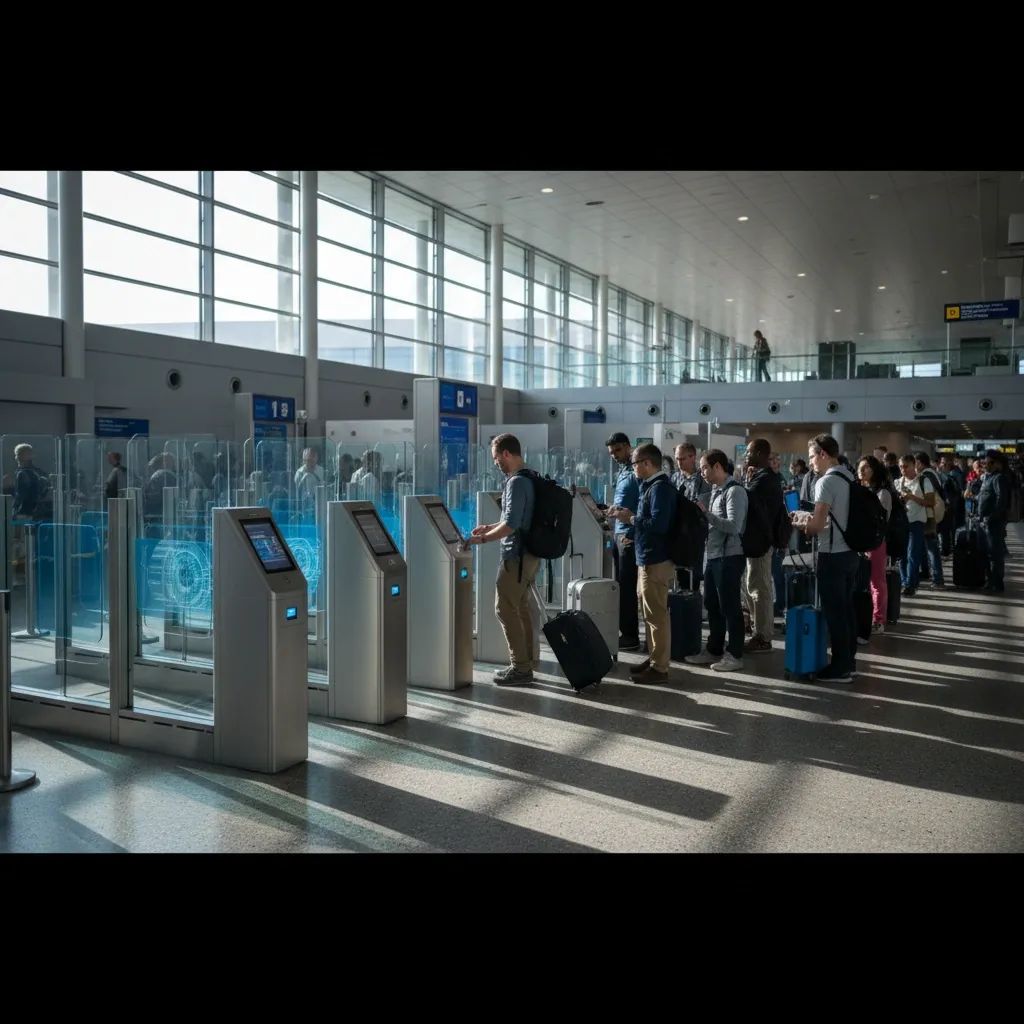
Portugal's Public Security Police (PSP) confirmed that the European Entry/Exit System (EES) reached full operational status across all Portuguese border checkpoints, ending a six-month grace period that allowed authorities to temporarily suspend biometric controls during peak traffic. The move signals a permanent shift in how non-EU travelers enter and exit the country, with immediate implications for wait times, tourism flows, and airport capacity heading into the summer season.
What This Means for Portugal Residents
If you're hosting visitors from outside the EU, or if you're a non-EU resident yourself, this permanent implementation directly affects your life in several ways:
• You're advising international guests: Friends and family arriving from non-EU countries will now face mandatory biometric processing. Instruct them to download the Travel to Europe app before departure and complete pre-registration up to 72 hours early—this can cut processing time by several minutes per person.
• Non-EU residents returning to Portugal: If you live in Portugal and hold a non-EU passport, the EES now applies to your re-entry from any trip outside the Schengen Area. Plan for 60–90 minutes extra at the airport during peak hours.
• Business implications: If your company hosts international clients or employees from outside the EU, expect them to experience longer airport delays. Brief them in advance and adjust meeting schedules accordingly for arrivals in July and August.
• Your airport experience: If you're traveling out of Portugal, the EES doesn't directly affect departing passengers (outbound flights skip biometric processing), but returning EU citizens enter through the same checkpoints as inbound non-EU arrivals, so congestion affects you indirectly.
Why This Matters
• No more emergency suspensions: From now forward, Portuguese authorities cannot fully shut down the EES, even during peak travel periods—only biometric data collection can be paused for up to 90 days if queues become unmanageable.
• Wait times stabilized—for now: Early morning operations on the rollout date showed 20–30 minute waits at Lisbon, Porto, and Faro airports, a dramatic improvement over the multi-hour delays recorded in December 2025.
• Summer stress test ahead: Tourism operators and airlines warn that the system's true test arrives in June through August, when passenger volumes could overwhelm infrastructure and trigger the suspension clause.
How the System Works in Practice
The EES replaces passport stamps with digital biometric registration—facial photos and ten fingerprints—stored in a centralized EU database. Every non-EU citizen entering the Schengen Area for short stays (up to 90 days within any 180-day period) must submit to this process. The PSP (Polícia de Segurança Pública) and GNR (Guarda Nacional Republicana) inherited border control responsibility from the dissolved Foreigners and Borders Service (SEF) in 2023, making them the primary enforcers of the new protocol.
According to the European Commission, an ideal EES transaction takes 70 seconds when systems function smoothly. Reality has proven messier. Technical glitches, understaffing, and the sheer learning curve for both agents and travelers slowed processing significantly during the phased rollout that began on October 12, 2025. Lisbon's Humberto Delgado Airport became the national flashpoint, with travelers reporting two- to three-hour queues through November and December, prompting the government to suspend the system entirely for three months.
What Changed at Portuguese Airports
The PSP reported relatively smooth operations during the first hours of full implementation. All major international airports in Portugal are now fully integrated into the system: Lisbon (Humberto Delgado), Porto (Francisco Sá Carneiro), Faro, Madeira, and the Azores airports are all processing non-EU arrivals through EES checkpoints.
At Faro Airport, the busiest early morning checkpoint, passengers faced a one-hour wait at 5:30 a.m., which dropped to 20 minutes by mid-morning. Porto logged similar figures—20 minutes for departures, 10 minutes for arrivals. Lisbon, the previous problem child, clocked 30 minutes for departures and under 10 minutes for arrivals by 9:45 a.m.
These improvements stem from several adjustments made during the transition period. ANA – Aeroportos de Portugal, the national airport operator, expanded the number of self-service kiosks available for pre-registration. The National Civil Aviation Authority coordinated with airlines to stagger flight schedules slightly, reducing simultaneous arrivals. The PSP also deployed 24 additional agents from the GNR, which handles maritime border controls, to reinforce airport checkpoints during the final rollout phase.
Travelers can now use the "Travel to Europe" mobile app, developed by Frontex, to pre-register passport data and facial images up to 72 hours before arrival. Portugal supports the app's entry questionnaire feature, allowing passengers to complete preliminary paperwork digitally. While the app does not eliminate the need for in-person fingerprint scanning, it shaves minutes off the process and helps distribute the workload away from peak checkpoint hours.
The Flexibility Clause and Summer Concerns
The European Commission granted member states a critical compromise: while full system suspension is no longer permitted, national authorities retain the right to pause biometric data collection for up to 90 days, with a possible 60-day extension, if wait times become excessive. This means Portugal could theoretically revert to manual passport stamping during July and August if queues spiral out of control.
Tourism industry leaders argue this flexibility will be essential. Hotel associations, airline groups, and retail federations have collectively warned that peak summer traffic could generate four-hour waits at major hubs like Lisbon if the system buckles under volume. Such delays ripple across the entire hospitality value chain: missed hotel check-ins, canceled restaurant reservations, lost revenue for ground transport providers, and reputational damage that discourages future bookings.
Portugal's Ministry of Economy and Territorial Cohesion struck a more optimistic tone in January, stating that airport bottlenecks had been "resolved" and predicting tourism growth would continue to outpace national GDP in 2026. Yet this official confidence contrasts with on-the-ground anxiety from operators who recall the chaos of late 2025.
Impact on Business Travelers and International Reputation
While tourists can often absorb delays as an inconvenience, business travelers face productivity losses that directly affect Portugal's positioning as a hub for conferences, tech events, and corporate meetings. The country has aggressively marketed itself as a digital nomad and startup destination, with tax incentives and streamlined visa processes designed to attract remote workers and investors. Multi-hour airport queues undermine that narrative.
Reputational risk extends beyond tourism. International media coverage of the Lisbon delays in December circulated widely in North American and Asian markets, precisely the demographics Portugal courts for high-value investment and skilled migration. Competitors like Spain installed over 700 self-service kiosks at Madrid-Barajas and Barcelona-El Prat airports ahead of the rollout, positioning themselves as more technologically prepared.
Technical Challenges Across Europe
Portugal's struggles mirror broader technical implementation difficulties acknowledged by the European Commission. Spain's Gran Canaria Airport temporarily reverted to manual stamps after repeated e-gate failures. France's Eurostar terminals experienced frequent kiosk malfunctions, forcing passengers back into manual processing lines. The United Kingdom, though not part of Schengen, provided funding for infrastructure at Dover and Eurotunnel crossings to support smoother EU border checks, recognizing that delays on the French side would clog its own exit points.
Spain responded with 480 newly trained National Police agents dedicated to manual "fallback" counters, a contingency measure Portugal has yet to match at the same scale. The reliance on the PSP and GNR, both already stretched thin by domestic security duties, raises questions about whether staffing levels can sustain the system through sustained high-traffic periods.
Practical Advice for Portugal Residents
• Pre-registration is mandatory for efficiency: If you're meeting non-EU family or clients at the airport, instruct them to download the Travel to Europe app and complete the questionnaire before departure. This simple step can cut processing time by several minutes per person.
• Allow extra buffer time for airport pickups: Even with improvements, add at least 60–90 minutes to your airport arrival estimate if visitors or companions are non-EU citizens. Peak morning and evening slots remain the riskiest.
• Monitor summer flexibility announcements: If Portugal invokes the biometric suspension clause in July or August, expect sudden procedural changes. Airlines and ANA are required to notify passengers, but late communication could still cause confusion.
• Maritime crossings also affected: The EES applies equally to ferry terminals and marinas handling international arrivals. If you sail from Morocco or the Canary Islands to mainland Portugal, factor in the same biometric requirements.
The Road Ahead
Full implementation marks the end of the transition period but the beginning of operational stress-testing. The Portugal Internal Security System (SSI) coordinates between PSP, GNR, ANA, port authorities, and the aviation regulator to monitor real-time checkpoint performance and deploy resources dynamically. Whether this coordination proves sufficient during the July crush of North American and Brazilian tourists remains the critical unanswered question.
Tourism growth in Portugal exceeded national GDP in 2025, and early 2026 bookings suggest continued momentum. Yet capacity constraints at Lisbon Airport—already a bottleneck unrelated to the EES—compound the risk. Industry groups continue lobbying Brussels to extend flexibility provisions indefinitely, arguing that 70-second processing times are theoretical, not practical, given infrastructure limitations.
For now, the system is running. The real test begins when the system runs at full capacity.


