

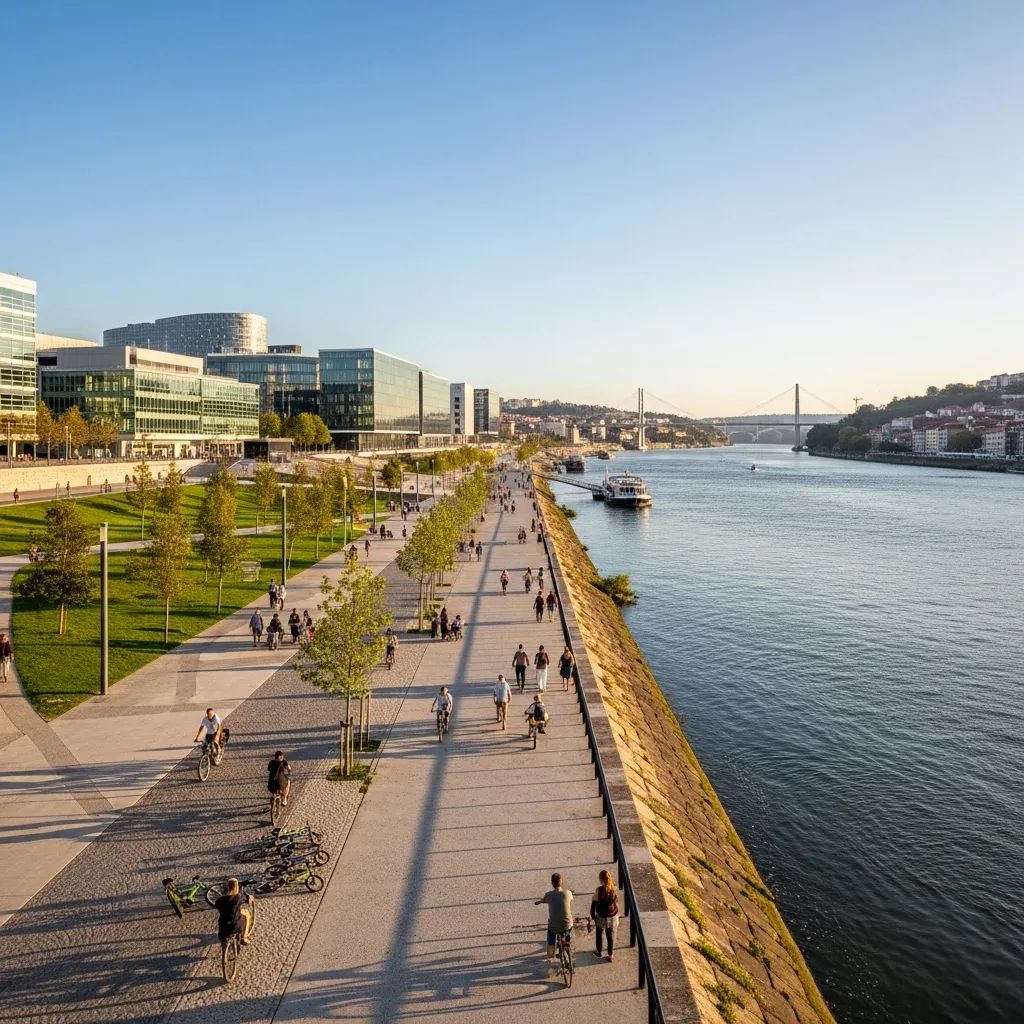
The Portugal Socialist Party (PS) in Vila Nova de Gaia has thrown its weight behind a controversial road deck for a new bridge over the Douro River, accusing the municipal government of breaking campaign promises and jeopardizing mobility solutions that could ease chronic traffic congestion.
Why This Matters
• Broken promises: Mayor Luís Filipe Menezes (PSD/CDS/IL) pledged during the 2025 municipal elections that no decisions would be imposed on Gaia against the municipality's will — a stance the PS now calls contradictory.
• New river crossing: The proposed road-rail bridge would offer an alternative route across the Douro, potentially relieving pressure on existing crossings between Porto and Gaia.
• High-speed rail impacts: The project is part of the Porto-Lisbon high-speed line, with construction set to begin in 2026 and completion targeted for 2030.
• Demolition toll: The revised plan affects 43 homes and 37 businesses in Gaia, with Santo Ovídio bearing the brunt of the works.
A Double-Decker Bridge at the Heart of the Row
The structure at the center of this political clash is a combined road-rail bridge designed to span the Douro and connect Porto's Avenida Gustave Eiffel to Gaia. The upper deck will carry the high-speed train (TGV) over 1,127.7 meters, while the lower deck will accommodate vehicles, cyclists, and pedestrians across 690 meters.
Specifically, the road level includes two vehicle lanes of 3.25 meters each, a 1-meter central divider, a 1.5-meter cycle path, and 2.25-meter sidewalks on both sides. This lower deck is what the PS describes as having "great relevance for the mobility system in the municipality," offering a new option where existing crossings face chronic bottlenecks.
The Portugal Environment Agency (APA) rejected earlier proposals from the AVAN Norte consortium for two separate bridges and relocating Gaia's high-speed station to Vilar do Paraíso, ruling they did not comply with the approved Environmental Impact Declaration. The project reverted to the original single bridge design and the Santo Ovídio station location, approximately 60 to 70 meters underground.
What This Means for Residents
For people living in Vila Nova de Gaia, the practical implications are immediate and tangible. If the road deck proceeds as the PS advocates, commuters gain a supplementary crossing that could distribute traffic more evenly and cut journey times during peak hours. The inclusion of dedicated cycling and pedestrian infrastructure also aligns with broader pushes for sustainable urban mobility.
However, the cost is significant. The Santo Ovídio neighborhood faces 14 home demolitions and the loss of 6 businesses, with industrial zones like São Caetano (15 enterprises) and Terços (9 enterprises) also in the line of fire. Construction is expected to last roughly five years, during which an estimated 200 truckloads of earth will move daily through the city center, inevitably choking streets and disrupting commerce.
Mayor Menezes has repeatedly voiced his "total opposition" to any increase in surface-level rail kilometers, insisting the line must be tunneled wherever it crosses Gaia. In a June 27 letter to the APA, he warned that "no urban area is in a position to support the movement of 200 trucks of earth per day in the city center" and flagged the risk of economic hardship for businesses during the construction phase.
The PS counters that this stance contradicts Menezes's own 2025 campaign platform, titled "Avançar Gaia 2025," which prioritized efficient mobility, including proposals for a 12-minute public transport system linking interior parishes to the urban core and a teleférico between Canidelo and Devesas. The socialists argue that refusing the road deck undermines the very connectivity improvements Menezes promised voters.
The Porto Side of the Equation
Across the river, the Porto municipality also faces upheaval. The latest execution project maintains the demolition of 44 homes, seven commercial activities (including the gas station on Avenida Gustave Eiffel), and three other category buildings. A new roundabout on Avenida Gustavo Eiffel will serve as the bridge's Porto landing point, requiring reconfiguration of surrounding streets.
The project's public consultation period closed on June 29, with the Environmental Conformity Report for the Execution Project (RECAPE) open for comments. The broader Porto-Oiã segment of the high-speed line is slated to break ground in 2026, reaching completion by 2030, while the full Porto-Lisbon route should become operational in 2032.
Political Friction and Policy Realities
The dispute highlights a familiar tension in Portuguese infrastructure planning: balancing urgent transport needs against environmental and social costs. The PS frames the road deck as a pragmatic win, easing a mobility crisis that has plagued the Porto Metropolitan Area for decades. The municipal executive, led by Menezes, emphasizes minimizing surface disruption and maximizing tunnel coverage to protect quality of life.
Both positions carry weight. Tunneling reduces noise, vibration, and visual blight once operational, and it spares surface land from expropriation. Yet deep tunnels also escalate construction costs, lengthen timelines, and generate their own environmental trade-offs — excavation waste, energy-hungry ventilation systems, and complex groundwater management.
What remains uncontested is the scale of the challenge. The current Douro crossings routinely log multi-kilometer tailbacks during morning and evening rushes, a bottleneck that costs the regional economy millions in lost productivity each year. Whether the solution lies in an additional road level on the new bridge or in alternative mobility investments is the core of the argument.
A Test Case for Infrastructure Governance
Beyond the technical merits, this clash serves as a test of how Portugal's local authorities negotiate infrastructure decisions that transcend municipal boundaries. The high-speed rail project is a national priority, backed by EU funds and designed to integrate Portugal into the broader European rail network. Yet its local footprint inevitably pits regional ambitions against neighborhood-level concerns.
For now, the revised project stands as filed: one bridge, two decks, Santo Ovídio station, and a phased demolition schedule. The final environmental green light rests with the APA, which has already demonstrated willingness to reject variations it deems non-compliant. Whether political pressure from the PS or the municipal executive will sway the outcome remains uncertain.
Residents in the affected zones of Santo Ovídio, São Caetano, and Terços are advised to monitor official communications regarding expropriation timelines and compensation packages. Those who rely on cross-river commutes should prepare for construction-related detours and delays starting in 2026. Meanwhile, the debate over campaign pledges versus infrastructure pragmatism will likely echo through the next electoral cycle, serving as a reminder that mobility solutions in dense urban corridors come with unavoidable friction.


