Fatal Crash Exposes Gas Infrastructure Risks in Central Coimbra
On April 8, a vehicle veered off the roadway on Avenida Sá da Bandeira in central Coimbra and struck a pressurized gas supply installation. The impact ruptured gas lines, which ignited and engulfed the vehicle in flames. The fire spread to an adjacent residential building. Two university students trapped in the vehicle—Bruno Paredes and Hugo Meneses, both 20 years old—did not survive. Two building residents were rescued unconscious and hospitalized. The crash has exposed critical questions about aging utility infrastructure and road safety across Portugal's oldest city.
The Incident: April 8, Central Coimbra
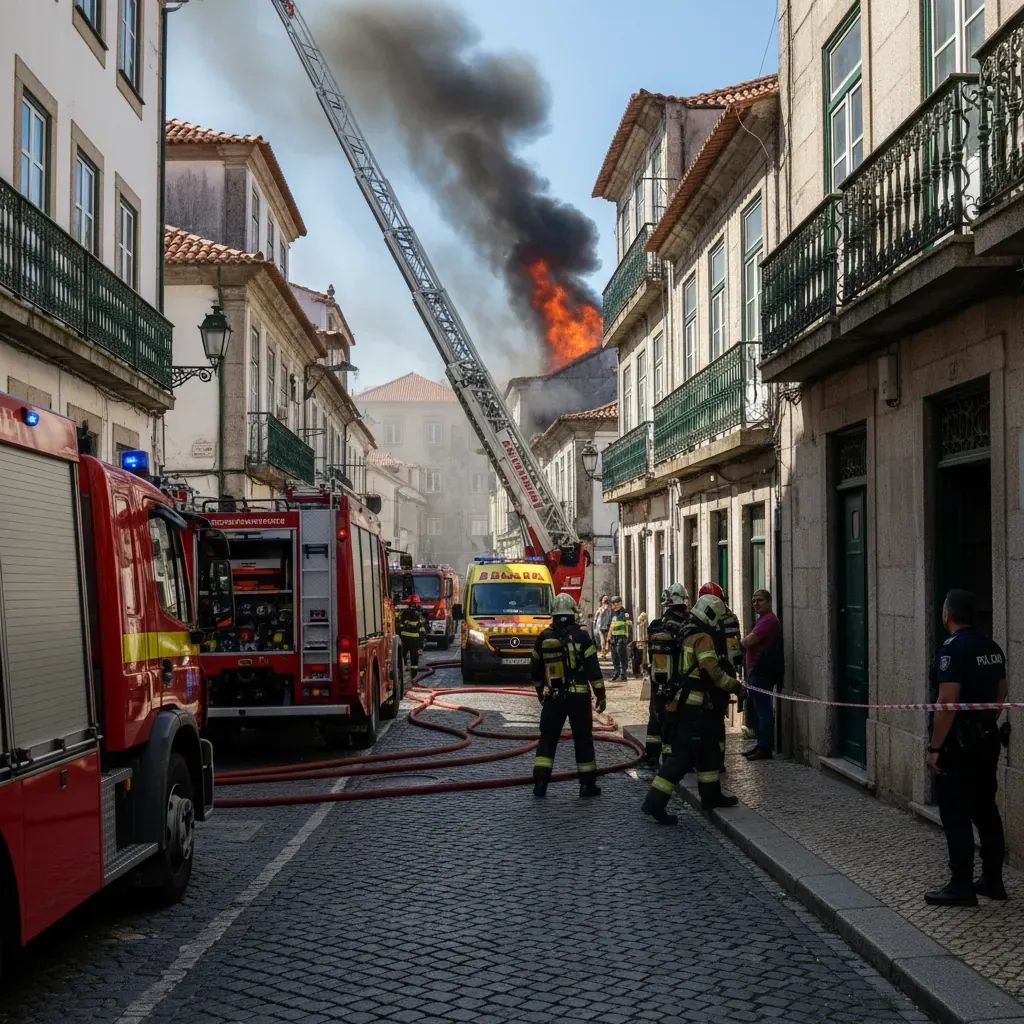
The emergency call came in at 6:18 a.m. A vehicle carrying three occupants in their early twenties lost control near Praça da República, in Coimbra's commercial and academic district. The car struck a gas installation—a pressurized natural gas (gás natural) distribution line serving surrounding buildings. Within seconds, pressurized gas escaped and combusted, transforming the vehicle into an inferno.
Firefighters from the Bombeiros Sapadores de Coimbra arrived to find intense flames and smoke spreading to the residential building above. The two young men inside the vehicle—Bruno Paredes, an Anthropology student, and Hugo Meneses, a Geography student, both enrolled at the Faculdade de Letras of the University of Coimbra—had already perished in the intense heat.
The fire penetrated the residential structure above, forcing occupants to flee. Two women in their thirties living in an attic apartment found themselves cut off by spreading smoke and heat. They lost consciousness from carbon monoxide and smoke inhalation. Rescue teams extracted both unconscious women and rushed them to the Hospital da Universidade de Coimbra in critical condition. Current hospital reports indicate the women are recovering steadily, though full recovery timelines remain uncertain.
A third passenger—a 23-year-old man—managed to exit the vehicle under his own power and suffered only minor abrasions and bruising. Three additional building residents (ages 19, 20, and 26) were treated for smoke inhalation and released after observation.
The rescue operation mobilized more than a dozen personnel from Bombeiros Sapadores de Coimbra, volunteer brigades, emergency medical teams, and police. A critical constraint on response: specialized gas technicians had to be summoned to safely isolate the ruptured line, which slowed evacuation efforts. The building sustained structural damage severe enough that authorities condemned it immediately as uninhabitable pending full safety assessments.
What Residents in Portugal Need to Know: Gas Installation Safety
The crash has exposed how street-level and building-level gas infrastructure can fail with catastrophic consequences. For residents across Portuguese cities, understanding your building's gas safety is now more urgent.
Understanding Your Building's Gas System
In Portugal, residential gas installations fall under strict regulatory oversight. Under Portuguese building codes (RTEGAS—Regulamento Técnico de Sistemas de Gás), gas installations must be inspected every five years by certified technicians. For condominium properties, responsibility for common-area inspections rests with the building administration (administração do edifício) or condominium association (associação de proprietários); individual unit owners must ensure compliance within their own apartments.
However, enforcement remains inconsistent, particularly in multi-unit buildings where responsibility is fragmented or ownership is unclear. National safety data suggests that approximately 30% of domestic gas-related incidents in Portugal stem from faulty installations, leaks, or inadequate maintenance.
Critical Safety Steps for Your Home
1. Verify Your Building's Inspection Records
• Request documented proof that your building's gas installation passed its mandated five-year inspection
• Ask your building administrator (or condominium manager) to provide certification from a Técnico Autorizado (Certified Technician) licensed by IPAC (Instituto Português da Acreditação)
• If records are incomplete or unavailable, contact your municipal government's building inspection office to request verification or demand an inspection
2. Check Installation Standards in Your Unit
• Fixed appliances (ovens, boilers, water heaters) must connect via rigid metal tubing; flexible hoses are permissible only for portable devices and cannot exceed 1 meter in length
• Never obstruct air vents or grilles that allow combustion byproducts to escape
• No more than four gas canisters (totaling 106 liters maximum) may be kept per dwelling, with no more than two per room
3. Know Your Legal RightsIf your building administrator fails to conduct mandated inspections, you have legal recourse:
• File a complaint with your municipal building inspection office (câmara municipal—department of urbanism/construction)
• Contact ASAE (Autoridade de Segurança Alimentar e Económica) or your regional gas safety authority
• Formally notify your building administrator in writing and demand inspection; persistent non-compliance may justify withholding maintenance fees until compliance is achieved
4. Emergency Response ProtocolIf gas odor is detected in your building:
• Do not ignite flames or activate electrical switches
• Open all windows and doors immediately
• Shut off the main gas valve at the meter/inlet
• Contact emergency services (112) or a certified technician immediately
• Evacuate the building if odor persists or if residents feel unwell
5. Consider Gas Detection SystemsWhile optional, installing gas detection systems that alert residents to dangerous concentrations of combustible gas or carbon monoxide offers practical protection—particularly in older buildings where inspection history is opaque or records are incomplete.
Impact on the University and Local Community
Condeixa-a-Nova, the municipality of approximately 17,000 residents located roughly 15 kilometers south of Coimbra where both victims had lived since childhood, issued a formal statement expressing profound grief. The Câmara Municipal de Condeixa-a-Nova described the deaths as leaving an "irreparable void."
The impact on the Universidade de Coimbra was immediate. The Núcleo de Estudantes da Faculdade de Letras (NEFLUC), the faculty's student union, activated peer support services. The broader Associação Académica de Coimbra (AAC), the umbrella student organization across the university, coordinated additional counseling resources—including services available to both Portuguese and international students. The AAC website (www.aacoimbra.pt) provides information on counseling availability, peer support networks, and emergency resources in multiple languages.
Portugal's Deteriorating Road Safety Picture
The collision on Avenida Sá da Bandeira reflects a troubling national trend in road fatalities accelerating through 2025 and into early 2026.
As of early April 2026, Portugal had recorded 16,498 traffic accidents since the start of 2026—an increase of 2,107 compared to the same period in 2025—resulting in 60 fatalities, 14 more than the prior year. The Easter holiday period (April 2–6, 2026) proved particularly dangerous: the Guarda Nacional Republicana and Polícia de Segurança Pública reported 20 fatalities, a fourfold increase compared to 5 deaths during the same holiday period in 2025.
Coimbra's accident rate, measured per capita, exceeds even those of Lisbon and Porto despite its significantly smaller population. The national road crime rate climbed 24% in 2025, with speeding, alcohol-impaired driving, and distracted driving identified as dominant factors. While immediate fatalities declined marginally (6.1% reduction), severe injuries surged 2.2% to 2,816 cases—suggesting crashes are becoming more violent even if fewer result immediately in death.
Drivers aged 16–30 are disproportionately represented in fatal crashes, and single-vehicle collisions—exactly the type that killed Paredes and Meneses—now constitute a growing share of fatalities.
Government Response and Road Safety Strategy
In response to worsening statistics, the Ministério da Administração Interna announced plans to introduce a comprehensive strategic package spanning short-, medium-, and long-term road safety measures. The focus emphasizes behavioral change—targeting alcohol consumption, excessive speed, and mobile phone use while driving—rather than infrastructure investment alone.
The Autoridade Nacional de Segurança Rodoviária operates under a strategic framework called "Visão Zero 2030," a commitment to halve road deaths by the end of the decade. The approach emphasizes data-driven identification of accident hotspots, targeted infrastructure improvements in high-risk zones, and coordinated enforcement by police agencies.
Coimbra's city government is developing a Plano Municipal de Segurança Rodoviária (Municipal Road Safety Plan)—a detailed map of local accident clusters, infrastructure vulnerabilities, emergency response protocols, and evidence-based countermeasures. Whether this incident will accelerate design modifications, speed restrictions, or enforcement intensification on Avenida Sá da Bandeira remains an open question. Preliminary indications suggest local authorities will prioritize visibility improvements and traffic calming measures.
Investigation and Legal Framework
The Polícia de Segurança Pública and the Instituto de Medicina Legal are leading the investigation into the crash circumstances. Post-mortem examinations are underway to confirm identities and assess whether contributing factors—such as alcohol, drugs, mechanical failure, or road conditions—played a role.
Under Portuguese criminal law, drivers bear strict liability for loss-of-control incidents. If prosecutors determine that negligence, recklessness, or criminal behavior contributed, charges may range from negligent homicide to reckless endangerment.
For families, the legal landscape extends beyond criminal accountability. Civil claims may be brought against the vehicle owner, driver, or potentially against municipal or utility authorities if investigation reveals that infrastructure maintenance failures contributed to the tragedy.