

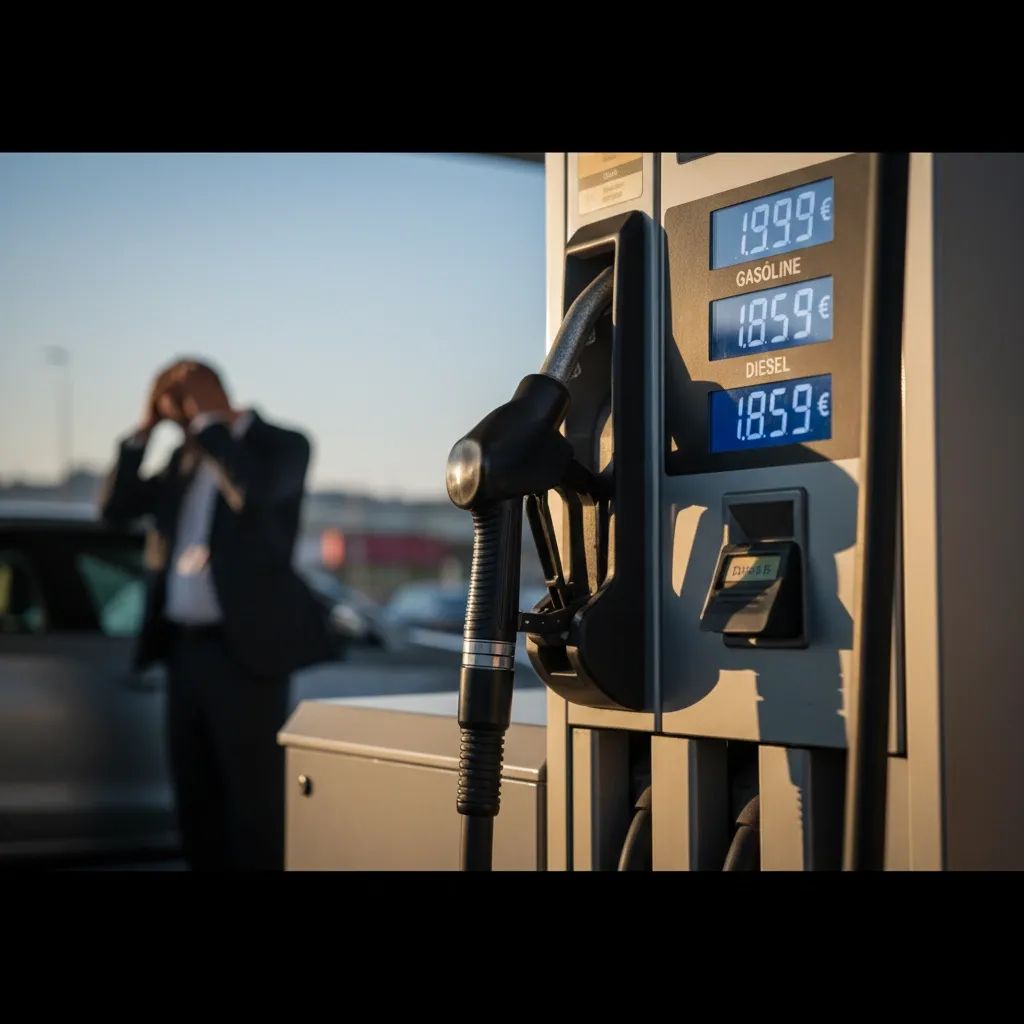
The OPEP+ alliance has approved its 5th consecutive monthly production increase, adding 188,000 barrels per day (bpd) to global supply starting this month—a decision that will accelerate the ongoing collapse in oil prices and likely translate into cheaper fuel costs at Portugal's petrol stations by late summer.
Why This Matters
• Fuel prices poised to fall further: Brent crude has already dropped from $109.62 per barrel in late April to $62.74 last week—a 42% decline that should eventually reach Portuguese consumers.
• Inflationary pressures easing: Lower energy costs reduce overall inflation, potentially stabilizing household budgets and influencing European Central Bank monetary policy.
• Market oversupply looming: The International Energy Agency projects a surplus of 3.8M bpd globally in 2026, which could keep prices depressed for months.
• Investment implications: Energy sector portfolios face headwinds; diversified investors may benefit from cheaper industrial inputs.
The Decision Behind Closed Doors
Seven core OPEP+ members—Saudi Arabia, Russia, Iraq, Kuwait, Kazakhstan, Algeria, and Oman—convened via digital conference this week to ratify the production adjustment. According to a statement from the Organization of the Petroleum Exporting Countries (OPEP), headquartered in Vienna, the move continues the gradual reversal of voluntary cuts implemented in April 2023.
The alliance emphasized its commitment to "market stability," but also signaled maximum flexibility: the July increase can be "paused, suspended, or fully reversed" depending on market dynamics. This escape clause reflects deep uncertainty about whether demand can absorb the extra barrels flooding the system.
Significantly, the seven nations confirmed they will fully compensate for overproduction since January 2024, suggesting internal compliance issues have plagued the cartel. Iraq and Russia, in particular, have historically exceeded their quotas during periods of high prices, undermining collective discipline.
From War Premium to Peacetime Glut
The context for this decision is a dramatic shift in Middle Eastern geopolitics. For much of early 2026, the Strait of Hormuz—the maritime chokepoint through which roughly 20% of the world's oil once flowed—was effectively paralyzed by conflict. U.S. and Israeli airstrikes on Iran in late winter triggered retaliatory actions across the Gulf, forcing Saudi Arabia, Iraq, and Kuwait to slash combined output by approximately 6M bpd between the first quarter and May.
Oil prices surged above $127 per barrel in mid-March as markets priced in catastrophic supply disruptions. But a memorandum of understanding between Washington and Tehran in mid-June changed everything. The agreement, which extends a ceasefire while broader negotiations continue, has allowed tanker traffic through the strait to resume—albeit still far below pre-war levels.
As shipments recovered, the war premium evaporated. OPEP reference crude plunged from $127.02 on March 19 to $60.31 by last Thursday, according to official notifications. The Brent benchmark, widely used in European markets, now trades near $72 per barrel—well below the $80+ Saudi Arabia needs to balance its national budget.
Competing Pressures and the Risk of Oversupply
The OPEP+ production hike arrives amid a surge in non-cartel output that threatens to overwhelm global demand. The United States, Brazil, Argentina, Guyana, and Canada are collectively expected to add roughly 800,000 bpd in 2026, with American shale producers in the Permian Basin alone accounting for half of U.S. production, projected at 13.7M bpd this year.
Brazil's state-owned Petrobras has brought two new floating production units online at the Búzios field, pushing national output past 4M bpd. Guyana, a relative newcomer, is on track to exceed 1M bpd by 2027 thanks to the Uaru project. Argentina's Vaca Muerta shale formation now supplies over 60% of the country's crude, with output expected to hit 810,000 bpd in 2026.
Adding to the complexity, the United Arab Emirates formally exited OPEP on May 1, freeing it to produce at maximum capacity—around 5M bpd—without quota restrictions. Iraq, the second-largest OPEP producer after Saudi Arabia, has formally requested a quota increase to compensate for war-related losses, further straining internal cohesion.
What This Means for Residents
For anyone living in Portugal, the immediate impact will be felt at the pump and in energy bills. While retail fuel prices don't move in perfect lockstep with crude benchmarks—taxes, refining margins, and distribution costs account for roughly 60% of the final price—a sustained decline in Brent crude typically filters through within 4 to 8 weeks.
Portugal's Autoridade da Concorrência (Competition Authority) has previously flagged sluggish pass-through of wholesale price drops to consumers, particularly in rural areas with less competition. Monitoring your local station's pricing against national averages via the Mais Barato government app remains advisable.
Beyond transportation, cheaper oil reduces input costs for plastics, chemicals, and logistics—sectors that feed into everything from packaging to food distribution. Lower energy inflation also gives the European Central Bank more room to maintain accommodative monetary policy, which could stabilize mortgage rates tied to Euribor benchmarks.
The Fragile Fundamentals
Despite the production increase, OPEP+ remains cautious. The alliance's statement stressed a "prudent approach" and reaffirmed that adjustments are fully reversible, including previously implemented cuts announced in November 2023. This language suggests internal debate about whether the market can absorb additional supply without triggering a price collapse that harms member states' fiscal positions.
Several factors cloud the outlook. The Strait of Hormuz remains only partially functional, with daily throughput still below pre-conflict levels. Geopolitical risks persist: ceasefires in Gaza and Lebanon remain fragile, Houthi forces in Yemen could resume attacks on Red Sea shipping if hostilities escalate, and Israel continues strikes against Hezbollah positions.
On the demand side, China's economic slowdown poses a structural threat. OPEP maintained its 2026 global demand growth forecast at 1.38M bpd, reaching a total of 106.53M bpd, but acknowledged "transitory weakness" in the second quarter due to Middle Eastern disruptions. Whether that weakness proves temporary depends on Chinese manufacturing activity and European industrial output, both of which have underperformed expectations.
Analysts at XS.com warned that the market may be shifting "from temporary scarcity to oversupply," creating downside risk for prices. If non-OPEP+ producers continue to ramp up and the alliance proceeds with planned increases, inventories could swell, pressuring prices below the $60 per barrel threshold some members consider unsustainable.
The Cartel's Cohesion Test
Founded in Baghdad in 1960 by Saudi Arabia, Venezuela, Iran, Iraq, and Kuwait, OPEP now comprises 11 member states. The OPEP+ alliance, formalized in 2016 with 10 additional nations including Russia, has historically struggled with compliance. The departure of the UAE—a top-five producer—undermines collective leverage and raises questions about whether other members might follow.
Iraq's formal request to expand its quota signals growing dissatisfaction with production restraints. With output capacity between 3M and 3.4M bpd, Baghdad argues it deserves a larger share, especially given war-related losses. Such disputes risk fragmenting the alliance at a moment when coordination is most needed to prevent a supply glut.
Russia, facing Western sanctions and reliant on discounted sales to Asia, has its own incentives to maximize volume over price. Kazakhstan and Algeria, both seeking to monetize reserves quickly, may resist further cuts if prices soften. The challenge for Saudi Arabia—OPEP's de facto leader—is maintaining discipline while protecting market share against American shale producers who can respond rapidly to price signals.
Looking Ahead
The July production increase marks a critical juncture. If Middle Eastern output recovers smoothly and the Strait of Hormuz returns to full capacity, global markets could face a sustained surplus, keeping prices depressed through the second half of 2026. For Portugal, that scenario means prolonged relief at the pump but also potential headwinds for energy sector investments held in pension funds and retail portfolios.
Conversely, any escalation in regional conflicts—particularly involving Iran or disruptions to Iraqi Kurdistan's 450,000 bpd export pipeline—could trigger a rapid reversal. OPEP+ has built in flexibility for precisely this reason, retaining the option to freeze or roll back increases on short notice.
For now, the trajectory favors lower prices, cheaper fuel, and reduced inflation. But in an industry where geopolitics and geology intersect unpredictably, the alliance's cautious language serves as a reminder: today's glut could quickly become tomorrow's shortage.


