

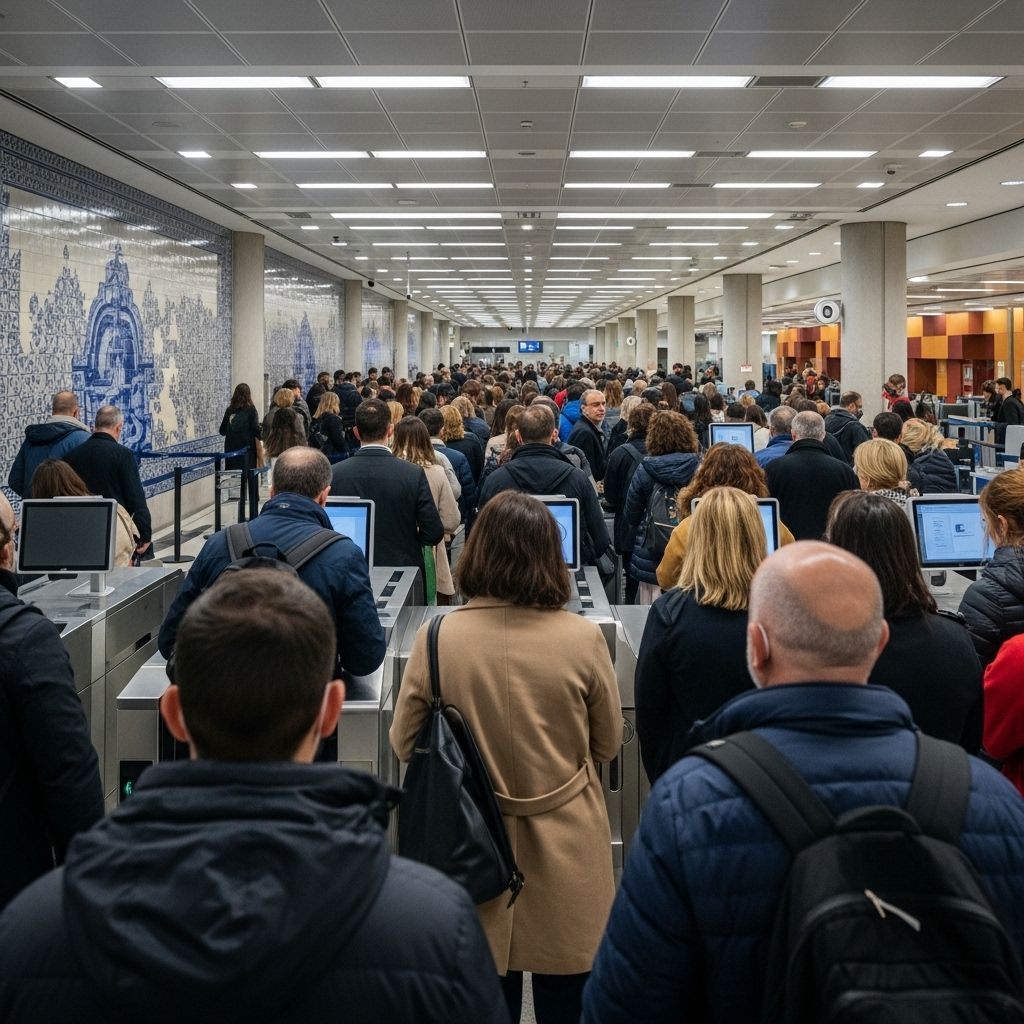
The Portugal Ministry of Internal Affairs (MAI) has clarified that the authority to suspend biometric data collection at border checkpoints lies solely with the Public Security Police (PSP), not with Brussels—a revelation that comes as airports nationwide grapple with delays exceeding two hours under the European Union's new Entry/Exit System (EES).
Why This Matters
• PSP can pause fingerprint and facial scans for up to 6 hours when wait times become excessive, without needing European Commission approval.
• Lisbon Airport has triggered this contingency repeatedly since the EES became fully operational on April 10, 2026.
• Travelers from outside Schengen face unpredictable processing times, with biometric requirements sometimes waived mid-queue.
• New staffing and equipment went live today at Lisbon's international terminal to tackle the crisis.
The system—which replaces passport stamps with digital fingerprint and facial recognition logs for non-EU citizens—has been running at 100% capacity since April 10, following a phased rollout that began in October 2025. Since then, Portugal's border police have repeatedly invoked emergency protocols to suspend biometric collection during peak hours, a move permitted under EES regulations but one that highlights persistent bottlenecks at the country's gateways.
What This Means for Travelers
If you're arriving in Portugal from Brazil, the United States, the United Kingdom, or any other nation outside the Schengen zone, your border experience is now a gamble. The EES mandates that first-time visitors—and anyone whose biometric data has expired—submit to four-finger scans and facial imaging at the point of entry. Subsequent visits within a rolling 180-day window should be faster, as the system retrieves stored data.
But when passenger volumes spike—think Friday evening long-haul arrivals from São Paulo or Newark—PSP officers can unilaterally switch off the biometric requirement, reverting to traditional document checks for up to six hours. The Ministry of Internal Affairs, led by Luís Neves, emphasized that this decision is a notification to Brussels, not a request for permission. "Portugal has made no formal request to the European Commission to suspend biometry," the MAI stated, noting that the Commission merely receives "sporadic operational notifications" from Portuguese authorities.
The suspension window—capped at six hours per episode—can be triggered as many times as necessary during the initial 90-day adaptation period, which expires in early July, plus an additional 60-day extension window running through September. After that, flexibility measures are expected to phase out across the Schengen area.
The Infrastructure Strain
Portugal's main airports—Lisbon, Porto, and Faro—were not built for biometric processing at scale. The Lisbon hub, in particular, suffers from saturated terminal space, peak-hour flight concentration, and insufficient staffing, according to industry analysts who spoke to the press in recent weeks. When technical glitches hit—malfunctioning scanners, software crashes, or network timeouts—the cascading effect can leave hundreds of passengers standing in narrow corridors for hours.
To mitigate the chaos, the government announced today that Lisbon Airport has received a reinforcement of human and technical resources, including additional PSP agents and expanded e-gate infrastructure. The hope is that this infusion of capacity will stabilize wait times before the peak summer season arrives in July and August.
Yet the problem is not unique to Portugal. Switzerland, Germany, Greece, France, Spain, and Italy have all reported similar disruptions and have invoked temporary suspensions of biometric checks. The European Commission has acknowledged the teething troubles but insists the system is vital for security and will stabilize once member states adapt.
How the System Works—and When It Doesn't
The EES applies to 29 European countries, including all Schengen states and four associated non-EU nations (Iceland, Liechtenstein, Norway, and Switzerland). Ireland and Cyprus remain outside the system and continue using manual passport stamps.
For travelers, the process should—in theory—be straightforward:
First entry: Provide passport details, a facial photo, and fingerprints (four fingers). This data is stored for three years.
Subsequent entries: The system retrieves your profile automatically, speeding up border clearance.
Exit registration: Your departure is logged, ensuring compliance with the 90-days-in-180 rule for short stays.
But the theory has collided with operational reality. Portugal's PSP spokesperson, Sérgio Soares, told local media that the force resorts to partial biometric suspension "in exceptional circumstances, namely when waiting times at an air border crossing become excessive." The threshold for "excessive" is not publicly defined, leaving travelers uncertain whether they'll face a five-minute scan or an hour-long standstill.
The Ministry underscored that border security has never been compromised during these suspensions, as officers maintain standard document verification and security protocols even when biometric capture is paused.
The "Travel to Europe" App Lifeline
To ease the crush, the European Union launched the "Travel to Europe" mobile application, which allows non-EU travelers to pre-register passport and biometric data up to 72 hours before arrival. Users upload a selfie, scan their passport, and generate a QR code that can be processed at self-service kiosks.
The app is currently operational for entries into Portugal and Sweden, with plans to expand across the bloc. While not mandatory, it offers a tangible advantage: travelers who pre-register can bypass manual biometric stations if kiosks are available and functioning. The catch? Not all airports have deployed sufficient self-service terminals yet, and technical glitches have been reported.
Frequent travelers and legal residents should note: If you hold a Portugal residency card that is non-biometric or outdated, update it before your next trip. The EES does not apply to legal residents who present valid biometric residence permits, but officers have been known to delay or demand additional checks if documents appear outdated.
What's Next: ETIAS and the Double Layer
The EES is not the final chapter. The European Travel Information and Authorization System (ETIAS), a separate electronic travel authorization, is slated for full deployment in Q4 2026. ETIAS will require visa-exempt travelers—such as Brazilians, Americans, and Canadians—to obtain pre-approval before boarding flights to Europe, adding a second administrative layer.
While EES tracks movements, ETIAS screens security and public health risks. Combined, the two systems aim to mirror the U.S. ESTA model, but critics warn that dual requirements could compound existing delays if infrastructure and staffing do not keep pace.
The Tourism Industry's Alarm
Portugal's tourism sector—which accounts for roughly 15% of GDP—is watching nervously. Trade associations and airlines have warned that extended wait times could divert travelers to competing Mediterranean destinations that have managed the EES transition more smoothly. The Ryanair carrier group publicly called for postponement of full EES enforcement until September, and Greece temporarily deferred adoption at some regional airports.
Hotel and tour operators in the Algarve report that client inquiries have included pointed questions about arrival delays, with some groups reportedly considering alternative destinations. The government's response—bolstering resources and leveraging the mobile app—will be tested in the coming months as summer bookings ramp up.
Impact on Expats and Long-Term Residents
If you live in Portugal but hold a passport from outside the EU, familiarize yourself with the EES exemptions. Legal residents with valid biometric residence permits are not subject to EES registration. However, keep your documents current and accessible. Anecdotal reports suggest some border officers have been slow to recognize exemptions, leading to unnecessary questioning.
For residents traveling frequently for work or family visits, the three-year biometric validity window means you won't face repeated scans on every trip—only when your data expires or if you're flagged for secondary screening.
The Road Ahead
Portugal's MAI insists that the EES is mandatory and non-negotiable, as it is a pan-European regulation binding all Schengen states. The flexibility built into the system—those six-hour suspension windows—was designed precisely for this transition period. The question is whether the infrastructure and human capital can catch up before public patience runs out.
For now, travelers should budget extra time at Portuguese airports, download the "Travel to Europe" app, and monitor real-time updates from airlines and the PSP. The government's latest resource boost at Lisbon Airport will serve as a critical test case: if wait times drop and biometric suspensions become rare, the model may stabilize. If not, Portugal may face renewed pressure to extend contingency measures well beyond the official September deadline.


