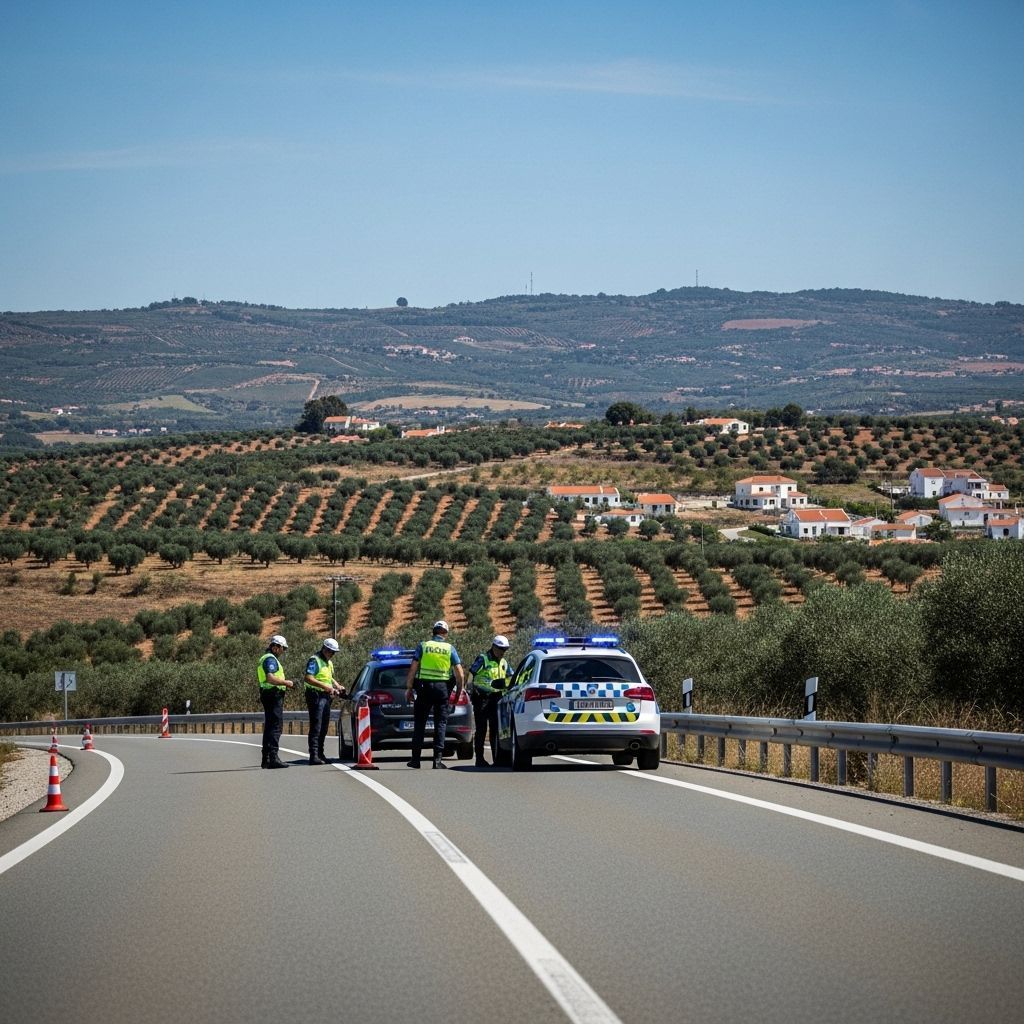
The Portugal National Republican Guard (GNR) has arrested two French nationals in Fátima after a harrowing child abandonment case that ended with two young brothers being rescued from a rural roadside near Alcácer do Sal in May 2026—a case that has shocked the nation and triggered a cross-border investigation involving European Arrest Warrants issued by France.
The Rescue: A Baker's Instinct on a Rural Road
Alexandre Quintas, a father of 10 who runs a family bakery in Monte Novo do Sul, was driving along the EN253 highway between Alcácer do Sal and Comporta on the evening of May 19, 2026, when he spotted two small children running toward his car, screaming and crying. The area, surrounded by rice paddies and irrigation canals, is isolated and potentially dangerous for young children alone.
"I saw them in my rearview mirror, running toward me, absolutely terrified," Quintas told reporters. "I knew immediately something was very wrong."
The boys—Zacharie, 5, and Barthelemy, 4—were visibly distressed. The older child, Zacharie, managed to communicate that they had been "playing a game" with their stepfather, who had blindfolded them and told them to search for a toy. Then the adults disappeared.
Quintas brought the children to his bakery, where his family gave them food, toys, and comfort while he contacted the GNR. The language barrier posed an initial challenge, so Quintas called a French-speaking acquaintance to translate by phone. When the boys heard the woman's voice, Zacharie reportedly mistook her for his mother—a moment that moved even the responding GNR officer to tears, according to local media.
"When I saw their backpacks—a change of clothes, a bottle of water, some crackers—I understood this wasn't an accident. They had been abandoned," Quintas said.
Why This Matters: Understanding Portugal's Response
Child protection protocols activated: The two French boys are now under provisional foster care in Portugal after being found abandoned and blindfolded. This rapid response demonstrates how Portugal's child protection system functions when minors are in immediate danger.
Legal jurisdiction complex: The suspects face charges in both Portugal (domestic violence, child abandonment) and France (suspected parental kidnapping), with European Arrest Warrants ensuring extradition even if released locally.
Community vigilance worked: A local baker and a café owner in different regions both played critical roles in the rescue and arrest, highlighting how awareness and quick action can save lives.
What This Means for Child Protection in Portugal
The Portugal Attorney General's Office in Setúbal confirmed that the boys were taken to Hospital São Bernardo in Setúbal for medical evaluation and have since been released to a certified foster family under a provisional judicial protection order issued on May 20, 2026. The boys are reported to be in good physical health, though the emotional impact remains under assessment.
Portugal's Law 147/99 on the Protection of Children and Young People in Danger guarantees protection to all minors on national territory, regardless of nationality or immigration status. In this case, the Institute of Social Security (ISS) coordinated the emergency foster placement, prioritizing family-based care over residential institutions—a policy directive enshrined in the Decree-Law 139/2019, which mandates foster care as the preferred solution for children under six.
The boys' biological father, who resides in France, filed a missing persons report on May 14, 2026, three days after the mother, Marine Rousseau, 41, and her partner, Marc Ballabriga, 55, entered Portugal via Miranda do Corvo with the children. French authorities immediately issued a cross-border alert, indicating the children might have been taken to Spain or Portugal. The Portugal Judicial Police (PJ) has now assumed lead investigative authority due to the international kidnapping dimension.
The Arrest: Five Hours in a Fátima Café
Contrary to initial assumptions that the suspects had fled Portugal, the couple remained in the country. On the afternoon of May 21, 2026, a vigilant café owner in Fátima, more than 200 kilometers north of Alcácer do Sal, noticed the French pair spending over five hours in her establishment without ordering much. After engaging them in conversation and growing suspicious, she contacted the GNR.
Officers arrested Rousseau and Ballabriga without resistance. According to the GNR spokesperson interviewed by SIC television, the suspects appeared "detached" and have been largely uncooperative with investigators—a behavior attributed to possible mental health issues rather than substance use. According to French press reports cited by Portuguese media, Ballabriga has a history of psychiatric disorders and a criminal record, though the specific offenses have not been disclosed. Rousseau, reportedly a sexologist by profession, had no prior police record in France.
Legal Complexities: Domestic Charges and European Warrants
The suspects were presented to a judge in Setúbal for their first judicial interrogation, facing charges of domestic violence and child abandonment or exposure—the latter a crime under Article 138 of the Portuguese Penal Code, punishable by up to five years in prison.
But even if the judge declines to order preventive detention (pre-trial custody), the couple cannot simply walk free. The European Arrest Warrants issued by French authorities trigger a separate legal process that mandates a second detention and appearance before the Portugal Court of Appeals (Tribunal da Relação), which will decide on extradition to France.
This dual-track system reflects the European Arrest Warrant (EAW) framework, which replaced traditional extradition treaties among EU member states in 2004. Under this mechanism, judicial authorities communicate directly, and decisions on surrender must be made within 60 days of arrest—or just 10 days if the suspect consents. For crimes involving minors, which fall under the list of 32 offenses exempt from dual criminality checks (meaning both countries need not define the crime identically), the process is streamlined further.
The Portugal Ministry of Public Prosecution in Setúbal emphasized that the investigation is in its early stages and under judicial secrecy, with the Specialized Support Unit for Specific Victims (NIAVE) in Santiago do Cacém leading the domestic inquiry.
Public Response and the Baker's Offer
The case has generated widespread public emotion in Portugal. Quintas, the baker who found the boys, told multiple outlets he would be willing to adopt the children if legal avenues permitted. "They played with my kids, we made bread together—it's hard not to feel for them," he said.
Portugal Interior Minister Luís Neves, speaking to reporters, declined to discuss investigative details but underscored the outcome: "What matters is that the children are safe, and the alleged perpetrators of these very ugly crimes—crimes against absolutely vulnerable children—are identified and in the hands of justice."
Neves, a former senior police official with over three decades in law enforcement, drew a clear line between his current political role and his former investigative functions. "For 31 years, I cared about criminal investigations. Now, I only care about the essentials. I will not, cannot, and do not want to speak about criminal investigations—that was my past," he said.
He confirmed that both the GNR and the Portugal Public Security Police (PSP) have jurisdiction over domestic violence and child abandonment cases depending on the territorial area, though the cross-border kidnapping dimension has elevated the case to the Judicial Police.
Cross-Border Cooperation and Next Steps
The boys' biological father has arrived in Portugal seeking to regain custody. French authorities have formally requested the children's return, but the Portugal family court system will determine the safest and most appropriate custodial arrangement, weighing the children's best interests against international parental rights disputes.
Portugal and France maintain a bilateral convention on judicial cooperation for the protection of minors, in force since 1997, which facilitates information-sharing and legal coordination. However, the criminal proceedings against Rousseau and Ballabriga will be governed primarily by the EAW framework and national penal codes.
The Portugal Institute of Social Security will continue monitoring the boys' welfare in foster care, with regular psychological and social assessments. Under Portuguese law, foster families receive financial support equivalent to 1.2 times the social support index (currently around €640 per child per month), plus access to specialized training and legal protections.
Impact on Expats and International Families
This case underscores the reach and speed of Portugal's child protection infrastructure, which applies equally to foreign nationals. Parents and guardians residing in or transiting through Portugal should be aware that Portuguese authorities prioritize child safety over national sovereignty or parental rights when minors are in immediate danger.
The European Arrest Warrant system also demonstrates that fleeing across EU borders offers no refuge for those accused of crimes against children. Judicial cooperation between Portugal and France—and across the broader EU—is designed to be rapid and near-automatic for serious offenses.
For families in custody disputes, the case highlights the importance of legal custody documentation and compliance with international child abduction treaties, particularly the Hague Convention on the Civil Aspects of International Child Abduction, to which both Portugal and France are signatories.
The investigation remains ongoing, with further hearings expected in both Setúbal and the Court of Appeals as the extradition process unfolds. The boys, meanwhile, are receiving specialized care designed to stabilize and protect them while their long-term future is determined through the courts.