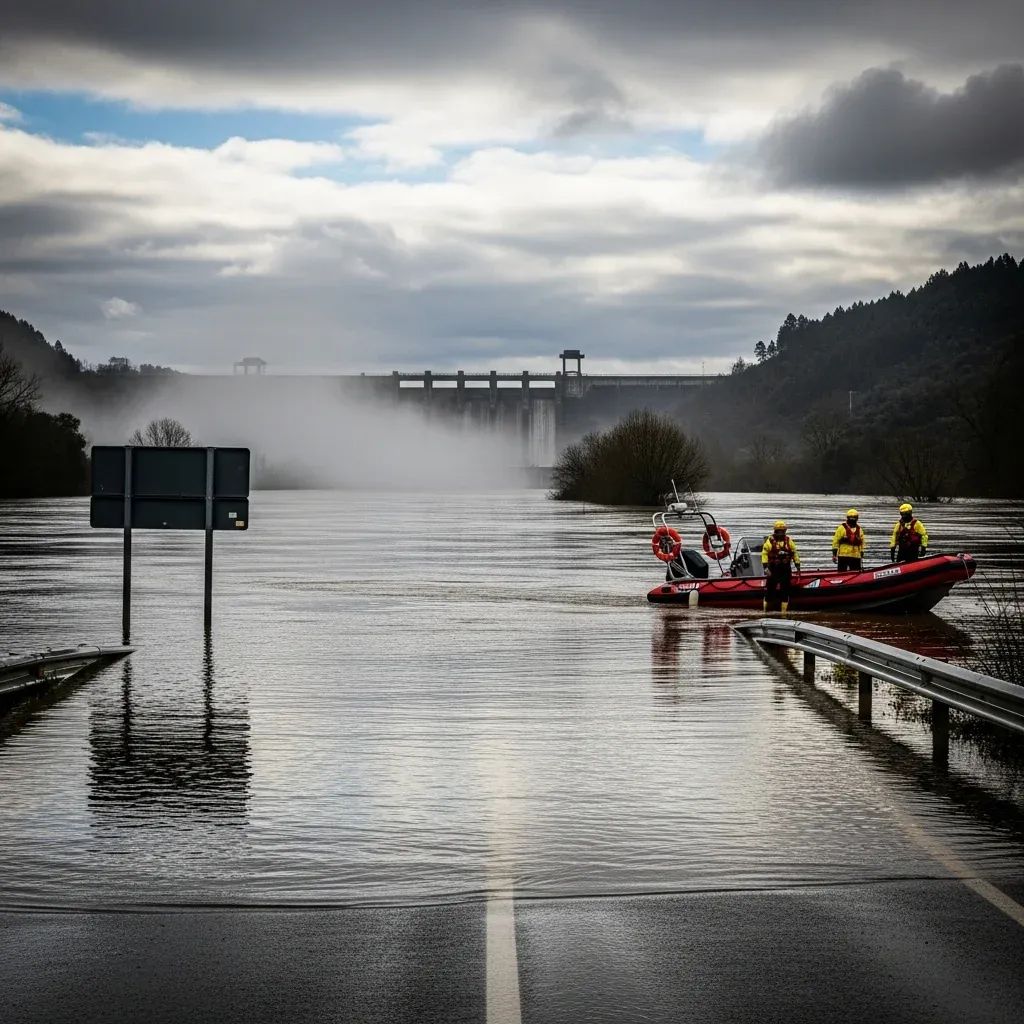
The Portugal Ministry of Agriculture has set a March 25 deadline for forest landowners to notify authorities whether they can remove storm-damaged timber from their properties—a requirement that trade associations now call "unrealistic and disconnected from ground conditions." With less than two weeks remaining, the National Federation of Forest Owner Associations (FNAPF) warns that neither private landowners nor state agencies possess the capacity to clear millions of fallen trees left by the winter storms that killed 19 people and caused billions in damage.
Why This Matters
• Wildfire risk escalates: Fallen timber creates a massive fuel load across central and northern Portugal; failure to clear by early May could trigger catastrophic summer fires.
• Price collapse feared: Forest owners worry timber buyers will exploit the glut, offering as little as one-third of normal rates—around €10–15 per tonne instead of the €35–40 minimum requested.
• State can seize control: After April 1, all removal operations require Institute for Nature Conservation and Forests (ICNF) authorization; landowners who miss the deadline risk having the government remove timber and bill them for the work.
The Cleanup Challenge No One Anticipated
Between late January and mid-February, depressions Kristin, Leonardo, and Marta tore through Portugal's Atlantic coast, toppling an estimated five to eight million trees in the Leiria Pine Forest alone. Over 90% of the forest's 1,200 hectares of mature stands were destroyed—areas that had survived the devastating 2017 wildfires now lie in tangled heaps of splintered trunks and broken branches.
Luís Damas, president of FNAPF, told national media that the complexity of the wreckage makes extraction far more difficult than routine logging. "This timber is shattered, interlocked, crisscrossed—it's not a simple harvest," he explained. "Access roads remain blocked in many zones. To reach certain sites will take months, not weeks. Anyone who set March 25 either doesn't know the terrain or failed to assess what actually happened."
The ICNF regulation stipulates that landowners who can handle removal themselves must notify the institute or their municipal council by March 25. After April 1, any timber work shifts to a permit system. If no communication is received, the state reserves the right to enter private land, clear the debris, and recover costs—a provision that has alarmed smallholders already facing financial strain.
Fire Season Looms, Infestations Spread
Forest owners acknowledge two urgent threats: fuel accumulation and phytosanitary decay. Dead and dying trees attract bark beetles and other wood-boring insects; infestations can spread rapidly to healthy stands if debris remains in place. At the same time, the sheer volume of dry biomass on the forest floor creates a tinderbox scenario. Fire-risk models indicate that if clearance isn't substantially complete by early May—before summer heat arrives—central Portugal could face a repeat of the catastrophic 2017 fire season.
Yet Damas insists the country lacks the workforce, machinery, and logistical infrastructure to meet the government's timeline. "There's no capacity in Portugal, let alone among the entities that could substitute for owners," he said. Even the Leiria Pine Forest, a state-managed asset, remains largely uncleared; areas that escaped earlier fires are now blanketed in fallen timber.
The Price War Landowners Fear
Financial pressure compounds the logistical bottleneck. Forest owners warn that a sudden oversupply of storm-damaged wood will depress market prices, leaving them vulnerable to predatory purchasing. In past disasters—including the 2017 fires—timber traders offered rock-bottom rates, knowing desperate landowners had no storage options and faced regulatory penalties for inaction.
FNAPF is urging the government to establish state-backed timber depots that guarantee a floor price of €35–40 per tonne. "When there are fires or catastrophes, the owner always takes the loss, ending up at the mercy of timber merchants," Damas said. "Out of desperation, people accept any price, even knowing they're being robbed. It happened after the fires; now, with the tonnage on the ground, it will be worse."
Although no official price data has been published, anecdotal reports suggest buyers are already offering €10–15 per tonne in hard-hit districts—a figure that may not cover extraction and transport costs, let alone compensate for decades of growth.
Government Aid: Ambitious Promises, Implementation Questions
The Portuguese Cabinet has approved a €3.5 billion reconstruction package under the updated Portugal Transformation, Recovery and Resilience Program (PTRR). Within that envelope, €80 million is earmarked for restoring productive capacity in agriculture and forestry through the Common Agricultural Policy Strategic Plan (PEPAC), and a €150 million credit line for affected businesses is open until March 31, with works to begin by July 31.
Damas acknowledged that the PTRR document "lists many things that make sense," but questioned whether the state has the administrative capacity and equipment to deliver. "Agricultural businesses also have huge losses, and we'll see if there's money for all of this," he said. "Now, on top of everything, with oil prices up, the war, and all the rest—it's not easy."
The ICNF recovery plan for Leiria prioritizes clearing access roads, allowing natural regeneration where feasible, and reforesting where necessary—a process officials concede will take decades. Interim measures include authorizing landowners to remove timber without prior permits if they notify authorities, and enabling state crews to enter private land regardless of ownership identification.
Lessons From Europe: What Portugal Could Learn
Across the European Union, member states are required under the new Nature Restoration Law to restore at least 30% of degraded habitats by 2030 and 90% by 2050. Projects such as LIFE Resilient Forests in Spain and Germany have developed decision-support tools that balance biomass removal, water availability, and fire risk—recognizing that over-extraction can deplete soil nutrients and organic matter.
Best practices elsewhere include sanitation harvesting (targeted removal of dead or diseased trees), spatial compartmentalization to limit fire spread, and controlled burns or grazing to reduce understory fuel. Several countries also use state-managed timber parks during emergencies, providing temporary storage and price stabilization—precisely what Portuguese forest owners are requesting.
Portugal's reliance on landowner responsibility, combined with fragmented ownership records and limited state forestry capacity, contrasts with more centralized models in Scandinavia and Central Europe. The recurring cycle of disaster, delayed clearance, and market exploitation suggests structural reform may be necessary.
What This Means for Residents
If you own forested land affected by the storms, act before March 25 to retain control of timber removal. Even if you lack the means to clear debris immediately, filing a notification with ICNF or your municipal council preserves your rights and may position you for future aid. After April 1, any work requires a permit, and silence could trigger state intervention—with costs passed to you.
For the broader population, the unresolved timber crisis translates into elevated wildfire danger this summer, particularly in Centro, Lisboa e Vale do Tejo, and Alentejo—the regions that bore the brunt of the storms. Local authorities have warned that without significant progress by May, firefighting resources will be stretched beyond 2017 levels.
Economically, the collapse in timber prices affects rural incomes and municipal revenues in forestry-dependent areas. The €150 million business support line closes March 31; eligible enterprises—including sawmills, resin producers, and forest cooperatives—should apply immediately through the Institute for Financing Agriculture and Fisheries (IFAP).
The Clock Is Ticking
The tension between regulatory deadlines and physical reality has placed Portugal's forest sector in a precarious position. Damas summarized the frustration: "We've seen there's no capacity, and you can't force owners into such a tight deadline. There has to be common sense."
With wildfire season less than two months away, the question is whether that common sense will arrive in time—or whether Portugal's forests will pay the price for a mismatch between policy ambition and operational capacity. The storms may have passed, but their aftermath is only beginning.