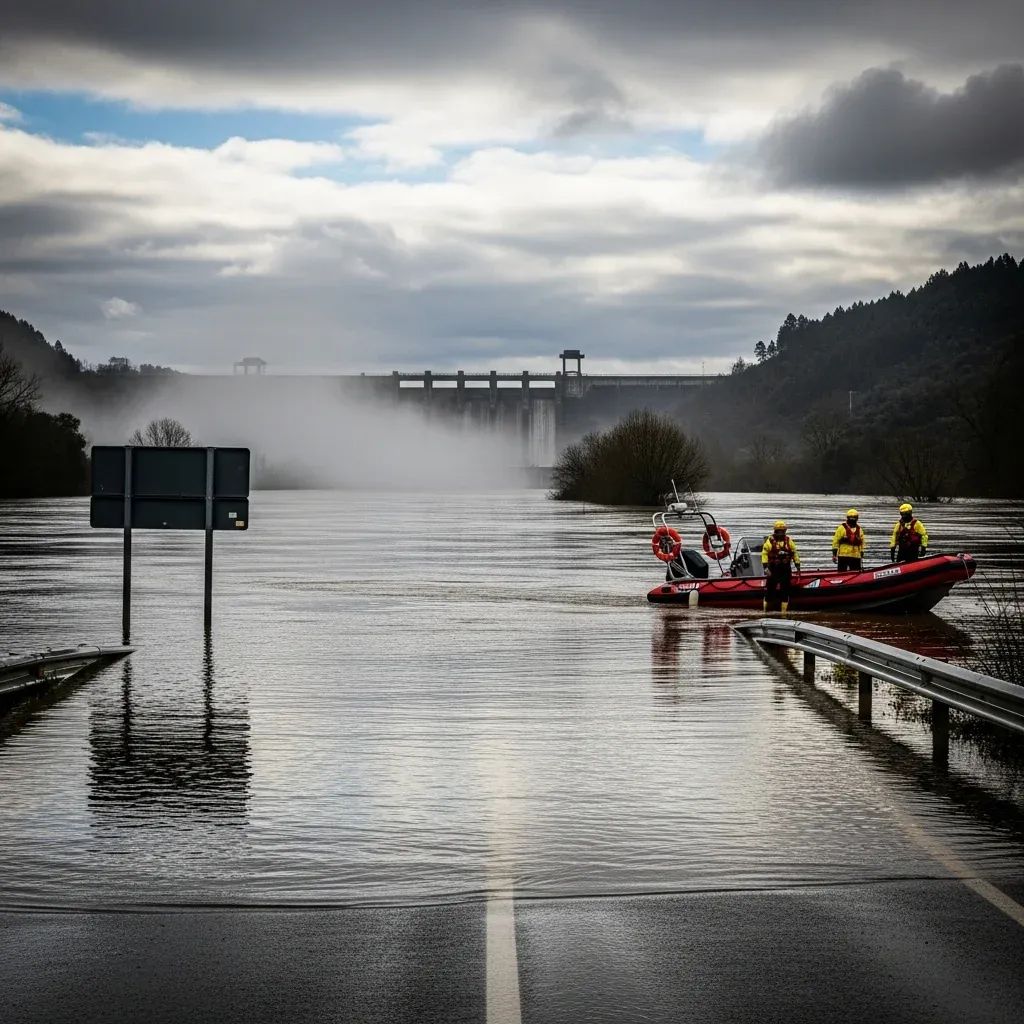
The Portuguese Environment Agency (APA) has executed controlled water releases from multiple dams in central and southern Portugal this week, a preemptive maneuver designed to absorb incoming rainfall from Storm Therese while reigniting a long-standing national debate about whether more dams solve flooding problems—or create new ones.
Why This Matters
• Immediate flood risk in Alcácer do Sal managed through discharge operations at Vale do Gaio and Pego do Altar dams, both currently near 90% capacity.
• Timing conflict: Controlled releases coincide with peak tidal surge of 3.5 m on the Sado River, complicating drainage and raising flood risk through Thursday afternoon.
• Policy clash exposed: A high-profile national debate this week revealed sharp divisions among hydrologists, agronomists, and environmental groups over Portugal's €1 billion "Água que Une" water strategy and the controversial Tejo River navigation project.
Emergency Management Meets Saturated Ground
José Pimenta Machado, president of the APA, confirmed that discharge operations began Tuesday across the Mira River basin at Santa Clara dam and intensified Wednesday on the Sado River system. The strategy aims to create "encaixe"—reservoir buffer capacity—ahead of the heaviest rainfall Thursday, when soils already saturated from weeks of winter precipitation will struggle to absorb additional runoff.
Vale do Gaio dam, located in Alcácer do Sal municipality and currently holding 90% of its 51 million cubic meter capacity, is the most critical structure for the region. Its drainage basin covers a vast upstream area, making it the primary defense against urban flooding in the city, which saw the riverside Avenida dos Aviadores submerged for two weeks between late January and mid-February following earlier intense rainfall.
Pimenta Machado emphasized the complexity of Wednesday's operation, noting that a 3 p.m. high tide on the Sado estuary creates a hydraulic bottleneck. When tidal flow peaks, river discharge struggles to reach the ocean, backing up inland and exacerbating flood conditions in low-lying urban zones. "We want to avoid the meeting of the tide—whenever there is a tidal peak, the river has difficulty entering, and that situation can trigger floods," he explained.
Despite these pressures, the APA president expressed confidence that coordinated management with Alcácer do Sal municipal authorities and regional irrigation associations would prevent major inundation. "I believe that with the management we have done and the rain that is forecast, we will control the situation and not have floods on the Sado River," he stated, adding that "the worst has passed" even as forecasts called for renewed precipitation later Thursday.
The Portuguese Institute for Sea and Atmosphere (IPMA) issued warnings that Storm Therese, which began affecting mainland Portugal on Tuesday, would remain centered west of the coast through Saturday. The system is expected to generate organized instability lines advancing south to north, with the Centro and Southern regions bearing the brunt of heavy downpours and localized extreme wind events.
Dams on Trial: The Debate Portugal Can't Resolve
While the APA executed its emergency protocols, more than 150 registered participants from environmental associations and citizen movements nationwide joined a Wednesday evening webinar that laid bare Portugal's most contentious water policy question: do large hydraulic structures protect communities or degrade the ecosystems they depend on?
The session, organized by the proTEJO movement in partnership with #MovRioDouro and the Sustainable Water Platform, featured João Joanaz de Melo, a professor at NOVA University Lisbon and member of the ecological group GEOTA, debating Jorge Froes, an agronomist with the Associação +Tejo, under moderation by Paulo Silva. According to proTEJO spokesperson Paulo Constantino, the exchange was "lively and participatory," exposing two antagonistic perspectives on water governance and the infrastructure that controls it.
One conclusion highlighted during the debate challenges the conventional wisdom that new dams offer effective flood control. Participants pointed to the proposed Girabolhos dam as a case study: hydrological modeling suggests its retention capacity would be rapidly exhausted under scenarios of intense precipitation, offering minimal protection while imposing significant ecological costs.
The discussion also scrutinized the safety of aging infrastructure, land-use planning failures—particularly construction in floodplain zones—and the limited contribution of hydroelectric production relative to environmental and financial expense. Participants concluded that optimizing existing structures delivers better returns than building new ones, especially given the residual electricity output many smaller dams generate.
The Tejo Project: Navigation Dream or Ecological Nightmare?
The most heated exchange centered on the Tejo Project, a multi-dam proposal to render the river navigable, expand irrigation networks, and regulate flow volumes. Froes defended the plan as essential infrastructure for modern agricultural water management. Joanaz de Melo and the proTEJO coalition countered with a catalog of anticipated harms: fragmented river connectivity, loss of biodiversity, disrupted sediment transport, and accelerated coastal erosion as sediment-starved estuaries fail to replenish shorelines.
"There are those who defend increasing the profitability of intensive agriculture based on irrigation, and those who defend the protection of ecological values as a condition for long-term sustainability," Constantino summarized. The clash reflects a broader policy tension in Portugal, where the €1 billion "Água que Une" national water strategy—now one year into its 2050 timeline—seeks to balance reservoir expansion, efficiency upgrades, and inter-basin water transfers with ecosystem preservation goals.
José Pedro Salema, president of the Alqueva Development and Infrastructure Company (EDIA), suggested at a March conference hosted by the Confederation of Portuguese Farmers (CAP) that the country faces a paradigm shift. He proposed renegotiating hydroelectric concessions to repurpose large reservoirs for agricultural use, a move that would upend decades of power-sector arrangements.
Geographer Maria José Roxo argued in February that Portugal must "rethink and redesign the territory" in the face of extreme weather, advocating for systematic integration of legal instruments and more programmed, controlled dam releases to minimize flood damage. She noted that the implementation of existing legislation remains challenging due to inter-relationships and conflicts among different decision-makers.
Solutions Beyond Concrete
ProTEJO and allied groups insist that dams do not generate water—they merely redistribute it, often at the cost of natural systems that provide long-term hydrological stability. Their alternative framework prioritizes native forest restoration, riparian vegetation corridors, and soil-retention strategies designed to improve infiltration and regulate rainfall patterns organically.
This ecosystem-based approach mirrors strategies gaining traction across the European Union, where the Water Framework Directive and emerging European Water Resilience Strategy emphasize river connectivity, fish migration, and hydro-morphological health. Countries like France have implemented national river-continuity legislation since 2007, sponsoring dam removal and bypass-channel projects to restore ecological function while maintaining energy output through technological upgrades rather than new construction.
Portugal's 260 large dams already provide irrigation, public supply, and energy generation, and many now stand literally full after persistent winter rains—enough to secure supply for the next two to three years, according to national assessments. The proTEJO webinar series, which follows citizen assemblies held in Coimbra in 2024 and Constância in 2025, has defined priorities including defense of ecological flow regimes and opposition to new dam construction.
What This Means for Residents
For anyone living in flood-prone river valleys or coastal municipalities, the policy debate is far from academic. The emergency discharges underway this week illustrate the trade-offs inherent in dam management: release too much water too quickly and downstream communities flood; hold too much and the dam itself becomes a hazard during extreme weather.
Residents in Alcácer do Sal, Setúbal, and Beja districts should monitor APA and IPMA alerts through Saturday as Storm Therese continues. Those in agricultural zones dependent on irrigation associations should follow announcements regarding water allocations and potential supply interruptions.
On the strategic level, the outcome of the Tejo Project debate and the execution of "Água que Une" will shape land values, agricultural viability, and coastal property risk for decades. Portugal's recognition at the upcoming COP17 biodiversity conference in Armenia this October as a model for systematic water management adds international scrutiny to domestic choices.
The tension between intensive agriculture profitability and long-term ecological sustainability will not resolve quickly. What is clear is that Portugal's saturated soils, aging infrastructure, and increasingly volatile weather are forcing a reckoning on water policy that no amount of concrete alone can solve.