
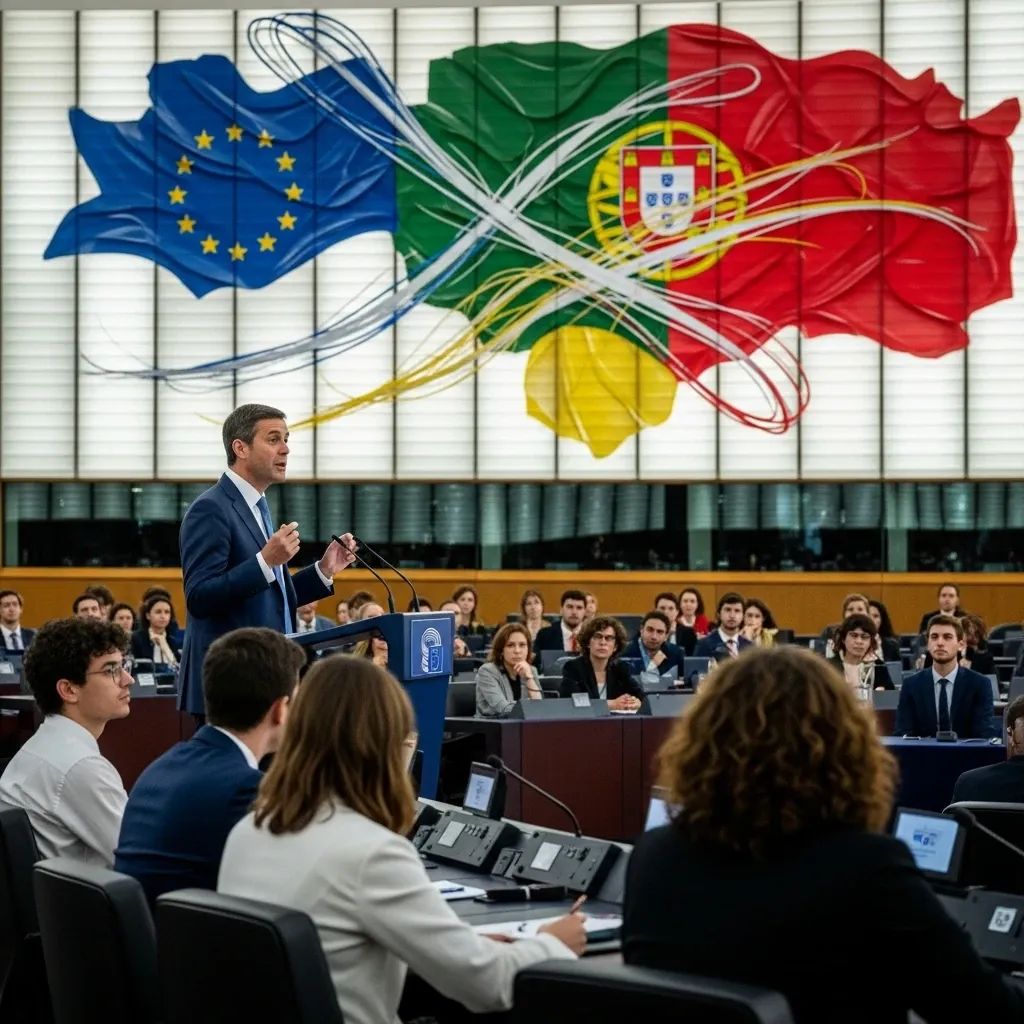
Portuguese President Marks Historic Luxembourg Visit Amid 90,000-Strong Diaspora
President António José Seguro is in Luxembourg this weekend celebrating the first official Dia de Portugal abroad since his March inauguration. The visit carries particular weight: it marks the Grand Duke's first official state visit since ascending to the throne in October 2025. But beyond ceremony, this moment reflects 135 years of deepening bilateral ties rooted in people, not just politics.
The Core Facts:
• Nearly 90,000 Portuguese citizens live in Luxembourg as of January 2026, forming 12.8% of the entire Grand Duchy's population.
• The relationship runs both directions: over 1,500 Luxembourgers now reside in Portugal, signaling genuine two-way flows of talent and investment.
• Luxembourg invested €1.1 billion in Portugal during 2025, cementing its position as a top-three global investor in the country.
• This dual celebration marks official recognition of Portugal's diaspora as essential to bilateral relations.
What This Visit Signals for Portuguese Residents and Expats
For Portuguese nationals in Luxembourg, this state visit legitimizes long-standing advocacy efforts. Community leaders have pressed for better representation in schools, stronger labor protections, and targeted poverty interventions. When a sitting president travels to celebrate a diaspora's achievements, it creates political opening for those conversations.
According to Luxembourg's 2025 Social Cohesion and Labor Report, Portuguese citizens face a poverty risk rate of 41.4%, the highest among any major migrant groups. Their average monthly incomes are the lowest in the country, and children of Portuguese heritage are twice as likely to drop out of school early compared to native Luxembourgers. Portuguese is nonetheless one of the most spoken languages in the Grand Duchy—heard not only in neighborhoods but within the Ducal Palace itself. Radio stations broadcast in Portuguese, and organizations like the Confederation of the Portuguese Community in Luxembourg (CCPL) have moved beyond cultural preservation into advocacy for better educational access and employment pathways.
For Portuguese entrepreneurs and tech professionals, Luxembourg remains a recruitment pipeline. Companies actively hire software engineers, IT specialists, and industrial designers from Portugal. Portuguese startups—like SolarCleano, a solar panel cleaning automation firm—are establishing satellite offices in the Grand Duchy to access capital and EU regulatory expertise.
For Luxembourg-based investors looking at Portugal, this visit reinforces institutional commitment. Investopedia's recent analysis shows Luxembourg contributed €1.1 billion to Portuguese ventures in 2025, positioning it as the second-largest global investor. Much of this is "transit investment" routed through Luxembourg's financial hubs, but direct capital flows in fintech, digital services, and construction are accelerating.
For Luxembourgers considering a move to Portugal, the diplomatic visibility offers assurance. Portugal's government has signaled priority status for EU investors; bilateral agreements mean legal clarity for property ownership, tax treatment, and residency.
A Relationship Rooted Deeper Than Recent Memory
Portugal's President and the Grand Ducal Court maintain diplomatic relations dating back to May 21, 1891—the day the Viscount of Pindela became the first Portuguese envoy to the Grand Duchy. What began as formal protocol evolved into something more intricate. In 1893, Grand Duke William married Maria Ana of Bragança, daughter of Portugal's deposed King Miguel. That union created a lasting dynastic thread; today's Grand Duke carries Portuguese royal blood.
History tested this bond. During World War II, Grand Duchess Charlotte found sanctuary in Portugal when Luxembourg fell under Nazi occupation. The arrangement was quiet, practical, and ultimately forgiving—a template that seems to define how these two nations interact.
That pragmatism extends to modern cooperation. In May 1970, Portugal and Luxembourg signed a labor agreement governing the employment of Portuguese workers in the Grand Duchy. This wasn't aspirational policy; it was institutional response to economic reality. Thousands of Portuguese were already there, building Luxembourg's post-war economy, and both governments formalized what was already happening on the ground.
The Reverse Movement: Why Luxembourgers Are Looking South
At a state luncheon with Grand Duke Guillaume and Grand Duchess Stéphanie, the Portuguese leader noted that the flow isn't unidirectional. Over 1,500 Luxembourgers now live in Portugal. Several hundred students arrive each year to study and work. This represents genuine two-way movement, driven partly by Portugal's lower cost of living, but increasingly by its tech ecosystem and climate appeal.
Luxembourg's business community has taken notice. In November 2024, a Portugal-Luxembourg Business Forum was held to explore joint ventures in sustainable construction, digital technologies, and health innovation. The discussions weren't theoretical—they identified concrete collaboration opportunities between two nations positioning themselves as innovation hubs.
In April 2026, Luxembourg's Energy Minister Lex Delles visited Portugal specifically to explore renewable energy cooperation. Portugal leads Europe in wind and solar deployment; Luxembourg has capital and technical expertise in financial mechanisms. The conversation centered on establishing joint investment structures under EU directives—practical collaboration that generates returns for both economies.
These arrangements reflect institutional recognition that Portugal and Luxembourg solve each other's problems. Luxembourg provides capital, financial expertise, and regulatory access. Portugal provides talent, innovation appetite, and renewable capacity. Neither nation has sufficient leverage alone to reshape European policy. Together, through coordinated investment and advocacy, they become players.
The Mechanics: Treaties and Ongoing Arrangements
Portugal and Luxembourg operate under a framework of formal agreements. A Cultural Cooperation Program established in 2008 covers education, science, technology, media, and youth exchanges. A Convention to Avoid Double Taxation (amended in 2010) removes fiscal friction for cross-border workers and investors. An Agreement on International Road Haulage (1983) facilitates goods transport.
More recent additions reflect changing priorities. In 2017, both nations signed memorandums on space technology, scientific research, and startup support—recognition that innovation ecosystems require institutional scaffolding. By 2022, they formalized cooperation between Luxembourg's House of Financial Technology and Portugal Fintech, acknowledging the fintech sector as a priority axis.
Luxembourg's startup ecosystem now counts over 500 active companies, concentrated in ICT and financial technology. Portugal ranked 16th among European nations for venture-backed tech investment between 2000 and 2023—higher than Belgium, Greece, or the Czech Republic—placing Portugal firmly in mid-tier European innovation infrastructure.
Where the Celebrations Continue
After three days in Luxembourg, President Seguro and Prime Minister Luís Montenegro will travel to Terceira Island in the Azores on June 9 and 10 for the official domestic celebration of Portugal's National Day. This dual-location format reflects a deliberate strategic choice: honoring communities abroad before celebrating the nation's interior underscores that Portuguese identity is no longer geographically bounded.
The Grand Duke will join the Luxembourg portion of events on Sunday, meeting with the Portuguese community in a public forum. This rare attendance by a reigning monarch at a diaspora gathering signals that Luxembourg views this population not as temporary residents but as integral to its national story.
Looking Forward: What Both Nations Are Building Together
Both leaders expressed measured commitment to deepening ties. President Seguro noted that their partnership rests on "shared values, a common European vision, and close cooperation within EU and international institutions." The Grand Duke reciprocated, hoping the coming years would see relations "strengthen further, to the benefit of both our countries and the Europe we build day by day."
That language signals neither nation is relying on nostalgia alone. They're describing forward-looking collaboration grounded in economic complementarity, demographic reality, and institutional alignment.
For residents of Portugal observing this visit, the takeaway is straightforward: your nation's influence in Europe extends far beyond government buildings in Lisbon. It travels through professional networks in Luxembourg's offices, through Portuguese students studying in EU institutions, and through Luxembourg investors assessing opportunities in the Azores and Algarve. This visit simply formalizes what citizens are already building on the ground.
The real measure of success won't come in formal communiques. It will arrive when a Portuguese engineer in Luxembourg's fintech sector lands a job offer in Lisbon. When a Luxembourg investor closes a deal in Portugal without friction. When the Confederation of the Portuguese Community in Luxembourg presents updated integration targets to policymakers, backed by the weight of a presidential visit. That's when institutional acknowledgment becomes institutional change.


