

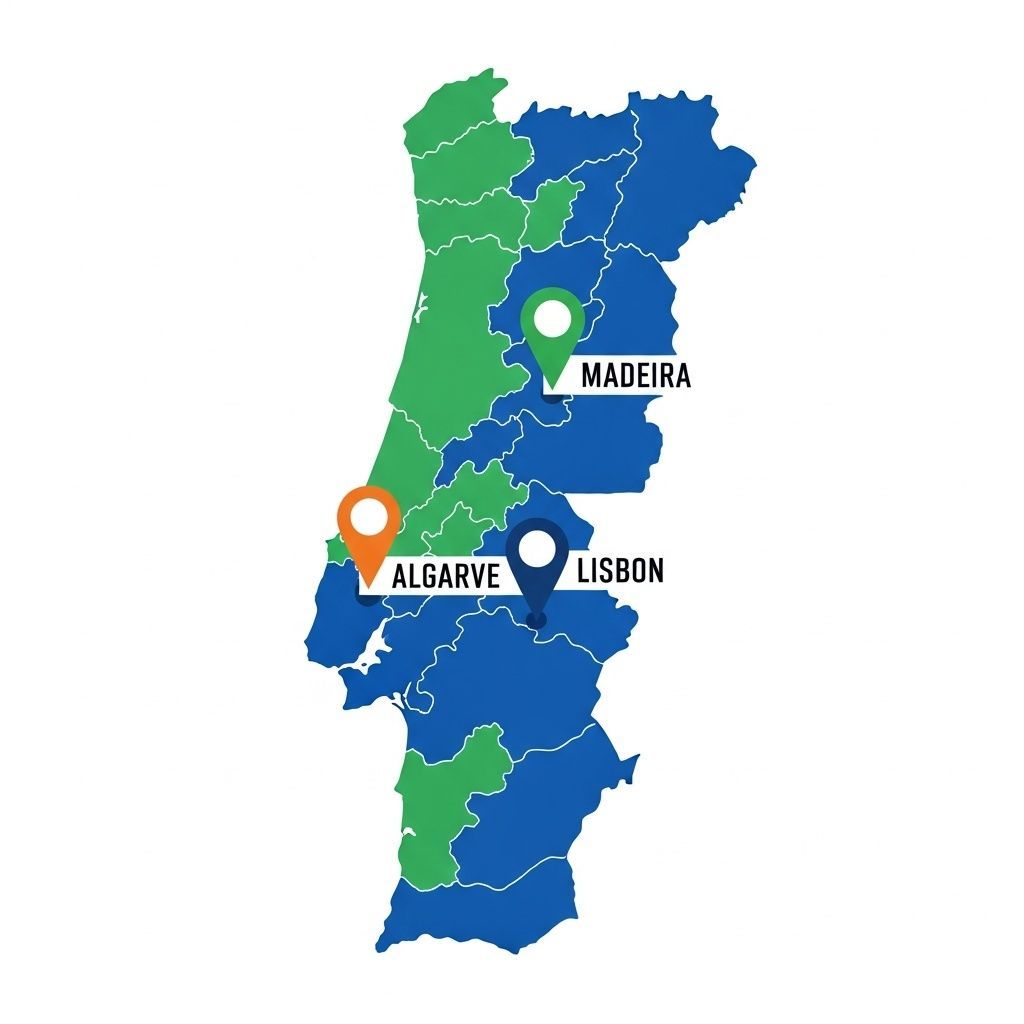
Portugal's tourism sector recorded modest growth in April 2026, but new data released by the National Statistics Institute (INE) reveals a troubling underlying shift: foreign visitors are carrying an increasing share of tourism revenues, while domestic travel is retreating and growth momentum is visibly slowing.
Key April 2026 Data
According to INE statistics, Portugal recorded 7.3 million total overnight stays in April—representing 0.6% year-on-year growth compared to April 2025. However, this overall figure masks a critical divergence:
• Non-resident overnight stays rose 1.2% to 5.2 million, directly offsetting a 1% decline in Portuguese resident bookings.
• Total accommodation revenue reached €600.7 million, up 5.2% year-on-year, yet this pace slowed notably from March's 6.1% growth, signaling deceleration.
• Room-only revenue stood at €453.1 million, advancing 4%—again, slower than March's 5.6%.
The Easter calendar effect contributed significantly to April's weakness. In 2026, Easter fell in late March, pulling forward domestic and regional travel from neighboring countries. This seasonal shift inflated March figures while leaving April artificially depressed by comparison.
Foreign Visitor Composition: Where Growth Concentrated
United Kingdom visitors maintained dominance with 925,000 nights and 17.8% of total arrivals, though numbers slipped 0.5% year-on-year.
Germany seized second place with 4.5% growth to 617,000 nights, reflecting confidence among Europe's largest economy. The United States advanced to third with 6.5% growth reaching 507,000 nights.
Secondary markets showed stronger acceleration:
• Canada surged 12%
• Netherlands advanced 9.9%
• Brazil climbed over 17% in certain regions, emerging as one of Portugal's fastest-expanding source markets
Italy experienced its steepest decline since spring 2021, tumbling 9.7%, potentially reflecting cost-of-living pressures among Italian consumers.
Regional Performance: Clear Winners and Losers
Regional data from INE shows stark divergence:
• Alentejo led with 8.4% overnight expansion and 7% guest growth, driven by agritourism, heritage experiences, and wine tasting circuits.
• North region ranked second with 4.1% overnight growth, exceeding 1.33 million nights.
• Greater Lisbon commanded 30.8% of national accommodation revenue, with the capital absorbing 1.5 million overnight stays—roughly 20.3% of Portugal's total.
• Albufeira posted the strongest percentage gain among major cities, rising 8.5% to 729,300 nights, with growth balanced between resident and non-resident arrivals.
• Porto registered 3.6% growth to 615,700 nights.
Contraction emerged in mature markets:
• Lisbon and Algarve posted single-digit gains of 1.5% and 0.9%, hinting at market saturation.
• Centre region endured the steepest contraction, dropping 8.7%.
• West, Tagus Valley, Setúbal Peninsula, Azores, and Madeira all registered declines.
Domestic Travel Decline: A Concerning Signal
The 1% decline in Portuguese resident overnight stays represents the month's most troubling indicator. As domestic demand retreats, the sector's foundation narrows. Cost-of-living pressures—especially housing, utilities, and food—are squeezing middle-income households and limiting discretionary spending on hotel stays.
This trend particularly impacts shoulder-season bookings (April, May, October, November) when international travel dips and hospitality operators depend on local fill to maintain occupancy and staff utilization.
Average Stay Duration and Revenue Implications
The typical traveler now remains 2.46 nights, down 1.8% from the prior year. The Centre and West regions recorded the shortest average stays nationally, suggesting these areas may be primarily stopover markets rather than destinations.
Divergence between rising guest counts and slowing revenue gains points to pricing pressure and a potential shift toward lower-rate booking segments. Greater Lisbon commanded premium pricing despite moderate occupancy growth, while the Alentejo's strong occupancy surge translated into 10.6% revenue expansion—the strongest financial growth. The Centre region suffered the steepest monetary decline at 8.3%, consistent with its overnight-stay collapse.
Portuguese Tourism in European Context
Across the European Union, overnight stays in tourist accommodations rose 4.3% during the first quarter of 2026, totaling 471.1 million nights. Ireland led the bloc with 35.3% growth, followed by Malta at 11.1% and Denmark at 9.3%.
Portugal's 1.4% gain during the same three-month period sat well below the EU average, signaling relative underperformance in an expansionary continental environment.
What This Means for Residents
For people living in Portugal, April 2026's data carries practical implications:
Employment outlook: Tourism jobs remain available but increasingly seasonal and wage-pressured. Workforce shortages persist, and staff utilization fluctuates with international travel patterns.
Service quality: The sector's outward dependency on foreign visitors means local service provision can deteriorate during shoulder seasons when staffing drops—a dynamic visible in hospitality and transport services across resort-heavy regions during spring and autumn.
Regional opportunities: Growth is concentrating in specific areas. The Alentejo's agritourism expansion and the North region's cultural attractions are attracting investment and employment, while mature beach-resort markets face stagnation.
Industry Outlook
The Portuguese Hotel Association forecasts full-year 2026 growth of 2.5% in guests, 1.7% in overnight stays, and 3% in revenue—acknowledging what they term a "clear slowdown" relative to 2025.
The Portugal Tourism Board is accelerating diversification efforts, targeting emerging markets including Brazil, South Korea, Japan, and Mexico, while simultaneously promoting traditional high-value segments such as luxury wellness retreats and curated culinary experiences to offset volume constraints.
The Portugal tourism engine will continue running in 2026, but April 2026 data confirms the growth pace has visibly decelerated. For Portugal's hospitality workforce, municipalities, and residents monitoring the sector, that recalibration warrants attention to how shifts in international demand patterns affect employment, local investment, and regional development.


