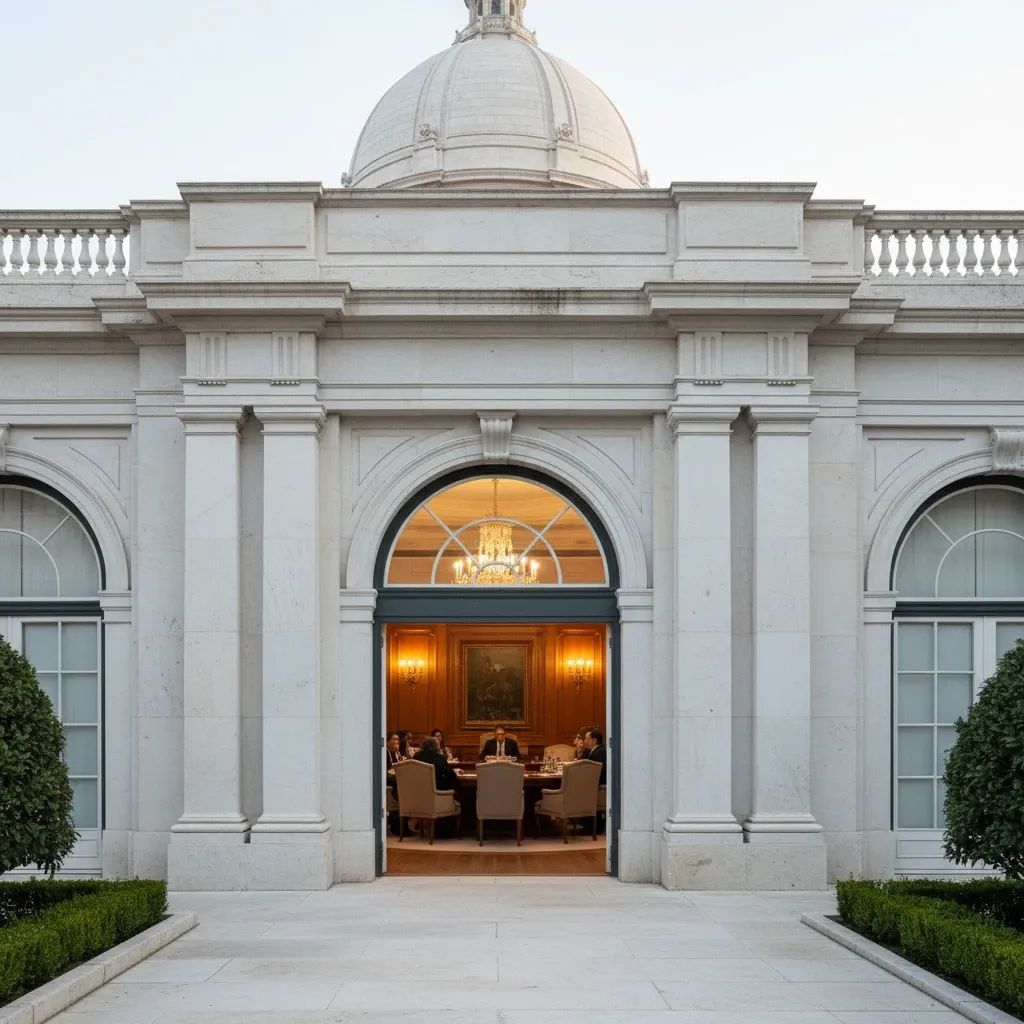
Portugal's Belém Palace prepares for a significant transition on March 9, 2026, as António José Seguro assumes the presidency, replacing Marcelo Rebelo de Sousa. The transition marks not just a political handover but a shift in the presidential style—less frequent public commentary, more strategic interventions, and a notably firmer approach toward the center-right government of Prime Minister Luís Montenegro.
Why This Matters
• Labor reform likely faces a veto: Seguro has pledged to block changes to labor legislation if they lack social concertation agreements, a direct challenge to the PSD/CDS-PP coalition agenda. Under Portugal's semi-presidential system, a presidential veto returns legislation to parliament, where a supermajority can override it.
• Healthcare becomes presidential priority: Expect scrutiny of public-private partnerships and medical contracting arrangements that have strained state resources.
• Presidential restraint replaces constant commentary: Observers predict fewer but more deliberate interventions, representing a departure from the previous decade of frequent presidential statements.
• Social Security privatization emerges as red line: Any attempt to restructure the pension system will likely trigger constitutional confrontation.
The Shift from Accessibility to Authority
Ana Gomes, the former Socialist MEP and diplomat, offered an assessment in an interview with Lusa Extra podcast this week. She anticipates Seguro will be "considerably more sparing in his use of words, so that they naturally carry more weight than they did with Professor Marcelo Rebelo de Sousa." The implication is clear: where Rebelo de Sousa cultivated visibility through selfies with residents, impromptu press conferences, and frequent public appearances—Seguro will adopt a more measured approach, intervening strategically rather than continuously.
The outgoing president, who takes his leave after a decade of what he termed "proximity politics," dissolved parliament twice during his tenure (in 2021 and 2023-2025), earning mixed assessments for stabilizing some political moments while contributing to others. Gomes and other observers have criticized the repeated use of these dissolutions as a governance tool, arguing they sometimes resolved rather than clarified political crises.
Seguro's ascent to Belém represents the first Socialist president in 20 years, following the lineage of Mário Soares and Jorge Sampaio. His victory on February 8, 2026, with 3.5 million votes (66.84%), set a record turnout and represented a decisive outcome against André Ventura and the Chega party, whose political approach Seguro explicitly pledged to oppose.
What This Means for Residents
For anyone navigating Portugal's strained public services, Seguro's priorities translate into immediate policy areas of focus. Healthcare, elevated as a first-year priority, means potential engagement with government policy over billion-euro flows to private clinics and contract physician arrangements. Gomes and others have criticized the current model's efficiency, language Seguro has echoed in public statements about public health management.
On labor reform, the president-elect has drawn a clear line: any legislation passed without consensus from unions and employers will face his veto. This directly challenges the Montenegro government's agenda, which seeks to adjust hiring and firing rules—a move the Socialist opposition argues affects worker protections established over decades.
The most significant potential confrontation centers on Social Security. Gomes warned that the PSD/CDS-PP coalition has discussed restructuring the pension system. Seguro has not publicly detailed his specific stance, but his record as PS secretary-general (2011–2014) suggests resistance to any major restructuring of the pension framework.
The Montenegro Dynamic: Institutional Relations
Seguro's relationship with Prime Minister Montenegro will test Portugal's semi-presidential system. Gomes predicts the president will be "very correct but very demanding," using regular meetings to hold the government accountable for policy commitments. When necessary, public statements signaling disagreement will follow—a standard practice in Portugal's institutional framework.
This represents a shift from Rebelo de Sousa's approach, which alternated between accommodation and intervention. Seguro, who ran an "independent, non-partisan" campaign despite his Socialist background, promises to engage actively with government while avoiding destabilizing crises. His supporters describe him as a "consensus builder," based on his roles as Youth Secretary of State (1994), Minister-Adjunct (2001), and Member of the European Parliament (1999–2001).
The political context matters: Montenegro governs with a minority coalition in a parliament where Chega holds the second-largest bloc. Internal disagreements within the PSD—including Pedro Passos Coelho's recent criticism of coalition approaches—mean Seguro must navigate not just government-opposition dynamics but also internal coalition tensions.
The Chega Question and Democratic Governance
Seguro enters office with what observers term strong popular support across the political spectrum, a mandate some argue obliges active engagement with parliamentary conduct. He has spoken of countering what he views as Chega's destabilizing parliamentary behavior, positioning himself as a defender of constitutional norms. Whether this involves specific institutional actions or primarily public positioning remains unclear.
The president-elect has stated his intention to prevent Chega's interventions from further polarizing Portuguese society, language that signals intent but stops short of detailed action plans. In practice, this may mean using presidential platforms to critique specific positions, vetoing legislation he views as unconstitutional, or supporting parliamentary procedures that enforce institutional standards.
The Outgoing President's Legacy
Rebelo de Sousa leaves office at 77 years old after a presidency marked by constant media engagement and public visibility. He has indicated he will reduce his public profile, though observers expect he will remain active in civil society and comment on public affairs through various channels.
The outgoing president's tenure shows mixed outcomes. His first term, from 2016 to 2021, coincided with the so-called "Geringonça" (contraption), a left-wing coalition that governed with relative stability until the 2022 budget collapse. His second term included the Spinumviva scandal and subsequent government transitions, ending with a parliament more fragmented than at any time since 1974.
Victims of the 2017 Pedrógão Grande wildfires, which caused 66 deaths and destroyed 500 homes, issued a statement thanking Rebelo de Sousa for his "proximity and engagement" during that disaster. Whether Seguro will employ similar symbolic politics or favor an institutional approach remains to be seen.
Seguro's Path to Belém
Seguro's return to prominence is itself notable. After losing the 2014 PS primary to António Costa—a defeat that ended his party leadership and led to his departure from public life—he spent a decade in business and academia, maintaining distance from public affairs. His candidacy announcement in late 2024 surprised observers; formal party endorsement followed months later.
Now, at 64 years old, the master's degree holder in Political Science (ISCTE-IUL) and graduate in International Relations (Universidade Autónoma de Lisboa) prepares to take office. He has divested business interests and plans to reside primarily in Caldas da Rainha—the city where he launched his campaign—rather than make Lisbon his primary base, a choice reflecting his emphasis on family and regional connection.
His characteristic phrase—"What's the rush?"—uttered during political debates about timing, signals an approach based on patience and deliberation rather than urgency. Applied to the presidency, this may define his governance style as much as any specific policy position.
What Comes Next
Observers across the political spectrum acknowledge Seguro assumes office during a challenging period: European instability, economic uncertainty, and a fragmented parliament create a complex governance environment. The new president's supporters argue his measured approach and institutional focus suit Portugal's current needs after a decade of high-visibility presidential engagement.
For residents, the practical measure will be whether Seguro's disciplined style produces effective influence on government policy—or whether strategic restraint results in reduced presidential impact. The first major test will likely involve labor reform, with legislation expected to reach his desk within months. How he engages with that challenge, and whether the government accepts or contests his position, will establish the pattern for his presidency.
Seguro prepares to move into Belém Palace, where the next chapter of Portuguese democratic governance will unfold. His presidency will be defined by its contrasts with the past decade: deliberation instead of constant commentary, institutional weight instead of symbolic visibility.