
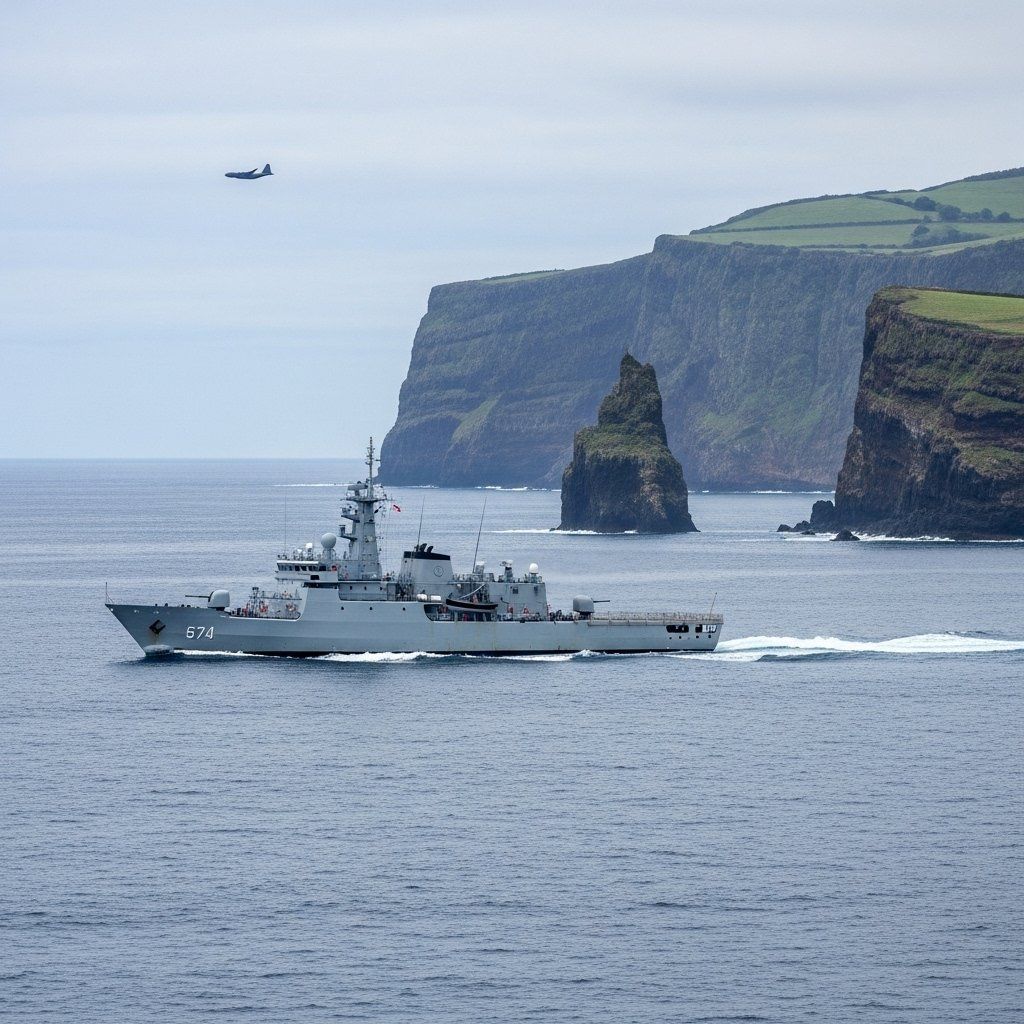
Portugal's armed forces are taking on a bigger role in NATO as melting Arctic ice reshapes North Atlantic security. The strategic shift comes as the Alliance demands European members shoulder more of their own defense burden—and Portugal is responding with one of the sharpest military spending increases among NATO members.
Why This Matters
• Strategic Upgrade: Portugal's maritime jurisdiction—which neighbors U.S. waters—is becoming a critical entry corridor for Arctic traffic, vessels, and potential threats as new shipping routes open.
• Defense Spending: Portugal has increased military investment from 1.58% to roughly 2% of GDP, one of the sharpest jumps among NATO members, and committed to hitting 5% by 2035.
• Summit Focus: The upcoming NATO summit in Ankara on 7–8 July will assess defense trajectories, reinforce European military autonomy, and pledge robust support to Ukraine—a country now functioning as the Alliance's live testing ground for next-generation warfare.
Arctic Thaw Redraws the Atlantic Map
Paulo Vizeu Pinheiro, Portugal's permanent representative to NATO, emphasized in a recent interview that the emergence of a stronger European defense pillar will not diminish the importance of the North Atlantic—rather, it will amplify it. The reason: melting Arctic ice is unlocking new sea lanes, resource access, and security vulnerabilities that flow directly into the Atlantic basin.
The Northern Sea Route along Russia's coast and the Northwest Passage through Canadian waters are now navigable for ice-class vessels roughly five months per year, cutting transit times between Shanghai and Rotterdam by up to 14 days and reducing fuel consumption by as much as 40%. Traffic along the Northern Sea Route exceeded 37.9 million tonnes in 2024, much of it Russian hydrocarbons bound for Chinese ports. But alongside commercial opportunity comes geopolitical friction: Russia treats portions of the route as internal waters, operates the world's largest icebreaker fleet, and has fortified its Arctic coastline with radar and missile systems.
In response, NATO launched "Arctic Sentry" in February 2026, a mission combining naval patrols, long-range reconnaissance flights, and intelligence operations designed to monitor Russian and Chinese activity in the region. A newly deployed X-Arctic Task Force will operate above the Arctic Circle for 18 months, testing unmanned systems and enhancing situational awareness. The Alliance also conducted Cold Response 2026 in Norway, involving 25,000 troops from 14 nations.
Why Arctic Changes Matter to Portugal
For Portugal, located at the Atlantic's southern gateway, Arctic transformation means monitoring and responding to traffic that originates in the High North but moves through Portuguese maritime zones on its way to Mediterranean, African, and South American destinations. As new shipping corridors open and geopolitical competition intensifies in polar regions, Portugal's strategic position in the North Atlantic becomes increasingly critical to transatlantic security.
Portugal's Position on the New Front Line
Portugal may lie far south of the Arctic Circle, but its geographic footprint in the North Atlantic is substantial. The country's naval and air responsibility zones extend deep into the Atlantic, making it a neighbor to the United States in operational terms. As shipping and potential threats move southward from the Arctic, Portugal's Navy, Air Force, and Army will be called upon to monitor, patrol, and respond.
In 2024, Portugal deployed a submarine to NATO's Operation Brilliant Shield in the Iceland-Greenland-UK gap—a Cold War-era chokepoint regaining prominence. A Portuguese submarine also navigated beneath the Arctic ice cap during a NATO exercise, demonstrating Lisbon's capability to operate in extreme northern environments despite its southern latitude. Portugal has also signed a joint declaration on Greenland security, underscoring Arctic stability as a European and transatlantic priority.
Vizeu Pinheiro was adamant: Portugal's role within NATO "is going to grow, not shrink." He stressed that modernization of the Portuguese Armed Forces is essential not only for national tasks—environmental monitoring, fisheries enforcement—but for fulfilling NATO obligations in an era of renewed great-power competition.
What This Means for Residents and Public Finances
For Portuguese citizens, the shift carries substantial budgetary implications. The Portugal Cabinet has committed to raising defense spending from just over 1.5% of GDP in 2023 to 5% by 2035—a target agreed at last year's summit in The Hague. That 5% breaks down into 3.5% for core defense expenditures and 1.5% for dual-use infrastructure and strategic investments.
The government plans to phase in these increases gradually to preserve fiscal discipline. Prime Minister Luís Montenegro has pledged to maintain budget surpluses over the next four years while meeting NATO obligations. This approach suggests the government intends to fund the increase through economic growth rather than immediate tax rises, though the full funding strategy has not been publicly detailed in concrete terms. As defense spending grows, trade-offs with social spending, healthcare, education, and infrastructure investment will become increasingly apparent to Portuguese taxpayers.
On the operational side, Portugal's military will likely see expanded training, equipment purchases, and international deployments. The country has already made one of the largest proportional leaps in defense spending among NATO members, a point Vizeu Pinheiro attributed to "government mobilization." Whether that pace can be sustained—and whether it will translate into tangible capabilities—remains an open question for residents monitoring public finances.
Ankara Summit: Europe's Defense, Ukraine's Future
The 36th NATO summit in Ankara—the second time Turkey has hosted, following Istanbul in 2004—will revolve around three pillars: tracking defense investment trajectories, strengthening the European pillar within the Alliance, and solidifying support for Ukraine.
NATO Secretary-General Mark Rutte has framed the gathering as a moment to fortify the Alliance against "critical security challenges." Chief among these is the expectation that European members and Canada assume more responsibility for their own defense. According to Vizeu Pinheiro, this reflects a broader shift within NATO. "The Americans have been paying for European collective defense for 77 years," he noted, highlighting that NATO's collective defense model has historically relied on U.S. contributions. "It is absolutely necessary, and I would say fair, that we Europeans contribute to the defense of the Euro-Atlantic space."
Seven of the eight Arctic states are now NATO members following the accession of Finland and Sweden, a development that has significantly bolstered the Alliance's northern footprint. Only Russia, the eighth Arctic state, remains outside the fold—and its military buildup in the region has been a primary driver of NATO's renewed focus.
Ukraine: Live Laboratory for NATO Doctrine
The war in Ukraine has fundamentally reshaped how NATO thinks about future conflict. The Portugal representative confirmed that the Ankara summit will include a "strong commitment" to Kyiv, with continued financial and military support to be coordinated primarily by European allies and Canada, in consultation with the United States.
Last week, the North Atlantic Council—NATO's principal political decision-making body—met in Kyiv for the first time, reviewing all aspects of Ukraine's security situation. Vizeu Pinheiro described Ukraine as "directly linked to Euro-Atlantic security" and noted that the Alliance is "learning a great deal" from Ukrainian battlefield experience.
Ukraine has become what defense analysts call a "battlefield laboratory," where the urgency of combat has compressed technology development cycles from decades to weeks. The country fields more than 800 defense companies and employs roughly 200,000 people in the sector, despite ongoing hostilities. Ukrainian engineers have developed drone-detection systems that have proven highly effective at identifying Russian incursions into European airspace—systems NATO is now incorporating into its own defenses.
The European Union has approved a €1.5 billion work program under the European Defense Industry Program (EDIP), with €260 million earmarked specifically for Ukraine through the Ukraine Support Instrument (USI). This funding aims to rebuild and modernize Ukraine's defense industrial base, foster joint production projects, and deepen integration with NATO standards.
A NATO–Ukraine joint innovation initiative, "UNITE – Brave NATO," was launched to accelerate the transfer of cutting-edge technology to the front lines. The first competition under this program will focus on counter-drone systems, air defense, and frontline communications—all areas where Ukraine has battle-tested expertise to share.
Defense Industry Consolidation and Interoperability
The Ankara summit will also feature an Industrial Forum—what Vizeu Pinheiro called "a second summit"—focused on expanding the Alliance's defense production capacity. Europe currently operates with significant duplication: countless armored vehicle models, drone types, and munitions standards that complicate logistics and drive up costs.
"Interoperability, innovation in planning—all of this is done within the Atlantic Alliance, and that is a fundamental point," the ambassador said. He added that NATO's planning work directly benefits the European Union, which in turn enables and executes much of that planning. "Never have the EU and NATO been so necessary to each other," he observed.
Ukraine's defense sector is already adapting to European integration. Ukrainian firms are establishing export centers across the continent, including in Germany and the Baltic states, allowing NATO partners to purchase combat-proven weapons such as drones and missiles. President Volodymyr Zelenskyy announced that 10 such centers will be operational in 2026. Germany and Ukraine have also announced plans to co-develop long-range missile production.
Geopolitical Pressure and Russian Activity
The strategic calculus driving these developments is clear: Russia's military presence in the Arctic has expanded dramatically, and its cooperation with China has deepened. The Northern Sea Route is not merely a commercial corridor but a potential avenue for power projection. NATO's concern is that unchecked Russian and Chinese activity in the High North could eventually threaten sea lanes, undersea cables, and satellite infrastructure critical to transatlantic security.
The Greenland question has also taken on new urgency. As ice recedes, the island's strategic location, mineral wealth, and potential for port development have made it a focal point of great-power competition. Portugal's joint declaration on Greenland reflects a broader European recognition that Arctic security is indivisible from continental defense.
Fiscal Discipline Meets Strategic Ambition
For Portugal, the challenge is to balance fiscal prudence with the demands of a more assertive defense posture. The country has historically maintained relatively modest military spending, and the leap to 5% of GDP—even phased over a decade—will require sustained political will and public buy-in.
The government's commitment to maintaining budget surpluses while increasing defense outlays suggests confidence in economic growth projections. But the trade-offs are real: every euro allocated to submarines, aircraft, and personnel is a euro not spent on healthcare, education, or infrastructure. Public debate over these priorities is likely to intensify as the 2035 deadline approaches.
From a security standpoint, however, the investment may prove prudent. The Portugal Armed Forces are being asked to perform a role that aligns with the country's geographic endowment: maritime domain awareness, long-range patrol, and credible deterrence in the North Atlantic. As the Arctic thaws and geopolitical competition intensifies, Portugal's value to NATO is less about troop numbers than about strategic positioning and operational reach.
The Ankara Verdict
The upcoming summit will serve as a litmus test for European resolve. Will members meet their spending commitments? Can the Alliance harmonize its industrial base and eliminate redundancies? And most critically, can NATO sustain support for Ukraine while simultaneously preparing for a future in which the Arctic, the North Atlantic, and the European mainland are all active theaters of strategic competition?
For Portugal, the answers to these questions will shape not only its military modernization plans but also its broader role in transatlantic security architecture. The message from NATO headquarters is unambiguous: the North Atlantic is no longer a quiet backwater. It is a frontline—and Portugal sits squarely on it.


