

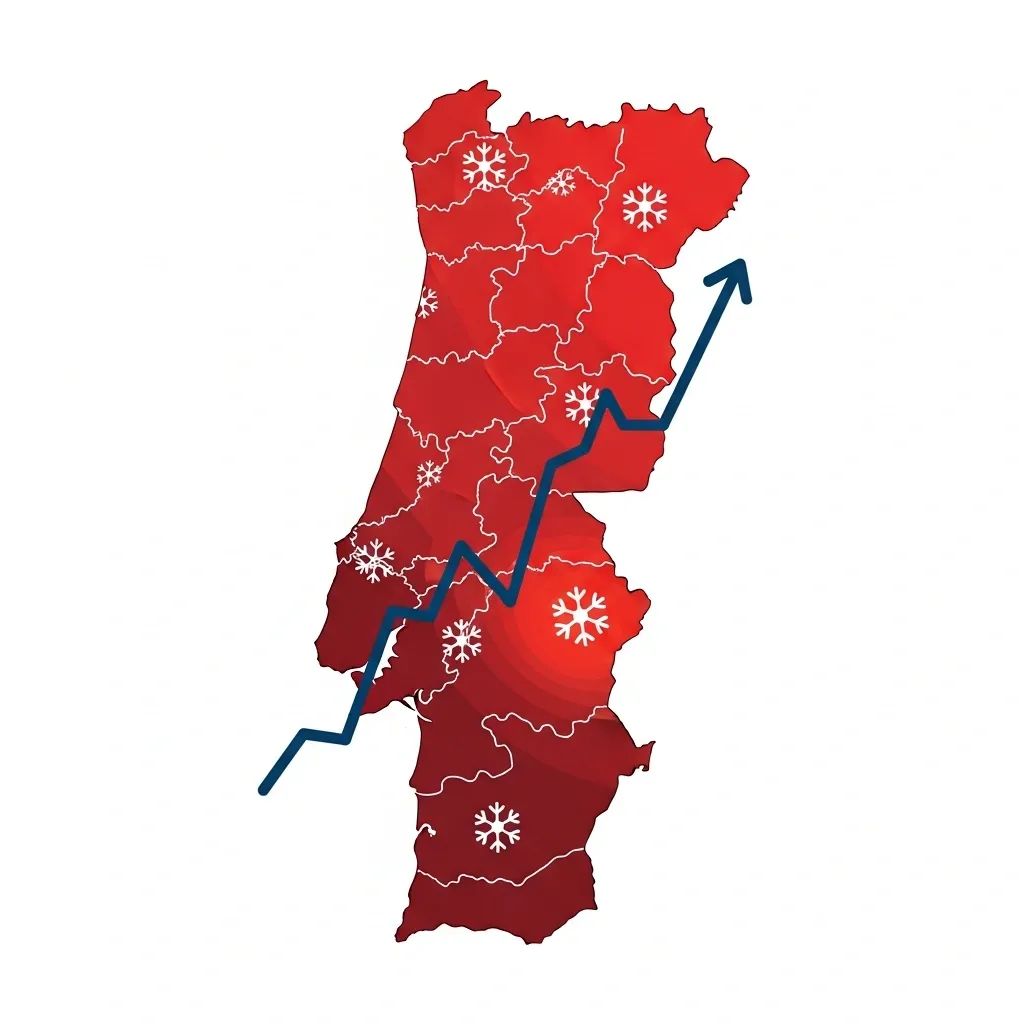
The Portugal Ministry of Health has acknowledged that the current heatwave sweeping through the country could drive a measurable increase in deaths, particularly among elderly and chronically ill residents, as temperatures are forecast to surpass 40°C in parts of the interior and remain above 20°C through the night this week.
Why This Matters
• Temperature spike: The Portuguese Institute for Sea and Atmosphere (IPMA) has placed interior central and southern districts under yellow alert, with warnings escalating through Wednesday as thermometers approach 43°C in the Tagus valley and Alentejo.
• Mortality tracking: The Ministry's Ícaro monitoring system, which correlates temperature with excess deaths, has flagged the potential for significant fatalities—mirroring patterns already observed in France and elsewhere across Europe.
• Continental toll: According to reporting on World Health Organization assessments, the broader European heatwave has already been linked to more than 1,300 excess deaths since June 21, with mortality peaks in Hungary, Slovakia, and Poland.
Europe's Deadliest June on Record
This is no ordinary summer heat. Across the continent, 130 M people are enduring daytime highs above 35°C, while over 269 M face maximums exceeding 30°C. The intensity is unprecedented for late June: Slovakia registered its hottest day ever at 41°C, surpassing a 2007 record; Hungary neared its national ceiling of 41.9°C with a June high of 41.6°C in Aszód; and Austria has placed its eastern provinces, including Vienna, under red alert.
The World Weather Attribution initiative, a consortium of climate scientists, concluded that such temperatures would have been "practically impossible" in June without the influence of anthropogenic climate change. Absolute records have tumbled in Germany, Poland, and the Czech Republic, with monthly benchmarks broken in the United Kingdom and Switzerland.
In Ukraine, the heatwave compounds the devastation of war. Cities including Lviv, Odesa, and Uzhhorod logged temperatures between 36°C and 38°C, placing unbearable strain on an electricity grid already crippled by Russian bombardment. Authorities warned of rolling blackouts, heightened wildfire risk, and additional hardship for military operations along front lines.
Italy issued red health alerts for 25 major cities through Wednesday, while the Balkans contend with temperatures nearing 40°C and active wildfires in Bosnia. In Poland, drowning deaths have surged to 56 since early June—17 on Sunday alone—prompting urgent appeals for vigilance around beaches and lakes. France is experiencing a spike in mortality so severe that funeral services in several regions have begun turning away bodies, unable to keep pace with demand.
What This Means for Portugal Residents
Health Minister Ana Paula Martins stressed that while the first heatwave of this summer had no measurable impact on mortality, the current episode is "very concerning." She emphasized that Portugal's Ícaro system—which cross-references real-time temperature data with hospital admissions and death certificates—is signaling a risk profile comparable to neighboring countries already reporting excess fatalities.
Vulnerable groups face the highest danger:
• Elderly residents, especially those over 85, accounted for a substantial portion of excess deaths during last year's severe heatwave in July 2025.
• Chronic disease patients, including those with cardiovascular, respiratory, metabolic, and renal conditions, are at elevated risk of heat-induced complications.
• Infants under six months should never be exposed to direct or indirect sunlight.
• Pregnant women must moderate physical activity, avoid sun exposure, and maintain frequent hydration.
• Isolated individuals or those with reduced mobility require proactive outreach and monitoring.
The Directorate-General of Health (DGS) urges residents to drink at least 1.5 liters of water daily—roughly eight glasses—even without thirst, avoid alcohol and caffeine, and remain in air-conditioned spaces for two to three hours each day. Sun exposure should be avoided between 11 a.m. and 5 p.m., and outdoor physical exertion minimized. Light, loose-fitting clothing in pale colors, wide-brimmed hats, and sunglasses with UV protection are essential. Sunscreen with a minimum SPF of 30 should be reapplied every two hours and after swimming.
Protecting the Workforce
The DGS has launched comprehensive guidance aimed at safeguarding workers in high-risk environments—a critical step given that the International Labour Organization projects that by 2030, 2% of global working hours will become too hot for safe labor. The WHO estimates that 2.4 B workers worldwide are already exposed to excessive heat, resulting in more than 22.85 M health injuries annually.
In Portugal, outdoor laborers in construction, agriculture, forestry, fishing, waste collection, and emergency response bear the greatest burden, as do those in poorly ventilated indoor settings such as greenhouses, furnaces, and foundries. Prolonged heat exposure reduces concentration, escalates accident rates, and triggers conditions ranging from heat rash and cramps to life-threatening heatstroke.
Employers are now expected to draft specific heat-prevention plans, including task rotation, reduced exposure times, and extended recovery periods in cooled areas. The most physically demanding work should be scheduled for the coolest hours, with production targets adjusted accordingly. Potable drinking water must be available at all times, with intake encouraged every 15 to 20 minutes regardless of thirst. Rest areas with shade or climate control, enhanced ventilation, thermal barriers, and insulation of heat sources are mandatory upgrades.
Occupational health services must conduct workstation-by-workstation thermal stress assessments and identify vulnerable employees—pregnant workers, individuals on certain medications, or those managing chronic illnesses—who require additional protections. At least one person per shift must hold first-aid certification and be trained to recognize early symptoms of dehydration, heat exhaustion, and heatstroke, the latter necessitating immediate contact with 112.
National Contingency Plan Activated
Portugal's response framework, the Portuguese Contingency Plan for Heatwaves, operates annually from May through September—a protocol refined since the catastrophic 2003 European heatwave. The Ministry of Health funds and coordinates the plan, which monitors health outcomes, socioeconomic conditions, healthcare system strain, and meteorological extremes in real time.
The system employs a four-tier alert structure—green, yellow, orange, and red—each triggering escalating mobilization of hospital capacity, personnel, and care circuit reorganization. Local Health Units (ULS) draft and activate their own protocols aligned with national directives, adjusting resources as conditions evolve.
The government's National Climate Adaptation Strategy (ENAAC 2030) was established to bolster Portugal's resilience against heatwaves, droughts, and wildfires. The strategy integrates climate adaptation into public policy and territorial planning, aligning with the Paris Agreement and EU guidelines. Previous iterations, including ENAAC 2020, laid the groundwork for sector-specific adaptation, including public health.
The AdaPT Program, funded by the European Economic Area Financial Mechanism, has channeled investment into local-level adaptation, education, and sectoral projects. Portugal's Recovery and Resilience Plan allocates 38% of its total budget to climate objectives, including residential energy efficiency upgrades and forest protection to mitigate wildfire risk and enhance climate resilience. The Climate Change Adaptation Action Programme (P-3AC) implements cross-sectoral measures to reduce vulnerabilities identified for Portugal.
Historical Context and Future Outlook
Research from the NOVA University Lisbon School of Public Health has documented significant increases in hospital admissions during heatwaves across all age groups, with notable impacts on children. Recent analysis has revealed that heat-related mortality in Portugal has risen sharply over recent decades, particularly in northern and interior regions.
Last year, in late June and early July 2025, Portugal recorded 69 excess deaths potentially linked to extreme heat; the following month saw 284 excess deaths during a severe heatwave. These figures from 2025 provide critical context for understanding the current threat as the heatwave unfolds this week.
The WHO has called on European governments to strengthen prevention and response plans, emphasizing the need to integrate these measures into broader climate adaptation strategies. As climate models project more frequent, intense, and prolonged heatwaves, Portugal's layered approach—spanning surveillance, public guidance, workplace protections, and long-term infrastructure investment—represents a critical test of resilience in an era of accelerating thermal extremes.


