
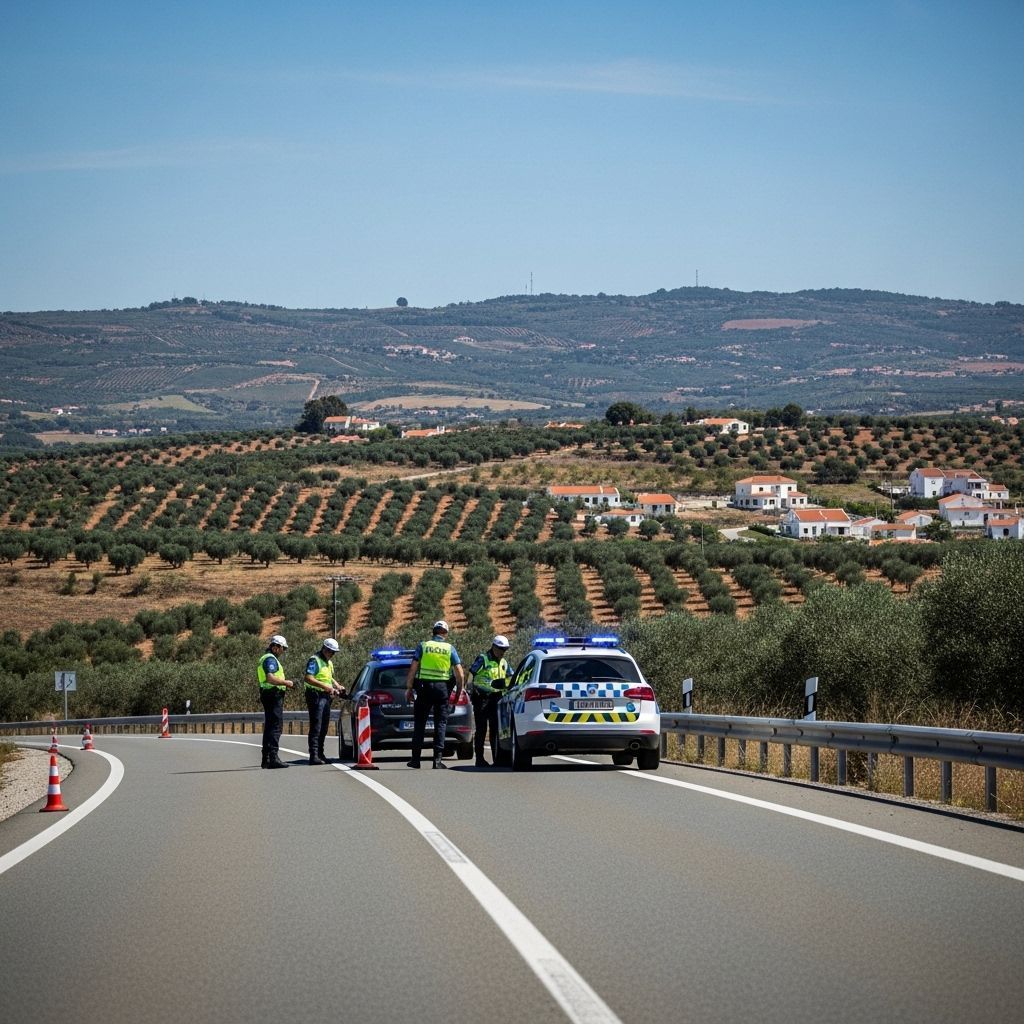
The Portugal Royal Police (PSP) and the National Republican Guard (GNR) have intensified their crackdown on drug trafficking across the country, with recent operations in Elvas, Pombal, Sintra, and Évora resulting in dozens of arrests and the seizure of thousands of individual doses destined for Portuguese streets. The operations underscore a national push to disrupt supply chains and protect vulnerable communities from organized narcotics networks.
Why This Matters
• Minors are being recruited: Two 16-year-olds were arrested near a school in Elvas with over 230 doses of hashish, highlighting the exploitation of youth by traffickers.
• Repeat offenders face tougher measures: A 51-year-old woman in Elvas was placed in preventive detention after being caught a second time with cocaine and heroin, despite previous court-ordered restrictions.
• Public housing crackdown: Families found with drugs in municipal housing in Sintra are being evicted as local authorities enforce zero-tolerance policies.
• Major seizures in central Portugal: The GNR in Pombal detained four people after a year-long investigation, confiscating over 20,000 doses of cocaine and hashish, plus €6,260 in cash and gold jewelry.
Elvas Emerges as Trafficking Hotspot
The PSP District Command of Portalegre detained four individuals in Elvas this week on drug trafficking charges, including two teenagers caught selling narcotics near an educational institution. Officers from the Criminal Investigation Squad of the Elvas Police Division recovered 231 daily doses of hashish, three nitrous oxide canisters, €90 in cash, and paraphernalia used to package and prepare drugs for sale.
The arrests mark the second time authorities have targeted the same 51-year-old woman. In November 2025, she was presented to court for drug trafficking but received lighter measures—regular check-ins at the police station, a ban on contacting co-defendants and known drug users, and restrictions on leaving the municipality. She was barred from areas associated with trafficking.
The Public Prosecutor's Office in Portalegre appealed that decision, and the Court of Appeal ruled in favor of harsher penalties, though the woman appealed to the Constitutional Court. That case remains pending.
This week, police intercepted her returning from Badajoz, Spain, with 5.64 grams of crack cocaine (28 doses) and 1.25 grams of heroin (12 doses). A search of her Elvas residence uncovered cutting and packaging equipment, and a bank deposit slip showing a €300 transfer. Her account held approximately €2,000—a sum incompatible with her declared income from the Social Insertion Income (RSI) welfare program, according to prosecutors.
The court ordered preventive detention this time, maintaining the classification of "lesser severity" trafficking but acknowledging both her continued criminal activity and violation of previous restrictions. The case illustrates the judiciary's struggle to balance rehabilitation with public safety.
A fourth suspect, a 21-year-old man, was also detained with 85 doses of hashish. His case has been forwarded to the Elvas Judicial Court for further proceedings.
Year-Long Investigation Yields Major Haul in Central Portugal
In a separate operation, the GNR in Pombal arrested four suspects—three men and one woman aged 20 to 38—following a 12-month investigation into trafficking networks operating across Montijo (Setúbal district), Ansião (Leiria), and Seia (Guarda). The group appeared before the Leiria Judicial Court for first judicial interrogation.
Officers executed four residential search warrants and eight non-residential searches, including seven vehicles, recovering:
• 17,600 doses of cocaine (3.52 kg)
• 2,727 doses of hashish resin (1.36 kg)
• 14 canisters of nitrous oxide (2 kg each)
• Gold jewelry: five rings, a pair of earrings, a necklace, and a bracelet
• A silver rosary
• 16 mobile phones
• €6,260 in cash
• Four digital scales, two banknote-counting machines, seven LCD televisions, two cars, a desktop computer, and a hard drive
The operation drew support from the Criminal Investigation units of the Leiria Territorial Command, the GNR Intervention Unit, and territorial commands in Guarda and Setúbal. Authorities have not disclosed whether the suspects are connected to larger international networks, though Portugal remains a critical entry point for South American cocaine bound for Europe via maritime routes through the Azores, Madeira, and the Algarve.
Municipal Housing Eviction Highlights Social Policy Dilemma
In Sintra, a family was evicted from municipal housing in Casal do Cotão (Cacém e São Marcos parish) after the Municipal Police and PSP discovered drugs in the residence. Mayor Marco Almeida announced the action on social media, declaring: "Drugs in council houses? Out of the question."
The mayor confirmed the home would soon be reassigned to "those who truly need it," though he did not specify whether arrests were made or what quantity of narcotics was recovered. Chega party councillor Anabela Macedo defended the move, stating that subsidized housing "is a social support intended for those who genuinely need it and involves rights, but also duties."
The eviction signals a hardline shift in housing policy, raising questions about proportionality and whether entire families should lose shelter due to the actions of one member. Legal experts note that eviction proceedings for criminal activity in public housing must balance administrative sanctions with constitutional protections for housing rights, particularly for minors or non-involved household members.
Nationwide Pattern of Intensified Enforcement
These local operations fit within a broader national strategy. Earlier in 2026, the PSP in Évora detained 23 people—18 for drug trafficking—dismantling a family-run network and seizing nine firearms, 531 rounds of ammunition, and nearly €11,000. Eight suspects were remanded in custody. In April, the GNR Territorial Command of Braga dismantled an organized network operating across northern and central Portugal, arresting 19 people and confiscating nearly 25,000 doses of hashish, 6,335 doses of cocaine, and €121,981 in cash.
Portugal's role as a European gateway for cocaine—arriving from South America via the Caribbean, Cape Verde, and West African routes—has made disrupting trafficking a top priority for law enforcement. The country's 2000 decriminalization of personal drug use, which treats consumers as patients rather than criminals, has not extended leniency to traffickers, who face severe penalties.
What This Means for Residents
For communities in Elvas, Pombal, and similar areas, these arrests may temporarily reduce local supply and visibility of street-level dealing, particularly near schools. However, experts caution that enforcement alone rarely eliminates demand or prevents recruitment of new distributors.
Parents and educators should be aware that traffickers increasingly recruit minors—some as young as 11—as couriers and street vendors, exploiting their vulnerability and the lighter legal consequences they face. The Tutelary Educational Law mandates rehabilitative measures rather than criminal penalties for offenders aged 12 to 16, while children under 12 are treated as victims and referred to family courts.
Residents in municipal housing should note that possession or trafficking from subsidized homes can now result in immediate eviction, a policy shift that prioritizes community safety over housing security. Those facing eviction have limited legal recourse unless they can prove non-involvement.
For those struggling with addiction, Portugal continues to offer free treatment programs, employment support with government incentives, and multidisciplinary commissions that encourage rehabilitation over incarceration. The national hotline and regional health centers remain the primary access points for these services.
Authorities have urged anyone with information on trafficking activity—especially near schools or involving minors—to contact the PSP Citizen Portal or the GNR's anonymous tip line. Public cooperation remains critical as investigators work to identify higher-level suppliers and dismantle financing networks that sustain street-level operations.


