

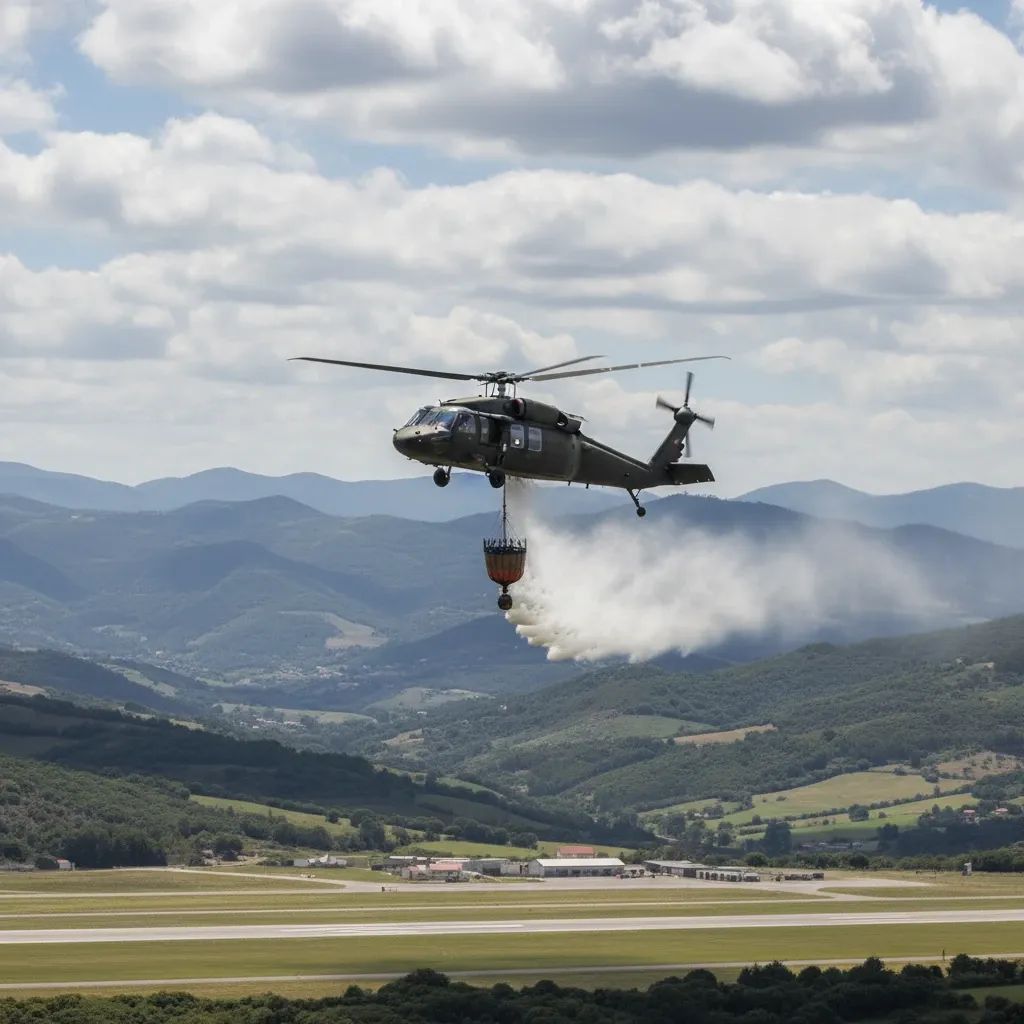
The Portugal Air Force will deploy two Black Hawk helicopters this summer to bolster wildfire response capacity, marking the operational debut of a fleet representing €125M in investment, with tactical adjustments underway following recent European drills.
Why This Matters:
• Two UH-60 Black Hawks will join the national firefighting apparatus by summer 2026—one for crew transport, the other for direct water drops
• Six of nine delivered firefighting helicopters are already operational, with three more arriving by August 2026
• Refueling bottlenecks emerged during May's EU simulation exercise in Viseu, prompting tactical adjustments before peak fire season
A Fleet Taking Shape
Portugal has committed to acquiring 13 Black Hawk helicopters for firefighting missions, alongside additional units for medical evacuation and Army support. The Portugal Ministry of Defense confirmed that nine firefighting-configured units have been contracted, with six already delivered and operational as of today. Three additional units are due by August 2026. These are predominantly reconditioned UH-60A and UH-60L models—the Lima variant features upgraded engines and gearboxes that handle Portugal's high summer temperatures and mountainous terrain more effectively.
The initial batch of six UH-60As cost roughly €43M, sourced through contracts with Arista Aviation Services (now United Aero Group) and Ace Aeronautics. Three additional UH-60Ls followed, though their exact cost remains undisclosed. Each helicopter can lift a 12-person firefighting crew fully equipped and drop up to 2,950 liters of water per pass. Onboard weather radar enables operations in variable conditions, while an external hoist supports search-and-rescue missions—a dual capability that Portugal's Defense Minister Nuno Melo has called "polivalente" (multipurpose).
Infrastructure to support the fleet is also advancing. On Wednesday, Minister Melo inaugurated a nearly €2M squadron building at Air Base No. 8 in Ovar, Aveiro district, funded through the Recovery and Resilience Plan. The facility will house Squadron 551 "Panteras," the unit tasked with Black Hawk operations. Air Force Chief of Staff Sérgio da Costa Pereira noted that pilot training will extend through 2026, with some Portuguese crews training in Austria to leverage that country's disaster-response experience.
Refueling Snags and Tactical Fixes
Despite the hardware advances, the PT EUMODEX 2026 exercise held in Viseu from May 5–7 exposed friction points. More than 700 personnel from six European nations simulated a large-scale rural fire, stress-testing command, communication, and interoperability. National Civil Protection Commander Mário Silvestre acknowledged that Black Hawk refueling presented a notable challenge. Unlike conventional firefighting helicopters that use a suspended bucket on a cable, the Black Hawk employs a belly tank—an underslung reservoir that requires different water-collection protocols and approach vectors at supply points.
Silvestre characterized the issue as natural for a new platform and emphasized that "adjustments" are underway before the critical summer months. Minister Melo, speaking in Leiria earlier this week, countered concerns by highlighting the Black Hawk's precision in water drops, arguing that the helicopters offer "more accuracy than other models" in targeting flames. He added that crews are being trained to the standards that characterize Armed Forces planning and execution efficiency.
Broader Arsenal Upgrades
The Black Hawks are one element in a multi-year modernization push. The Portugal Government has purchased firefighting kits for C-130 transport aircraft, now under production in the United States and slated for installation by late 2026 or early 2027. These kits will transform the four-engine workhorses into aerial tankers capable of covering larger burn zones.
Looking further ahead, Portugal has ordered two DHC-515 Firefighter heavy bombers (formerly known as Canadairs) for delivery in 2029 and 2030. The country will also host part of the European Union's new joint fleet of amphibious aircraft and firefighting helicopters starting this year, a pooling arrangement designed to accelerate cross-border deployments during peak fire season.
In total, the 2026 Special Rural Firefighting Device (DECIR) will field 76 aerial assets. That count includes the two Air Force Black Hawks, three operated by AFOCELCA (the Portuguese forestry owners association), and a mix of fixed-wing aircraft and lighter helicopters contracted from private operators.
What This Means for Residents
For anyone living in Portugal's fire-prone interior—especially districts such as Leiria, Aveiro, Coimbra, and Castelo Branco—the Black Hawk deployment translates to faster crew insertion and more targeted water drops during the initial attack phase, when containing a blaze is still feasible. The belly-tank system, once refueling procedures are ironed out, allows the helicopter to scoop from rivers, reservoirs, or portable basins without landing, theoretically cutting turnaround time.
However, the Viseu exercise revealed that logistical self-sufficiency—food, accommodation, crew rotation—for multinational modules remains a work in progress. If a major fire triggers an EU mutual-aid request, coordination hiccups could delay reinforcements. Civil protection authorities are using the spring window to refine these protocols, particularly the "Aldeia Segura, Pessoas Seguras" (Safe Village, Safe People) evacuation framework, which was also tested under simulated conditions last week.
The broader investment—€125M for helicopters to date, plus infrastructure and training—sits at the lower end of the European Black Hawk acquisition spectrum. For comparison, Croatia paid roughly €232M for eight UH-60Ms with full support packages, while Austria is negotiating a €970M deal for 12 units. Portugal's strategy of buying reconditioned A and L models rather than the latest M variant keeps upfront costs manageable but may entail higher maintenance overhead as airframes age.
Honoring Emergency Service
During the same ceremony in Ovar, Health Minister Ana Paula Martins presented the Air Force with the Gold Medal for Distinguished Services, recognizing a four-month airlift operation in summer 2025 when Air Force crews stepped in to support the National Institute of Medical Emergency (INEM) amid staffing shortages. The mission comprised 30 sorties, 32 patients transported, and more than 92 flight hours—a stopgap that kept Portugal's helicopter emergency medical service running when ground ambulances and INEM helicopters were stretched thin.
Martins described the medal as "more than formal recognition—it is the nation's gratitude to men and women who daily place their lives at the service of others." The episode underscored the Black Hawk's versatility: the same airframe that will drop water on a forest fire can, with a reconfigured cabin, perform high-altitude medical evacuations or troop transport.
Ground Operations Expand
Parallel to the aerial buildup, the Integrated Prevention and Operations Command (CIPO) is coordinating land-based fuel reduction across municipalities hit hardest by winter storms. Thousands of fallen trees from recent tempests have created abnormal fuel loads, and CIPO—staffed by personnel from the Ministries of Internal Administration, Defense, and Agriculture and Sea—is tasked with clearing critical corridors, reopening access roads, and reducing ignition risk before temperatures climb.
Minister Melo emphasized that the three Armed Forces branches are contributing patrols, drones for surveillance, and engineering assets. The Navy and Army are conducting foot patrols in vulnerable zones, while Air Force drones provide real-time thermal imaging to detect smoldering hotspots or illegal burns. This integrated posture reflects a shift toward year-round prevention rather than reactive summer firefighting.
Residents should expect increased military and civil protection presence in rural areas through June as crews race to complete hazard abatement. Local municipalities are being asked to facilitate access to private land where storm damage is most severe, a process that has occasionally triggered friction over property rights and liability.
Readiness for Summer
The Air Force achieved Initial Operational Capability for the Black Hawk fleet in November 2025. By February 2026, six helicopters had been delivered—four UH-60As and two UH-60Ls. The remaining three firefighting-configured units are en route, with final handover scheduled for August. Pilots completed theoretical coursework in the United States and are now logging flight hours in Portugal, adapting to the Garmin G5000H avionics suite that replaced older analog instruments in the reconditioned airframes.
The two helicopters earmarked for this summer's DECIR roster will be drawn from the six operational aircraft, meaning crews have roughly three months of additional training and tactical refinement before the traditional fire season opens in mid-June. Civil protection planners are banking on the Black Hawks to shorten response times in the Pinhal Interior, Serra da Estrela, and Algarve hinterland—regions where rugged topography often delays ground crews.
Given the refueling challenges flagged in Viseu, expect the Air Force and ANEPC to conduct joint drills at key water-collection points in coming weeks, testing belly-tank operations at rivers such as the Mondego, Zêzere, and Guadiana. Any procedural gaps discovered now will be easier to fix than mid-crisis in July or August, when Portugal's firefighting apparatus is stretched to capacity and international media attention is high.
The €2M investment in the Ovar squadron facility signals that the Black Hawk presence is permanent, not a short-term fix. As the fleet grows and C-130 tanker kits come online, Portugal is positioning itself as a regional hub for aerial firefighting expertise—a role that could attract EU co-funding and joint training exercises in future seasons.


