

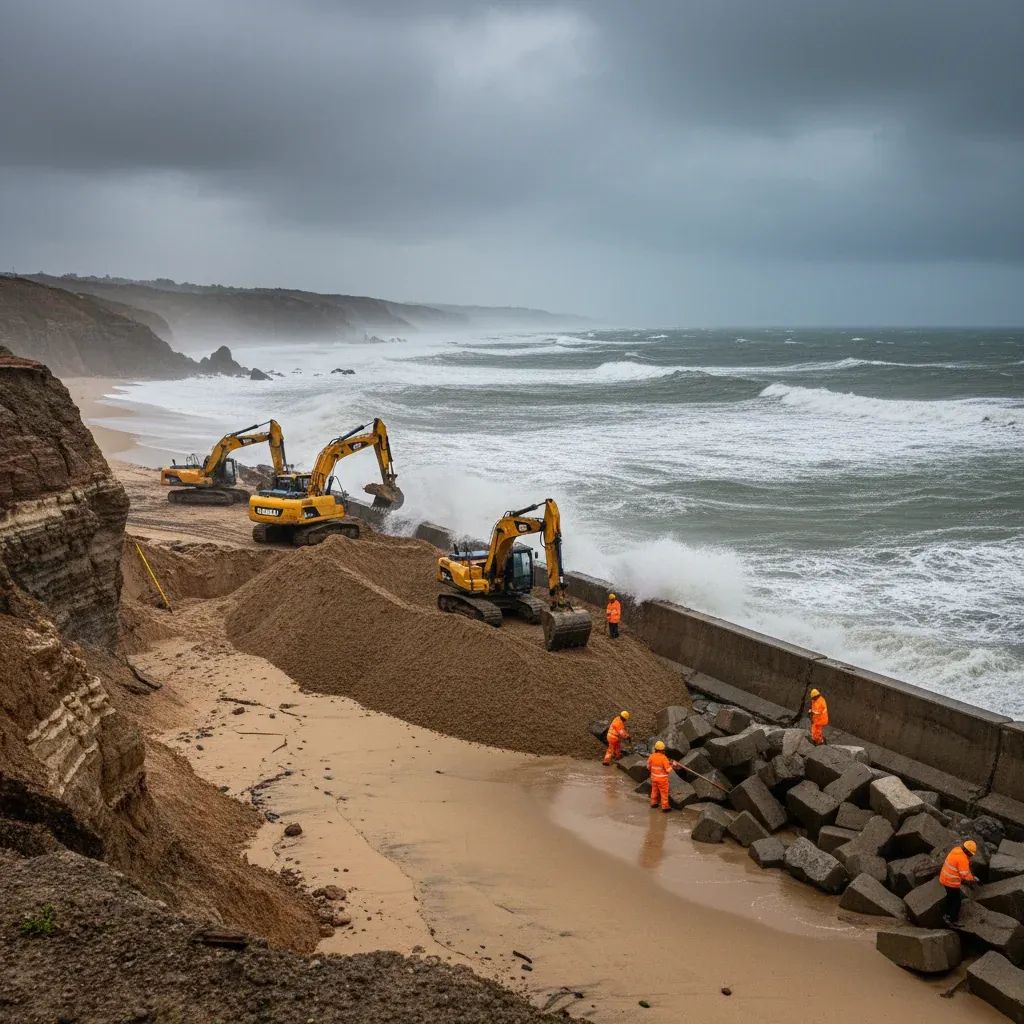
Portugal's environment agency is racing to repair coastal defenses battered by winter storms, deploying €27M in emergency funding across more than a dozen municipalities. The work, which began at the start of April, follows severe storm damage that pummeled the country's thousand-kilometer shoreline between October 2025 and February 2026, accelerating erosion along a coast already losing ground to rising seas.
Why This Matters
• Over 20% of Portugal's coastline is actively eroding, threatening homes, infrastructure, and entire beach systems.
• Emergency repairs worth €27M are on schedule, with additional funding bringing total coastal investment to €111M through year-end.
• Key beach access and safety infrastructure must be restored before the May bathing season, critical for tourism-dependent coastal economies.
• Residents in Ovar, Caminha, Esposende, Espinho, and Costa da Caparica will see immediate construction activity as crews work against the clock.
The Scale of Damage
The Agência Portuguesa do Ambiente (APA) confirmed that winter storms inflicted widespread damage requiring urgent intervention before summer visitors arrive. Pimenta Machado, the agency's president, categorized the €27M envelope as funding for "immediate and emergency actions" triggered by storm destruction along the coastal fringe.
Ovar emerged as the hardest-hit municipality, sustaining damage severe enough to warrant priority status in the emergency schedule. The northern municipalities of Esposende, Espinho, and Caminha also secured spots on the urgent intervention list, while the southern Algarve region faces its own restoration challenges.
In Caminha, crews are stabilizing the Moledo seawall with temporary fixes designed to hold through the bathing season. A more robust structural intervention will follow in autumn, carrying an estimated price tag between €3M and €4M.
Major Sand Replenishment Operations
The Algarve launched its largest sand restoration project on April 2, targeting the heavily damaged stretch between Quarteira and Garrão in Loulé municipality. Simultaneously, crews mobilized at Praia do Forte Novo, where storm surge stripped significant volumes of protective beach sediment.
Further north, the APA plans to begin sand replenishment at Costa da Caparica before the end of April. This densely populated beach zone south of Lisbon serves as a critical recreational outlet for metropolitan residents and draws substantial domestic tourism revenue during summer months.
In Mafra, contracts have been signed and construction is slated to commence within 15 days, targeting beach infrastructure damaged during the storm sequence.
What This Means for Residents
For property owners along the coast, these emergency repairs provide immediate relief but reflect a longer-term challenge: Portugal's shoreline is retreating. More than 200 kilometers of the nation's coast is actively eroding, a process accelerated by climate-driven sea level rise and increasingly intense Atlantic storms.
Local businesses in affected municipalities should prepare for construction activity through April and potentially into May. Beach access points may be temporarily closed or rerouted, and parking areas near active work zones will likely face restrictions. However, the APA's commitment to restoring facilities before bathing season suggests most tourist infrastructure will be operational by mid-May.
Residents in Caminha and Ovar face the prospect of recurring construction cycles. The provisional nature of some repairs means communities will experience a second wave of work post-summer, potentially disrupting autumn routines and requiring additional road closures or detours.
For homeowners considering coastal property purchases, these emergency measures highlight long-term considerations. Properties in erosion-active zones may face increased insurance costs and challenges with future land access. Prospective buyers should consult municipal erosion maps and factor climate adaptation costs into investment calculations.
The Broader Financial Picture
The €27M emergency package represents the opening phase of a €111M coastal defense program approved by the Portuguese government. Under the staged funding plan, €15M was allocated for deployment before May, coinciding with the start of bathing season, with an additional €12M earmarked for release before the end of 2026.
A separate €65M funding round through the Programa Sustentável 2030 targets longer-term protection projects across Continental Portugal, combining traditional engineering approaches with nature-based solutions like dune restoration and wetland reconstruction. These projects operate on multi-year timelines and aim to build systemic resilience rather than simply replacing damaged infrastructure.


