
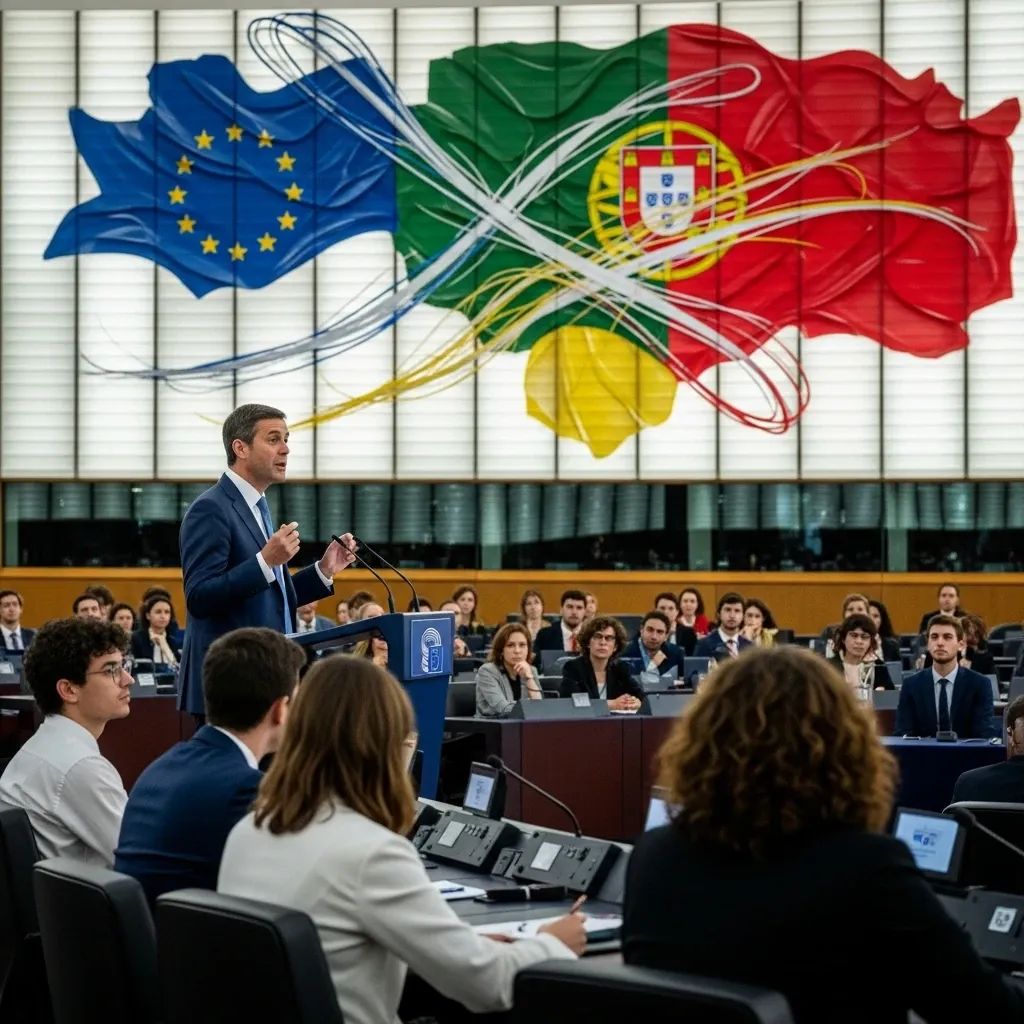
Four Decades In: Portugal Advocates for Delivery on Funding Commitments to Brussels
Four decades after joining what was then the European Economic Community, Portugal stands at a peculiar crossroads. Public confidence in the European Union has climbed to 73%—the highest recorded level since 2019—yet citizens remain acutely anxious about immediate material concerns: inflation, jobs, housing, and the capacity of institutions to respond. This apparent paradox contains an urgent message that Europe's leadership cannot afford to misinterpret.
Why This Matters
• Trust is conditional, not guaranteed: While 93% of Portuguese view the EU as a stabilizing force in an unstable world, cost-of-living pressures remain the defining personal anxiety—approval hinges on visible, tangible outcomes.
• Outermost regions face budget pressure: Portugal is pushing for a €200M funding increase for Madeira and the Azores in the 2028–2034 EU budget cycle, arguing that existing support frameworks have stagnated for a decade amid shifting Brussels priorities toward defense spending.
• Autonomy requires financial reinforcement: The 50-year-old Madeira Regional Autonomy model, which transformed the island from isolation to prosperity, now depends on whether Brussels will meaningfully upgrade support mechanisms designed for a different era.
The Execution Crisis Nobody Wants to Admit
The convergence of anniversaries—40 years of Portugal's EU membership and 50 years of Madeira's autonomy—created space for candid reflection on June 12 when officials gathered at the Fortaleza de São João Baptista do Pico in Funchal. The event brought together regional administrators, members of parliament, and European Union officials charged with assessing two generations of integration.
Carlos Coelho, the former Member of the European Parliament serving as commissioner for Portugal's accession anniversary, articulated a diagnosis that carries weight precisely because it avoids bureaucratic obscuring: Europe's problem is not ambition, but execution.
The observation deserves scrutiny. Decades of structural and cohesion funding have indisputably modernized Portuguese infrastructure—highways, airports, universities, healthcare systems. Literacy expanded dramatically. Per-capita GDP lifted substantially. Yet implementation remains hobbled by administrative friction, bureaucratic delay, misaligned incentives between national governments and European institutions, and persistent gaps between policy ambitions announced in Brussels and realities experienced in schools, hospitals, and small-business premises across the country.
Coelho's formulation—that citizens do not seek less European integration, but more effective European integration—distinguishes between two types of dissatisfaction. The first, populist and nationalist, demands withdrawal from shared structures. The second, emerging even among EU-trusting populations like Portugal's, demands that shared structures actually deliver on their promises at reasonable speed.
The Paradox at the Center of European Politics
Recent Eurobarometer data gathered between March 12 and April 5, 2026, maps this tension with unusual clarity. Across the European Union, 51% of citizens express confidence in the bloc—a climb of 3 percentage points from autumn 2025 and the highest reading since 2007. In Portugal, the figure reaches 73%, substantially exceeding the continental average.
Yet this headline masks a generational fault line. Six in ten Europeans (60%) express optimism about the EU's future; among those aged 15–24, the figure rises to 68%. Simultaneously, young workers struggle with housing costs and employment precarity. Older cohorts, who recall pre-EU economic isolation, remain more forgiving of Brussels' institutional slowness—but they cannot indefinitely shield younger generations from friction between democratic expectations and technocratic delivery.
The priority anxieties people cite do not reflect populist hysteria. Middle East tensions (cited by 25% across the bloc), the Russia-Ukraine conflict (20%), and general international instability dominate concern. Cost of living remains the single largest personal preoccupation in every member state. These are not anti-EU sentiments; they are demands that European institutions prove capable of managing the shocks that matter most to people's lives.
Madeira's Strategic Recalibration
The autonomy framework established in 1976—now marking its 50th anniversary—represented a profound recognition that regional difference requires differentiated governance. Madeira gained legislative authority over taxation, regional development, education, and fisheries while remaining fiscally interdependent with the Lisbon central government and the European Union.
That interdependence has historically functioned. EU cohesion funds, combined with the POSEI programme (designed to offset insularity and remoteness costs), underlay the transformation of an economically isolated Atlantic territory into a region with per-capita GDP exceeding national averages. Tourism, agriculture, and services infrastructure developed on this financial foundation.
But the architecture is aging. João Cunha e Silva, commissioner for the Madeira autonomy commemoration, emphasized that autonomy was not a gift bestowed from above but "a struggle of a fearless people." That phrasing signals recognition that the framework remains contested, subject to renegotiation as broader European budget priorities shift.
European Commission officials are now recalibrating multiannual spending priorities. Defense, geopolitical resilience, and strategic autonomy—responses to Russia's invasion of Ukraine and broader Indo-Pacific competition—are claiming larger shares of constrained budgets. The funds available for regional cohesion face corresponding pressure.
The Funding Gap Nobody Is Quietly Tolerating
In March 2026, the Madeira Regional Assembly approved a formal resolution defending both protection within the Common Agricultural Policy framework and a standalone, reinforced POSEI programme within the 2028–2034 financial cycle. The request signals urgency: Portugal formally requested that European Commission increase support for Madeira and the Azores from €700M to €900M—a €200M addition that sounds modest in Brussels budgetary terms but represents meaningful runway for agriculture, fisheries, and digital infrastructure in two territories where insularity creates costs that mainland competitors do not face.
The Madeira Regional Government, operating on a 2026 budget totaling €2.33 billion, has prioritized housing investment and tax relief as anchors for population retention. Youth migration outward remains a structural challenge across all Atlantic peripheries. Climate adaptation pressures—rising sea levels, shifting fish stocks, intensifying weather systems—compound the difficulty. Without stable co-financing from Brussels, these priorities risk retreat into austerity.
Miguel Albuquerque, President of the Madeira Regional Government, has expressed concern about potential "bad faith" within Commission planning and warned explicitly of risks that cohesion funds could be diverted or diminished as European defense investments expand. The anxiety is not paranoia; it reflects institutional memory of previous budget cycles in which regional interests were subordinated to broader European priorities.
What Residents Should Monitor
For people living in Madeira, the Azores, and mainland Portugal, the outcome of imminent budget negotiations will ripple through lived experience. Agricultural subsidies directly support rural livelihoods. Fisheries support determines whether island economies can sustain traditional sectors. Infrastructure investment—ports, digital networks, transportation links—shapes accessibility and economic diversification.
António Leitão Amaro, Minister of the Presidency in the Portuguese Government, has publicly committed to defending autonomous region interests in Brussels negotiations. Yet divergence between Lisbon and Funchal over competencies and financing authority is acknowledged as "natural and healthy"—diplomatic language that masks real friction between central government prerogatives and regional ambitions.
If Portugal cannot secure differentiated treatment for its outermost regions within the next budget framework, pressure for deeper fiscal autonomy or renegotiation of autonomy statutes themselves will intensify. These are not academic institutional questions; they affect whether housing affordability improves, whether young people remain in their home communities, whether agricultural and fishing sectors survive, and whether Portugal's Atlantic frontier territories remain economically viable or enter managed decline.
The Human Dimension of Trust
Teresa Anjinho, the European Ombudsman, offered grounded perspective during the Funchal ceremony, describing trust as something earned through consistency rather than rhetoric. Complaints and petitions flowing into her office reflect populations that are demanding, attentive, and genuinely committed to European values—but insistent that institutions align words with actions and make serious commitments that they actually keep.
This framing cuts to a truth that citizens understand strategically: they are not fundamentally anti-Europe; they are anti-dysfunction and anti-broken-promises. The message is clear: the European project's vulnerability lies not in excessive ambition but in visible failure to deliver.
A Maturing Partnership
The ceremony in Funchal symbolized both satisfaction with historical achievements and impatience for systemic upgrade. Portugal's evolution from gratitude for integration to partnership with Brussels reflects institutional maturation. Four decades in, the nation has moved beyond the role of fund recipient into that of demanding stakeholder in European policy formation.
Coelho's insistence that Portugal cannot function as a passive beneficiary—that it must participate as an active, exigent, and ambitious partner—reflects this shift. It is not nationalist posturing; it is the language of an established member asserting legitimate interests.
Whether this translates into improved cohesion architecture, revised regional financing rules, or genuine multi-level governance innovation will become evident as budget cycles unfold. For now, the message from Funchal is clear: Portugal expects to be heard, to see demonstrable outcomes, and to receive treatment commensurate with its standing. Public confidence in the European project remains strong, but that confidence is no longer unconditional. It must be continuously replenished by institutions that deliver.


