

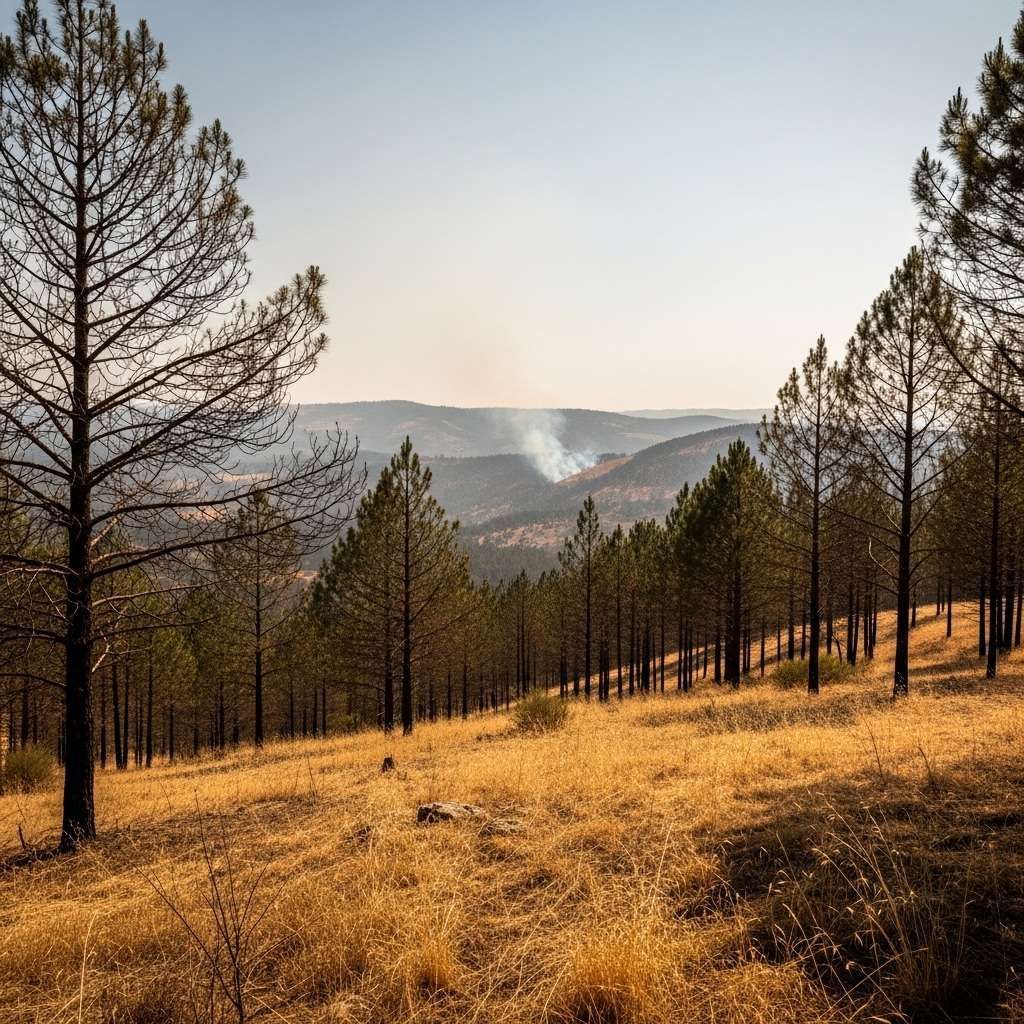
The Portugal National Health Service has activated emergency protocols as an extreme heat wave is set to deliver up to 44°C temperatures across much of the country in July 2026, a scenario authorities warn could drive a spike in mortality among vulnerable populations over the coming week.
Emergency Summary
• Temperature range: Up to 44°C across central and southern Portugal
• Red alerts issued: Lisboa and Setúbal (Thursday, 2 July 2026), expanding to Coimbra and Leiria on Friday
• Emergency numbers: SNS 24 at 808 24 24 24 | European emergency: 112
• Priority action now: Find your nearest cooling center
Why This Matters
• Red weather alerts issued for Lisboa and Setúbal districts starting Thursday, 2 July, expanding to Coimbra and Leiria on Friday.
• Health officials forecast excess deaths if current meteorological conditions persist, particularly among elderly, children, pregnant women, and people with chronic illness.
• Hospitals are scaling up teams and bed capacity, with all SNS units operating on Level 1 contingency plans.
• Energy grid experts caution that prolonged demand for cooling equipment may trigger localized power cuts in overloaded neighborhoods.
Find Your Nearest Cooling Center
Cooling centers are now being activated across Portugal. These air-conditioned refuges include churches, shopping centers, libraries, hotels, and public buildings.
How to locate your nearest center:
• Call SNS 24: 808 24 24 24 (they can direct you to facilities in your area)
• Contact your freguesia (local parish council): Find your parish council contact via your municipal website or by calling your municipality directly
• In Lisboa: Libraries at Palácio Galveias, Penha de França, Marvila, and Belém; MUDE design museum; Fado Museum
• Check with your hospital or health center: They maintain updated lists of active cooling facilities
Note: These centers will be fully activated if the national contingency level climbs to Stage 2 or 3. Currently, the country remains at Stage 1, but temporary climate shelters are standing by.
Climate Shelters Open Across Country
In an unprecedented coordinated push, Portugal's Ministry of Health, municipal authorities, and local health units are standing up a network of air-conditioned refuges to provide relief to residents without adequate cooling at home. The Secretary of State for Health, Ana Povo, announced that these "temporary climate shelters" will be activated if the national contingency level climbs to Stage 2 or 3.
The Lisbon Metro is keeping three stations—Oriente, Rossio, and Santa Apolónia—open beyond the standard 01:00 closing time to shelter homeless individuals during the hottest nights. Meanwhile, Lisboa and Setúbal municipalities have agreed to prohibit all barbecues and open flames in forest-adjacent parks and impose restricted access to children's playgrounds between 11:00 and 17:00 during peak heat hours.
Prime Minister Luís Montenegro acknowledged that the wave will "inevitably provoke concern, problems, and added pressure on public services, particularly health services." President of the Republic António José Seguro, speaking to journalists in Paris, urged citizens to follow "all instructions from health and civil protection authorities—hydration, fire prevention, protection of the vulnerable."
What This Means for Residents
Starting Thursday, 2 July 2026, expect radically different daily routines if you live or work in central and southern Portugal. The Portuguese Institute for Sea and Atmosphere (IPMA) projects an eight-to-ten-day spell of extreme heat, with overnight lows barely dropping below 24–28°C—so-called "tropical nights" that eliminate recovery time for the body.
Practical steps to take now:
• Identify your nearest climate refuge: Contact SNS 24 at 808 24 24 24 or ask your freguesia (local parish council—find yours via your municipal website or SNS 24) which public buildings will operate as cooling centers. In Lisboa, options include libraries in Palácio Galveias, Penha de França, Marvila, and Belém, as well as the MUDE design museum and Fado Museum.
• Check on isolated neighbors: The Direção-Geral da Saúde (DGS) has published a framework urging families, neighbors, and friends to monitor vulnerable individuals who live alone—30% of Portugal's population is over 65, and many lack air conditioning.
• Adjust work schedules: The DGS released employer guidelines mandating hydration breaks, rescheduling of outdoor tasks, and provision of shade for workers exposed to heat.
• Hydrate preemptively: Drink at least 1.5 liters of water daily, regardless of thirst. Avoid alcohol and caffeine, which accelerate dehydration.
• Avoid solar exposure 11:00–17:00: Use SPF 30 or higher sunscreen, reapplied every two hours, and wear loose, light-colored clothing.
If you experience intense sweating, nausea, vomiting, rapid pulse, or fever, contact SNS 24 at 808 24 24 24 or the European emergency number 112.
Health System Braces for Surge
Portugal's hospitals recorded an 18.9% jump in admissions during past heat waves, with children suffering the steepest increase (21.7%), according to studies cited by the Ministry of Health. Burns, trauma, infectious diseases, and respiratory illnesses all spike when temperatures soar. The catastrophic 2003 event—when the mercury hit 47.3°C in Amareleja, Alentejo—saw hospital deaths rise 35.2% even as total admissions climbed only 1.7%, suggesting the system was overwhelmed by acute cases.
Xavier Barreto, president of the Portuguese Association of Hospital Administrators, told reporters that if this heat wave stretches two weeks—as it has recently in Central Europe—it will become "a genuine problem." Hospitals are now freeing beds, extending shifts, and recalling staff from vacation where feasible, but Barreto emphasized that prevention remains paramount: "We cannot condemn elderly or chronically ill people to spend 15 days inside homes above 30°C. That is a recipe for emergency-room collapse."
The Médio Tejo sub-region (Santarém district, population 170,000) has activated a pioneering multi-agency response plan—PCARAP-FCE—that coordinates civil protection, health units, municipalities, police, social security, and the Red Cross. Comandante David Lobato, the sub-region's emergency chief, said the framework is being monitored by national authorities as a potential model for replication elsewhere.
Energy Grid Under Strain
While a nationwide blackout remains unlikely, energy specialists warn of localized outages in districts where cooling demand peaks simultaneously. Transformers and power lines operate less efficiently during extreme heat; prolonged exposure raises the risk of equipment failure. Residents are urged to set air conditioning to moderate temperatures, stagger use of high-consumption appliances, and improve home ventilation to ease grid stress during afternoon and early-evening peaks.
The Fire Equation
The National Association of Portuguese Municipalities (ANMP) called for "immediate prohibition" of all fire use near forested areas, noting that the fuel load of fallen timber—a concern highlighted during recent fire-prevention initiatives—compounds ignition risk. Barbecues, brush-cutters, chainsaws, and beekeeping fumigation without spark arrestors are banned for the duration of the red alert. Several councils may also close forest parks, though the Lisboa City Council stated "not yet" when asked whether Monsanto Forest Park would be shuttered, opting instead to relocate the Lisb-On music festival from Monsanto to Parque Eduardo VII.
Urban Heat Islands: The Lisbon Data
A citizen-science campaign by the residents' association Vizinhos em Lisboa measured street-level temperatures across nine of the capital's 24 freguesias in mid-June, when air temperatures ranged only 21–27°C. The study recorded 58.3°C on sun-exposed bituminous pavement—31°C above ambient air—and found that shade from a single tree lowered surface temperatures by an average of 10.2°C at zero energy cost. Water in public fountains registered 23°C, four degrees below air temperature, underscoring the cooling power of blue infrastructure.
Santo António, Misericórdia, and Campo de Ourique parishes logged the highest mean readings (above 40°C), with the hottest single spot at Avenida Álvares Cabral. The association is urging municipal authorities to prioritize tree planting, public water features, and strategic shade structures as immediate interventions against the urban-heat-island effect.
The Espinho municipality (Aveiro district) extended beach lifeguard coverage until 21:00 through the weekend to accommodate visitors during the AMB Volleyball Cup, described by organizers as "the world's largest youth international tournament." A medical post at Praia da Baía will staff a nurse, emergency technician, and on-call physician.
Government Response in Full Swing
The Direção-Geral da Saúde coordinated its municipal guidance with the ANMP and the National Association of Parishes (Anafre), calling on local authorities to update vulnerability registries, conduct preventive home visits, extend hours for public pools and libraries, install temporary shade canopies, and adjust municipal outdoor work schedules. A new DGS guide on adapting physical activity to extreme heat and another on recommended nutrition during hot spells are due for release in the coming days.
Health Minister Ana Paula Martins admitted that summer vacation schedules complicate staff rosters in emergency departments but insisted that SNS contingency plans account for the constraint. Álvaro Almeida, executive director of the SNS, said rotations are guaranteed and that health units have been preparing for weeks.
The Ministry activated the National Seasonal Health Preparedness and Response Plan, which establishes vigilance thresholds and stages gradual escalation of resources—primary-care reinforcement, hospital capacity expansion, home-care team deployment, and real-time mortality surveillance through the ÍCARO index developed by the Ricardo Jorge National Health Institute. Coordination runs through the DGS and the SNS Executive Directorate, in partnership with the National Institute of Medical Emergency (INEM), the Ministry Shared Services (SPMS), and regional health authorities.
The four most vulnerable groups identified by the DGS are: individuals over 65, children under five, and pregnant women; people with chronic diseases, disabilities, or reduced mobility; those living alone or experiencing homelessness; and outdoor workers or residents of institutions. The plan includes targeted outreach, public-water distribution, extended facility hours, and coordination with the Portuguese Red Cross, police, firefighters, and social-security services.
Residents living in districts under red alert should treat this heat wave as a public-health emergency requiring behavioral adjustment, not merely a meteorological inconvenience. The Ministry of Health's expectation of elevated mortality is grounded in historical data and predictive modeling; taking the guidance seriously may well be the difference between a manageable strain on health services and a systemic crisis.
The Climate Trajectory
Filipe Duarte Santos, a University of Lisbon climatologist and chair of the National Council for Environment and Sustainable Development, told reporters that Portugal will continue experiencing "more frequent and more intense heat waves, with higher maximum temperatures—something we are witnessing worldwide." Global mean surface temperature has risen nearly 1.5°C above pre-industrial levels, and annual emissions of CO₂ from coal, oil, and natural gas continue to set records.
Santos praised the European Union's progress: dependency on fossil fuels has fallen from 84% in 1990 to 68% in 2025 among the 27 member states, a reduction unmatched by any other region. Yet worldwide reliance on fossil fuels has dropped only marginally—from 87% in 1970 to 82% last year—while global energy consumption surged 54% since 2000. "This is a problem that will only be resolved when the mean atmospheric temperature starts to fall," he said. "We are still emitting more greenhouse gases every year."
Portugal's national temperature record—47.3°C, set in 2003 at Amareleja—is likely to stand for now, but Santos expects new benchmarks within one or two years unless global mitigation accelerates. He noted that anomalies of 3–7°C above seasonal norms are forecast for central and southern regions through at least 8 July, with some models suggesting the heat will persist until mid-month and a possible second severe wave after 18–20 July.


