

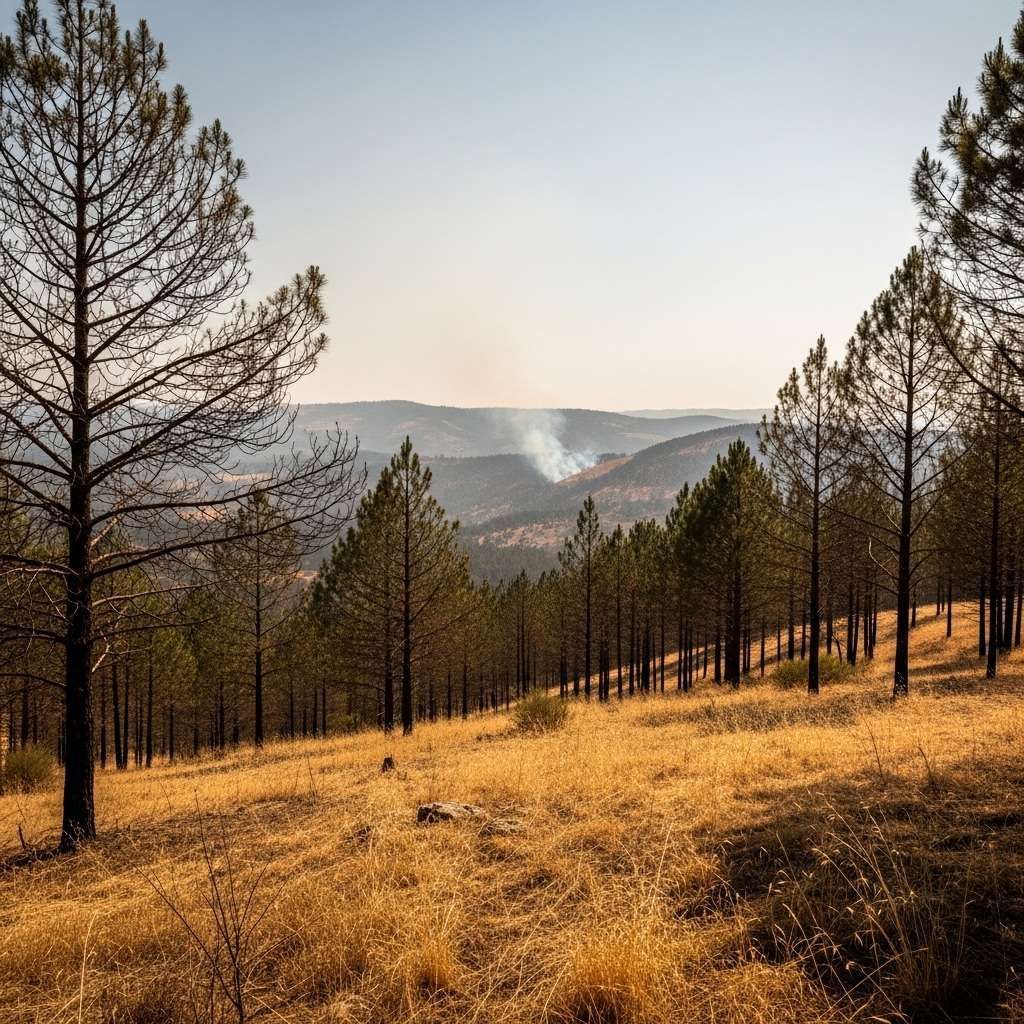
The Portugal Ministry of Internal Administration is preparing to impose strict behavioral bans and access restrictions as the country braces for an extreme heat wave that could drive temperatures to 45°C in interior regions, particularly across the Tagus Valley and inland Alentejo. Minister Luís Neves said today that "drastic decisions" on territorial measures and public alerts may be announced within 24 to 48 hours, pending final risk assessments from the Institute for Nature Conservation and Forests (ICNF).
The heat wave, forecast to be more severe and prolonged than a similar episode in late May, coincides with the São João festivities scheduled for next week across 23 municipalities—a timing that has prompted urgent government appeals to cancel the traditional launch of hot-air balloons with lit wicks, a centuries-old custom now deemed a critical fire risk.
Why This Matters
• Fire risk escalation: Fifteen municipalities across six districts are already under maximum rural fire risk as of today, with conditions expected to worsen through the weekend.
• Health strain: Overnight temperatures may remain above 25°C in Alentejo, preventing thermal recovery and increasing heat stress, particularly for elderly residents.
• Festival restrictions: Authorities are urging municipalities to ban balloon launches and fireworks during São João celebrations, with fines ranging from €140 to €5,000 for individuals and up to €60,000 for organized events.
• Immediate prohibitions: The use of brush cutters, disc harrows, and other combustion machinery in rural areas is now banned; smoking and open fires in forests or adjacent roads are strictly prohibited.
Maximum Fire Danger Declared Across Interior
According to the Portuguese Institute for the Sea and Atmosphere (IPMA), the municipalities of Sertã, Vila de Rei, Vila Velha de Ródão (Castelo Branco district), Sardoal, Mação (Santarém), Gavião (Portalegre), Santiago do Cacém (Setúbal), Serpa, Mértola, Castro Verde, Almodôvar (Beja), Alcoutim, Loulé, Tavira, and São Brás de Alportel (Faro) have entered the highest tier of fire danger. The forecast calls for low humidity, wind gusts up to 70 km/h in highland areas, and the possibility of dry thunderstorms—a combination that creates near-ideal conditions for rapid fire spread.
The National Authority for Emergency and Civil Protection (ANEPC) convened an extraordinary session of the National Operational Coordination Center (CCON) in Carnaxide, Oeiras, where Minister Neves confirmed that Portugal has activated the Charlie phase of its Special Rural Fire Combat Device (DECIR), the highest operational alert level. The daily deployment now includes approximately 830 personnel, 245 vehicles, and 60 heavy machines, with aerial reinforcement standing by in the central zone under the newly established Integrated Command for Prevention and Operations (CIPO).
Neves emphasized that the country has already cleared 18,000 kilometers of forest network, but acknowledged that storm damage from January and early February has left some terrain vulnerable. "It won't be for lack of funds that we fail to fight fires this year," he stated, adding that the National Health Service activated its summer heat plan on May 1, well ahead of the current crisis.
What Behavioral Bans Mean for Residents
The prohibitions now in force—and likely to be expanded—cover a broad spectrum of activities that many residents take for granted during summer months:
Agricultural and land management: The operation of motorized brush cutters, strimmer-mulchers, and disc harrows is prohibited. Farmers are advised to postpone non-urgent land clearing. Combustion-engine tractors and heavy transport vehicles must be equipped with fire extinguishers, spark arrestors, and flame suppressors on exhaust pipes.
Outdoor leisure and cooking: Lighting fires for food preparation, recreation, or any purpose is banned in rural areas except at designated, authorized sites outside critical zones. Smoking in forests or on roads that border or cross rural land is illegal. Beekeepers cannot fumigate hives unless smokers are fitted with spark-retention devices.
Pyrotechnics and festivity traditions: The launch of rockets, hot-air balloons with lit wicks, and other fireworks is prohibited. While municipalities may grant prior authorization for certain pyrotechnic displays outside the critical period, the current risk levels make approvals unlikely. Minister Neves issued a direct appeal to mayors and citizens: "Please do not use these instruments. You are putting people's lives and property at risk."
Access restrictions: In situations of general alert, access to forested areas may be restricted, and organized cultural, sporting, or social events that concentrate people in woodland zones—especially within Priority Prevention and Safety Areas (APPS)—are banned.
Violations carry financial penalties: €140 to €5,000 for individuals and €800 to €60,000 for legal entities organizing events. Beyond fines, non-compliance can result in criminal liability if ignitions lead to property damage or loss of life.
São João Under Pressure
The timing of the heat wave has created a cultural and safety dilemma. The festivities of São João, celebrated primarily in Porto and across northern municipalities, traditionally feature the mass release of paper hot-air balloons heated by lit wicks—a spectacle that draws thousands but also a known ignition source. In 2017, authorities imposed a national ban on balloon launches after the critical fire period was brought forward. Similar measures are now under consideration.
Neves confirmed that 23 municipalities are planning festivities next week and stressed the government's expectation that local leaders will take responsibility. "It is time for everyone to act together in a spirit of alert and clearance," he said, repeating a theme he emphasized over the weekend: "There is no room for separatism, for each acting alone. That time is over."
The minister's remarks reflect a broader push for inter-agency coordination. He stated that despite distinct legal competencies among security forces, emergency services, and municipal authorities, "only collaboration and a spirit of mutual aid can serve the people." He added: "At the end of the day, the Portuguese want to know who helps them, who saves them, who is present. There are no colors there—just one country."
Health and Civil Protection Guidance
Medical authorities have issued specific recommendations for managing heat stress during the coming days:
• Hydration and diet: Prioritize light, water-rich meals such as gazpacho, salads, and high-liquid-content fruits. Avoid heavy meals at midday.
• Vulnerable groups: Elderly residents, children, and individuals with chronic conditions should remain indoors during peak heat hours (12:00 to 18:00).
• Tropical and torrid nights: With minimum temperatures forecast to remain above 20°C—and potentially above 25°C in Alentejo—the body's ability to recover from daytime heat stress is significantly reduced. Use fans, damp cloths, and, if available, air conditioning.
The U.S. Embassy in Lisbon has issued a travel advisory urging American citizens in Portugal to monitor official updates, follow local authority guidance, and prepare contingency plans and evacuation kits containing water, food, medications, and essential documents. Residents are advised to consult fire risk maps on the IPMA website or fogos.pt and to call 112 in case of emergency.
European Context: A Continent Under Thermal Stress
Portugal's current crisis mirrors a broader pattern across southern Europe. In 2023, heat stress claimed approximately 48,000 lives across the European Union, making it the leading weather-related cause of death on the continent. In response, the EU has mobilized significant firefighting resources across high-risk zones, with 777 firefighters from 14 countries stationed in positions including Cyprus, Greece, Italy, France, Spain, and Portugal. An additional 22 aircraft and 5 helicopters from the EU fleet are on standby.
The European Forest Fire Information System (EFFIS), supported by Copernicus satellite data, provides continuous risk forecasting and geospatial analysis. A new European regional fire hub is being established in Cyprus to enhance training, preparedness, and cross-border coordination.
Europe is warming at twice the global average rate, a phenomenon that has made extreme heat and wildfire seasons more intense and frequent. Cities like Paris have invested in urban cooling infrastructure, including the planting of 170,000 trees and the expansion of underground cooling networks. Madrid has adjusted work schedules during summer months to avoid peak heat exposure.
The World Health Organization (WHO) has published a guide for Heat Action and Health Plans for Europe, with an ambitious goal of zero heat-related deaths through coordinated national and municipal measures. Portugal's activation of its health service's summer plan in early May reflects alignment with these EU-wide strategies.
What Comes Next
Minister Neves indicated that the government is awaiting final data on Rural Fire Danger (PIR) from the ICNF before announcing further measures, which could include temporary access bans to forested areas, inter-ministerial coordination orders, and expanded territorial restrictions. These decisions are expected today or tomorrow.
For now, residents should assume that the standard Critical Period prohibitions—normally in effect from July 1 to September 30—are being enforced early and may be intensified. The focus is on preventing ignitions rather than relying solely on suppression capacity, a lesson reinforced by devastating fire seasons in recent years.
The government's message is unambiguous: collective vigilance and strict adherence to prohibitions are non-negotiable. As Minister Neves put it, "The focus must be on people, on the Portuguese." Whether that message translates into compliance—particularly during São João—will determine how the country weathers the days ahead.


