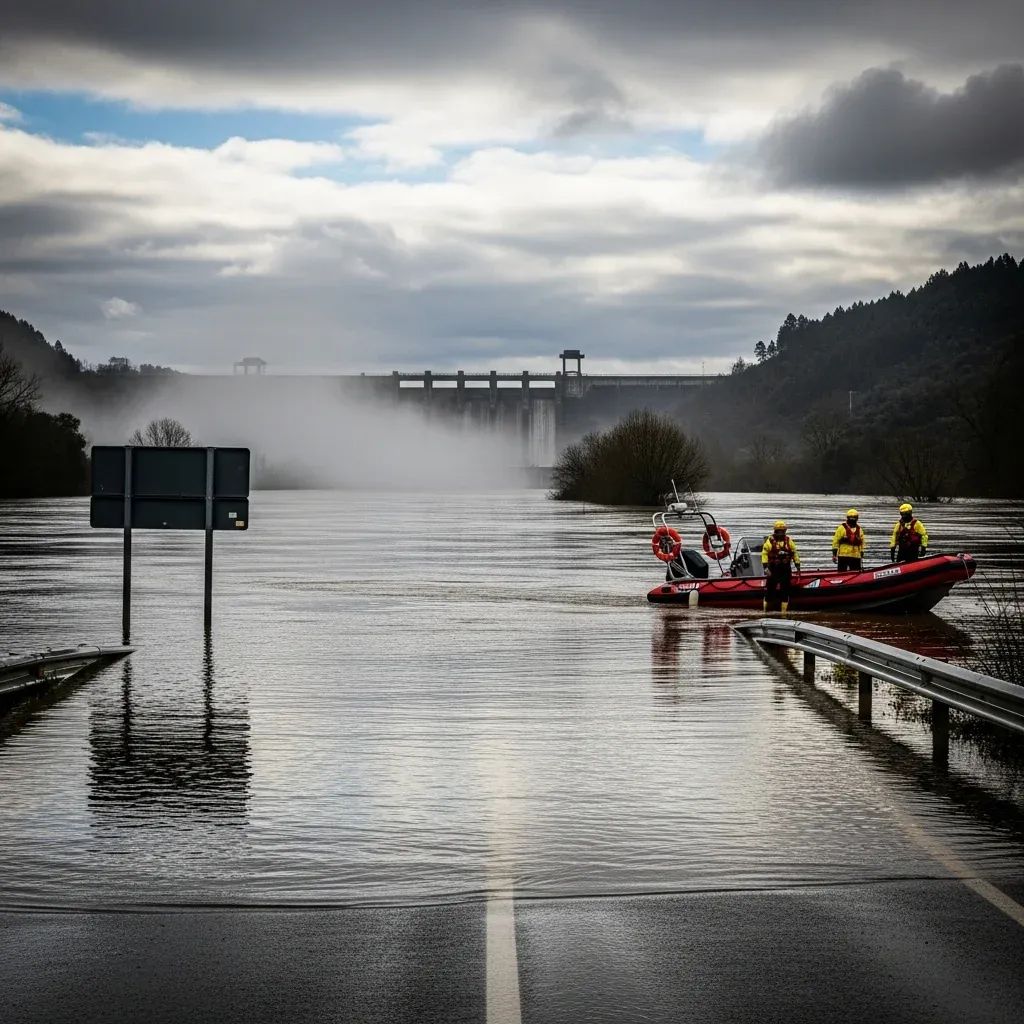

The Portugal Environment Ministry has unlocked €137M in emergency relief through its Environmental Fund, targeting municipalities still reeling from the catastrophic winter storms that killed 18 people and caused up to €6 billion in damage across central and coastal regions. The first official allocation of 2026 redirects existing budgets to address immediate reconstruction needs, river infrastructure repairs, and wildfire prevention. Prime Minister Luís Montenegro confirmed that reconstruction applications have already reached €115M in requested aid.
Why This Matters
• €35M flows immediately to town halls and inter-municipal bodies for emergency rebuilding of environmental assets damaged by flooding and dike failures.
• €13.6M earmarked for the Portuguese Environment Agency (APA) to repair breached dikes along the Mondego, Lis, and Tejo rivers.
• €61.6M reserved for forest firefighters under the Institute for Nature Conservation and Forests (ICNF), tasked with clearing storm debris before wildfire season begins.
• €27M in accelerated payments for waste management and circular economy projects, giving municipalities urgent cash flow.
The Storm Sequence That Devastated Portugal
Between late January and mid-February, a sequence of meteorological depressions — Kristin, Leonardo, and Marta — moved through mainland Portugal with winds exceeding 200 km/h and torrential rainfall. The district of Leiria suffered the most severe damage, with the capital alone tallying €792M in damages before final assessments were complete. Coimbra, Santarém, and Lisbon districts also experienced significant flooding, river overflow, and structural damage.
The death toll reached 18, with hundreds injured and displaced. Entire neighborhoods were evacuated as rivers breached their banks, and businesses across the region shuttered indefinitely. The Cabinet-appointed coordinator for the Central Region Reconstruction Mission, former Fundão mayor Paulo Fernandes, estimated total losses between €5 billion and €6 billion — making this the costliest natural disaster in Portugal's recorded history.
Initially, 68 municipalities were declared in a state of calamity. That figure expanded to 90 councils within weeks, and by late February, the government extended eligibility to all 308 Portuguese municipalities that could prove storm-related damage. This nationwide approach marks a departure from Portugal's traditional localized disaster response and reflects the scale of destruction.
How the Environmental Fund Is Being Deployed
Environment and Energy Minister Maria da Graça Carvalho emphasized the speed of the reallocation: "We redirected funds as quickly as possible to help municipalities recover from the storm effects," she stated in an official release. The Environmental Fund's inaugural 2026 dispatch carries an urgent designation, bypassing standard bureaucratic timelines to expedite disbursement.
The €35M municipal allocation covers emergency interventions, reconstruction, and rehabilitation of local environmental infrastructure — roads damaged by floods, public parks destroyed by wind, and water treatment facilities affected by overflowing rivers. Councils can access these resources without the usual multi-stage approval process.
The €13.6M for APA specifically addresses river management priorities exposed by the storms. Dikes along the Mondego, Lis, and Tejo suffered multiple breaches, affecting low-lying farmland and residential areas. APA engineers will reinforce these barriers and implement sustainable water management protocols designed to withstand future extreme weather.
The €61.6M wildfire prevention budget represents a dual-purpose investment. Forest firefighters under ICNF supervision will clear storm debris — fallen trees, uprooted vegetation, and accumulated biomass — that would otherwise fuel summer wildfires. Minister Carvalho noted that these sapadores florestais (forest sappers) must complete debris removal before the high fire-risk months of July and August.
The €27M in accelerated waste and circular economy payments gives municipalities immediate cash flow. Under normal circumstances, these disbursements follow quarterly or biannual schedules; the advance releases enable town halls to cover emergency expenses like debris removal, temporary housing, and infrastructure assessment without waiting for fiscal year appropriations.
Broader Government Response: €3.5B in Exceptional Measures
The Environmental Fund represents one component of the government's broader intervention. Prime Minister Luís Montenegro told Parliament that the government has mobilized €3.5 billion in exceptional support measures to date. Speaking to the Social Democratic Party (PSD) parliamentary group, Montenegro detailed the relief program's scope:
• 20,571 applications submitted for reconstruction of primary residences, totaling approximately €115M.
• 4,552 requests filed for financial support targeting households facing economic hardship.
• Mortgage moratoria in effect for homeowners and business credit lines.
• 5,852 applications for business treasury and reconstruction credit via the Portuguese Development Bank (BPF), which expanded its credit facilities to €3 billion. As of early March, €479M had been contracted for 2,587 requests, with another €269M in the contracting pipeline covering 736 additional petitions.
The government also implemented simplified unemployment schemes, Social Security contribution exemptions, and expedited processing for disaster-related claims. Montenegro highlighted that the Portugal Transformation, Recovery, and Resilience (PTRR) program is undergoing public consultation, with short-, medium-, and long-term interventions planned.
What This Means for Residents
If you live in one of the 90 initially declared calamity zones — or anywhere else in Portugal affected by the storms — you can now apply for reconstruction aid under the expanded eligibility framework. The government's late February decree extends protection to all municipalities and residents that can demonstrate storm-related damage, regardless of calamity classification.
For homeowners, the €115M in reconstruction applications indicates significant uptake of the primary residence repair program, though processing timelines should be confirmed with local authorities. The Portuguese National Association of Municipalities (ANMP) is collecting municipal input until March 19 to inform PTRR priorities, meaning final program details may be refined based on local feedback.
Business owners should note the BPF credit lines: with nearly €750M already contracted or in process for over 3,300 enterprises, demand is high. Early application is advisable, particularly for sectors like agriculture, tourism, and small manufacturing that experienced significant losses.
Renters and displaced families should contact local municipal authorities and social services. The 4,552 hardship applications represent available assistance, and temporary housing support remains available in affected districts. Cáritas Portugal, the Catholic relief organization, is also providing support services in impacted communities.
Forest Firefighters: A Pre-Emptive Strike
The €61.6M wildfire prevention allocation merits attention given Portugal's history with summer fires. The 2017 Pedrógão Grande fires highlighted the risks posed by unmanaged forest debris. The 2026 storms deposited significant volumes of biomass across central Portugal — material that requires clearance before the fire season intensifies.
ICNF's forest firefighters will conduct systematic debris removal over the coming months, clearing downed timber and vegetation from high-risk areas. This work also supports rural employment in municipalities where storm-related business disruptions created economic hardship.
The timing reflects operational necessity: Portugal's wildfire season typically intensifies from mid-June through September. Completing debris removal before late May creates safer landscape conditions before peak temperatures arrive.
Government Recovery Framework
The Portugal Transformation, Recovery, and Resilience (PTRR) program establishes the framework for recovery planning. The consultation period running until March 19 provides an opportunity for municipal associations and residents to contribute to program design. Municipal leaders have emphasized the need for efficient damage assessment processes and timely aid disbursement to minimize disruption to reconstruction efforts.
Prime Minister Montenegro's parliamentary updates have maintained focus on storm recovery, signaling that reconstruction will remain a legislative priority through the coming months. The decision to extend eligibility nationwide — rather than restrict aid to the original 90 councils — reflects the government's approach of providing support across all affected areas proportional to documented damage.