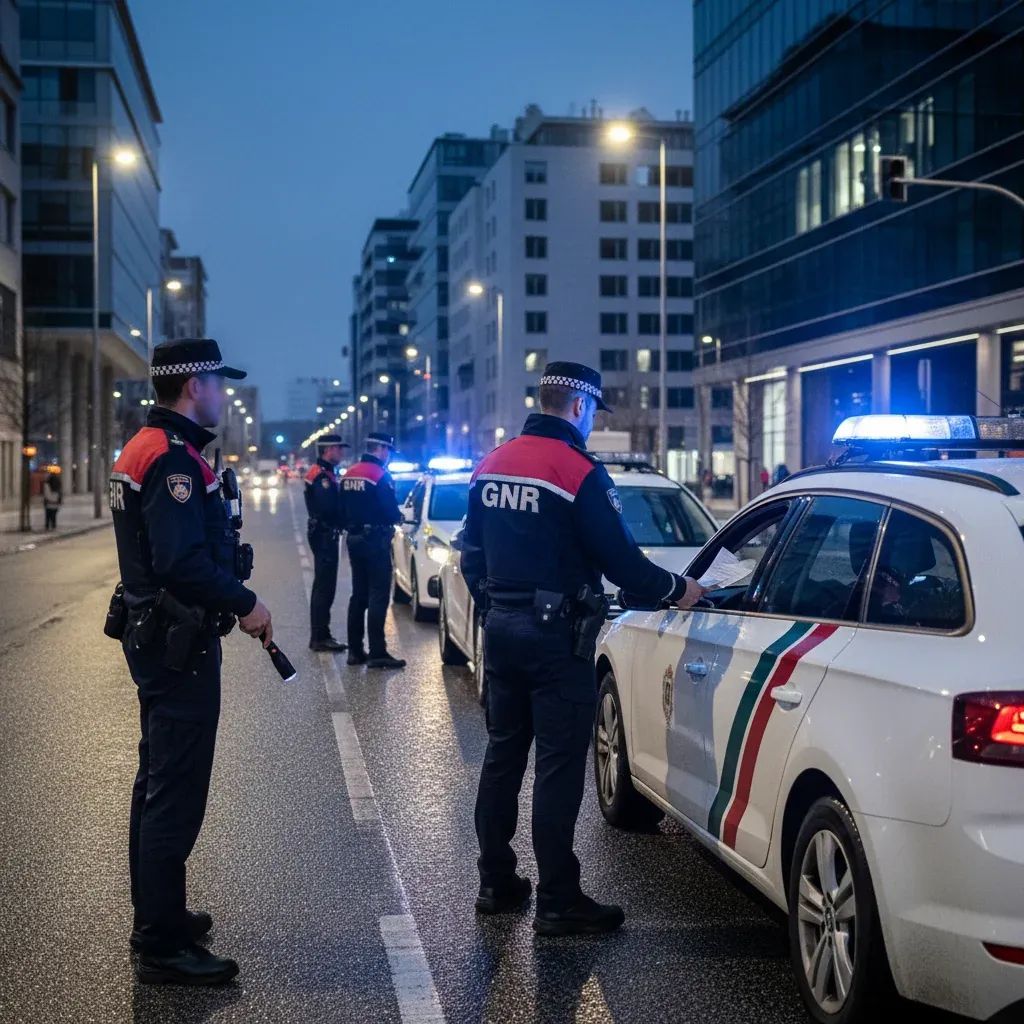
In mid-July 2026, Portuguese authorities concluded a week-long surge of anti-organized crime operations across the country, detaining 37 individuals and dismantling networks tied to drug trafficking, violent crime, and illegal hunting. The coordinated enforcement actions signal an escalation in tactical pressure on groups operating in suburban districts, rural Alentejo municipalities, and high-traffic tourist zones.
Seven suspects connected to a drug and weapons network in Barreiro—a suburb of Lisbon with persistent narcotics distribution problems—now face preventive detention (the most restrictive pre-trial measure available under Portuguese law). The PSP operation, executed on July 8 and disclosed publicly on July 14, netted more than 3,000 individual doses of crack cocaine and hashish, alongside a 9mm pistol, a revolver, and roughly 80 rounds of ammunition. Investigators recovered tools they believe were stockpiled for violent intimidation: hammers, a roll of barbed wire, and containers of alcohol.
Why This Matters
• Residents in Barreiro and Castro Verde lived under sustained exposure to organized traffickers; seven suspects are now in custody awaiting trial.
• Cross-agency coordination involved 111 officers from PSP and GNR units, including riot squads and criminal investigation nuclei.
• Drug pipeline disruption: Authorities seized over 700 doses of heroin, cocaine, and ecstasy in separate Alentejo and Castelo Branco raids.
• Preventive detention rate climbed: Of 37 detained, at least 10 suspects received immediate jail orders pending trial, reflecting judicial concern over flight risk and reoffense potential.
Drug Distribution Hubs Under Sustained Pressure
The GNR Territorial Command for Évora led the largest single operation, arresting 11 people—eight men and three women, aged 20 to 61—in Beja and Castro Verde during July 2026. The 18-month investigation culminated with nine arrest warrants and 12 search mandates (nine residential, three vehicle or commercial).
Officers confiscated:
• 619 doses of heroin
• 120 doses of hashish
• 35 doses of cannabis
• Two doses of methadone
• Three vehicles, four air rifles, a telescoping baton, and pepper spray
• Six precision scales and 22 mobile phones
• €2,048 in cash
Ten of the 11 suspects are scheduled for judicial hearings at the Almodôvar Court to determine pre-trial restrictions.
In Castelo Branco, a two-year GNR investigation targeting a 31-year-old man concluded with a significant seizure. Authorities say the suspect operated in densely populated urban zones frequented by young people, supplying both end-users and secondary distributors. The seizure included:
• 574 doses of hashish
• 232 doses of ecstasy
• 195 doses of cocaine
• 33 doses of amphetamines
• 29 doses of MDMA
• Three doses of marijuana
• 19 LSD stamps
A judge ordered preventive detention; the suspect is held at the local correctional facility.
The Barreiro Network: Under PSP surveillance since June 2025, this network drew particular attention for its proximity to commercial establishments and residential areas. Technical units recovered 10 canisters of nitrous oxide (a substance that can facilitate crack cocaine production), an electric stove, and ammonia. Five televisions and six electric scooters were also seized, items prosecutors may argue represent proceeds of crime. Two of the nine detained individuals were arrested in flagrante delicto during home searches.
Impact on Residents and Local Security
For communities in Setúbal district—which includes Barreiro—and the rural Alentejo, the operations remove networks that had embedded themselves in daily life. Internal security data from 2025 flagged Barreiro as a "critical point" for violent offenses tied to narcotics, including kidnappings and assaults. The PSP statement emphasized that dismantling the group will "reinforce the sense of security" for residents and protect the commercial fabric of the municipality.
Residents of Beja and Castro Verde faced similar concerns. The 18-month GNR probe revealed an organized distribution ring with logistics spanning both municipalities, using multiple vehicles and rotating safe houses. The recovery of weapons—primarily air rifles—points to the potential for intimidation tactics within the network.
National Context: Portugal's 2025 Internal Security Annual Report, published in March 2026, recorded 365,802 criminal complaints, up 3.1% year-on-year. While overall violent and serious crime decreased by 1.6% in 2025, cocaine seizures surged 20.6%, reaching 25.63 tonnes. Authorities attribute the increase partly to improved enforcement, but also acknowledge that trafficking organizations are adapting routes and recruitment strategies. Brazil remains the principal cocaine entry vector, with 95% of seizures occurring via maritime channels, particularly around the Azores and Madeira.
Parallel Enforcement Actions: Theft, Domestic Violence, and Environmental Crime
Outside narcotics cases, authorities executed targeted arrests across multiple crime categories in July 2026:
Elderly Theft Ring Dismantled in Manteigas: GNR officers from the Guarda Territorial Command intercepted a vehicle minutes after a 74-year-old woman reported the theft of two gold necklaces. Inside, investigators found the stolen jewelry plus additional gold pieces linked to ongoing investigations in other districts.
The operation recovered:
• Items valued at €2,500
• €1,249 in cash and US$52
• Two mobile phones
• One passenger vehicle
The suspects—a 44-year-old man and a 45-year-old woman—have prior convictions for similar offenses in Spain. Both received preventive detention orders.
Domestic Violence Arrests in Aljustrel and Serpa: The GNR's Specialized Investigation and Victim Support Unit (NIAVE) detained two individuals in July 2026:
• A 33-year-old woman in Aljustrel, charged with sustained psychological and physical abuse against her mother. She received preventive detention and a no-contact order.
• A 57-year-old man in Serpa, charged with abuse against his mother. He faces a 500-meter exclusion radius from the victim's residence.
Illegal Hunting Operation in Ansião: SEPNA environmental officers seized equipment on a property in Ansião, Leiria district:
• 23 trap-door snares
• 17 steel cable snares
• Five lethal "cepo" traps (traditional spring traps)
The 59-year-old landowner, who has prior convictions for environmental offenses, had constructed artificial ponds and feeding stations to lure game birds. Officers recovered eight protected and game species—including turtle doves, rollers, and goldfinches—and returned two stolen hunting dogs (a Beagle and an English Setter) to their owners. The case has been forwarded to the Pombal Judicial Court.
Counterfeit Jersey Seizure in the Algarve: With the 2026 Football World Cup underway, GNR customs units intercepted parcel shipments containing:
• 999 counterfeit sports jerseys
• 437 pairs of sunglasses
• Other branded items valued at approximately €14,125
The operation targeted distribution companies moving goods domestically. Authorities filed five official reports under the Industrial Property Code, warning that counterfeit purchases fuel tax evasion networks and undermine legitimate retailers.
What This Means for Residents
These operations represent intensified but routine enforcement. For residents in affected areas, the removal of active trafficking networks may reduce street-level drug activity. However, as a transshipment hub, Portugal often sees new networks emerge as established ones are dismantled. Continue standard safety precautions and report suspicious activity.
For expats and long-term residents in affected areas:
• Neighborhood safety perception may improve in Barreiro, Beja, and Castro Verde as active traffickers are removed from circulation.
• Judicial timelines will extend: Preventive detention can last months pending trial, signaling prosecutors' confidence in evidence strength.
• Reporting channels remain open: The GNR's SOS Environment and Territory hotline (808 200 520) operates 24/7 for environmental crimes; call 112 for emergencies or contact local PSP/GNR posts for other offenses.
• Economic impact: Counterfeit goods seizures protect legitimate retailers, but also highlight the scale of informal commerce around major sporting events.
Broader Enforcement Trends
The July 2026 operations fit within a larger pattern documented in 2025 and early 2026. The PSP's first-quarter 2026 activity report showed a 30% increase in search warrants (residential and non-residential) compared to Q1 2025, with 870 suspects detained—an 8% rise. Seizures included significant cocaine, heroin, and hashish volumes, plus over €1M in cash linked to criminal proceeds.
The "Portugal Always Safe 2026" multi-agency campaign, involving PSP, GNR, Judicial Police, Maritime Police, tax authorities, and immigration services, conducted sweeps in March and June 2026. The June operation alone recorded 111 crimes and 76 arrests, with focus on road offenses and narcotics. Authorities inspected 2,527 foreign nationals, identifying 41 in irregular status.
Despite these efforts, Portugal faces persistent challenges. Homicides reached a seven-year peak in 2025 with 108 cases, and crimes against elderly victims rose 30.5% between 2020 and 2025, reaching 44,161 incidents. Fraud and property theft remain the most common offenses against seniors.
A February 2026 European Drug Report noted that trafficking networks are diversifying routes and exploiting vulnerable youth faster than interdiction efforts can adapt. Portugal's geographic position—with Atlantic coastlines ideal for maritime smuggling and proximity to major European consumer markets—sustains its role as a transshipment hub.
Accountability and Next Steps
All 37 individuals detained across the July operations have undergone or are awaiting first judicial interrogations. Pre-trial detention decisions rest with investigating judges who assess flight risk, evidence tampering potential, and public safety concerns. The Barreiro cases are under the jurisdiction of the Setúbal district court system; Alentejo cases are split between Almodôvar, Beja, and Ourique courts depending on the municipality.
The PSP and GNR have committed to publishing quarterly enforcement metrics, with the next update expected in October 2026. Residents seeking crime statistics for their municipality can consult the annual Internal Security Report (RASI), typically released each March covering the prior calendar year.
For now, the immediate result is clear: dozens of suspects tied to organized networks are off the streets, and investigators have disrupted supply chains that had operated for months—in some cases, years. Whether that translates to sustained reductions in violent crime and drug availability will depend on judicial outcomes, prison capacity, and the ability of traffickers to rebuild logistics under increased surveillance.