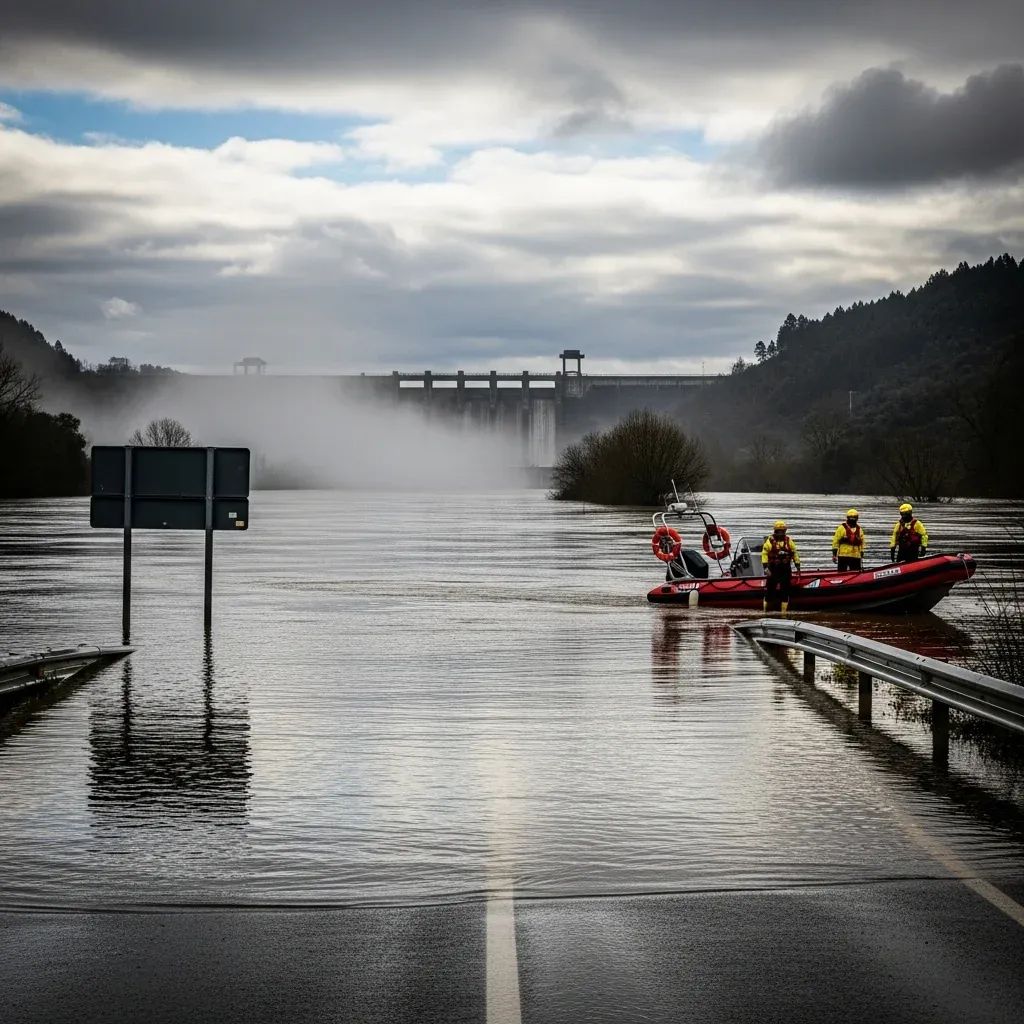
The Portugal Environmental Agency (APA) and the Portugal Order of Engineers have formally appointed a five-member expert panel to investigate the February 2026 dike rupture in the Mondego River Basin. The panel's mandate is to recommend a new co-management model that could distribute flood prevention costs and responsibilities among regional municipalities, economic stakeholders, and state agencies.
The technical commission, officially sworn in on March 20 in Coimbra, will operate under a 100-day deadline, delivering a preliminary assessment by May 9. The initiative responds to catastrophic flooding triggered by storms Ingrid, Joseph, Kristin, Leonardo, Marta, and two frontal systems from depression Nils—events that breached the central channel dike near the A1 motorway viaduct at Casais, cutting off the highway and submerging agricultural fields across the Lower Mondego floodplain.
Why This Matters
• Municipalities could potentially share flood infrastructure costs through a proposed participatory co-governance model if the panel recommends this approach and authorities approve it.
• Farmers and industrial users depending on the 12,000-hectare irrigation system may face potential fee restructuring to fund preventive maintenance, depending on the panel's recommendations and subsequent policy decisions.
• Residents in Coimbra, Montemor-o-Velho, Figueira da Foz, Soure, and Condeixa-a-Nova are expected to receive updated flood risk maps and emergency protocols within four months as part of the investigation.
• Climate adaptation requirements could potentially trigger mandatory upgrades to century-old hydraulic structures, which may influence property insurance premiums in flood zones if such upgrades are recommended and implemented.
The Specialist Panel
Coordinating the inquiry is Armando Baptista da Silva Afonso, a sanitary engineering specialist and advisory council member at the Order of Engineers. His team comprises José Alfeu Sá Marques (hydraulics and sanitation), Nuno Eduardo da Cruz Simões (hydraulics), Carla Andreia Pimentel Rodrigues (hydraulics), and Paulo José da Venda Oliveira (geotechnics)—a multidisciplinary lineup reflecting the complexity of the basin's challenges.
The panel's appointment stems from a February 27 protocol between APA and the engineering body, signed three weeks after emergency crews completed provisional repairs to the ruptured embankment. Prime Minister Luís Montenegro had publicly warned that intense precipitation forecasts raised the specter of additional breaches, underscoring the urgency of a systemic review.
Three Floods, One Pattern
The commission's core mandate includes a comparative analysis of the 2026 failure against predecessor disasters in 2001 and 2019—events that exposed recurring weaknesses in the Mondego's flood defense network.
The 2001 catastrophe remains Portugal's most severe hydraulic infrastructure failure. The Aguieira Dam released approximately 1,000 cubic meters per second for 24 hours—precisely when it should have been retaining the flood peak. Spillways designed to divert surplus water onto designated overflow fields malfunctioned, communication delays hampered emergency response, and sediment accumulation had already reduced the river's discharge capacity. A dike rupture occurred in the same geographic zone as 2026, though on the opposite bank.
By 2019, dam operations had improved—the Aguieira's performance drew no criticism—but the fundamental problem persisted: chronic sedimentation and deferred maintenance left sections of the embankment network at uneven elevations, creating weak points. Professor Fernando Seabra Santos attributed the recurring cycle to "human negligence," pointing to the absence of regular dredging schedules and preventive upkeep. The 2019 breach affected the right bank in a limited area, foreshadowing the 2026 rupture in adjacent territory.
Common threads across all three episodes include elevated discharge volumes from prolonged rainfall, riverbed sedimentation that narrows flow channels, infrastructure aging without corresponding maintenance investment, and localized low-point vulnerabilities in the dike system where failure initiates. Natural causes—exceptional precipitation and structural aging—compound technical shortcomings such as design flaws and material degradation, while human factors ranging from inadequate pre-construction studies to deficient ongoing supervision amplify risk.
What This Means for Residents
The expert panel's investigative assignment extends beyond forensic analysis. Their most consequential deliverable will be a governance recommendation for the Lower Mondego Hydraulic Project—the 36-kilometer system of dikes, pumping stations (including the Foja station), the Açude-Ponte de Coimbra weir, and upstream reservoirs (Aguieira, Raiva, Fronhas) that collectively protect populations, regulate flows, irrigate farmland, supply drinking water to Figueira da Foz, and support industrial operations.
The panel is tasked with proposing a participatory co-management framework that could secure stable financing for preventive conservation by distributing responsibility among municipalities, regional entities, and economic operators. For decades, flood defense funding has remained centralized within APA, with predictable results: maintenance cycles stretched, dredging deferred, and repair budgets allocated reactively after disasters rather than proactively.
Under a potential co-management model—if recommended and adopted by authorities—local governments whose jurisdictions benefit from flood protection might contribute proportionate funding, likely drawn from municipal budgets or dedicated levies. Agricultural and industrial water users—currently paying irrigation and abstraction fees—could potentially face revised tariff structures reflecting the true cost of maintaining the hydraulic network, though this remains subject to policy review and approval. This approach mirrors European Union water policy principles that assign costs to beneficiaries rather than taxpayers at large.
For property owners in the five affected municipalities—Coimbra, Montemor-o-Velho, Figueira da Foz, Soure, and Condeixa-a-Nova—any governance overhaul resulting from the panel's recommendations could potentially influence flood insurance premiums, as insurers may reassess risk profiles based on updated maintenance commitments and climate-adjusted infrastructure standards.
Climate Pressure on Century-Old Systems
The panel must also evaluate whether existing structures can withstand climate change projections specific to the Mondego Basin. Regional climate models forecast decreased annual precipitation but intensified winter rainfall events, paradoxically raising flood probability even as water scarcity worsens in summer months.
Sedimentation dynamics are expected to accelerate. Research indicates significant annual sediment accumulation upstream of the Açude-Ponte de Coimbra, with one study quantifying deposits that steadily reduce channel capacity. Traditional dredging proves costly, environmentally disruptive, and requires frequent repetition—prompting engineers to explore potential sedimentation basins (low-height weirs or dams) on the Mondego itself and its tributary, the Ceira River. These structures could trap sediments upstream, potentially extending maintenance intervals and reducing ecological impact.
The February 2026 breach highlighted how soil saturation and exceptional rainfall volumes can overwhelm even well-designed defenses. The panel's task includes determining whether the Lower Mondego's infrastructure requires fundamental redesign—raising dike elevations, reinforcing vulnerable sections, upgrading spillway capacities—or whether improved operational protocols and maintenance regimes might suffice.
Timeline and Transparency
President of APA José Pimenta Machado and Order of Engineers president Fernando de Almeida Santos jointly presided over the March 20 swearing-in ceremony in Coimbra, signaling institutional commitment to the process. The 100-day countdown began immediately, with the May 9 preliminary report serving as a midpoint checkpoint before final recommendations.
The protocol explicitly requires the panel to propose a governance model framework that could ensure continuous maintenance funding through co-management, with the goal of breaking the cycle of deferred upkeep that has characterized the system for decades. Whether municipalities possess the fiscal capacity—or political will—to shoulder partial responsibility, should such recommendations be adopted, remains an open question. Local budgets already strain under inflation and competing infrastructure demands.
Any governance changes resulting from the panel's recommendations would require approval and implementation by relevant authorities before becoming policy. The investigation unfolds against a backdrop of accelerating climate volatility and aging hydraulic networks across Portugal. The Mondego commission's conclusions will likely inform flood management strategies far beyond the river valley, potentially establishing precedents for shared governance and climate-adaptive infrastructure financing that could reshape water policy nationwide.