

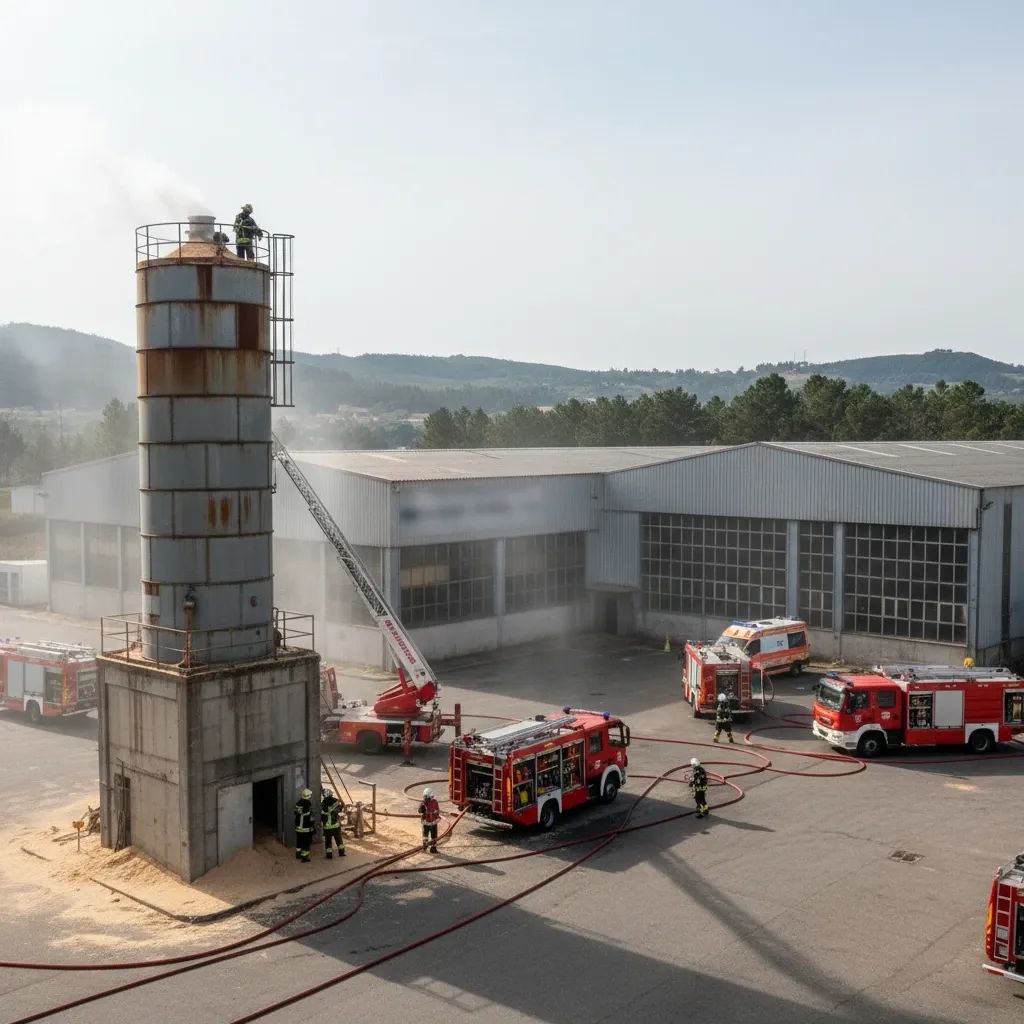
A warehouse blaze at a recycling facility in Montemor-o-Novo, located in Portugal's Alentejo Central region, has injured five firefighters and raised questions about industrial fire safety in waste management operations. The incident, which began Thursday evening at 6:07 PM and took over five hours to bring under control, consumed plastic and flammable materials before spreading to adjacent scrubland.
The Portugal Sub-Regional Emergency and Civil Protection Command for Alentejo Central confirmed yesterday morning that the fire at Gestão de Resíduos JM Magro—a recycling company operating in the Zona Industrial da Adua—entered resolution phase at 11:26 PM Thursday. By 5 AM Friday, 38 firefighters and 15 vehicles remained on scene conducting consolidation and surveillance work to prevent rekindling.
Five Firefighters Injured in Extended Operation
The human cost of the operation highlights the risks facing emergency responders tackling industrial fires. Among the casualties, three firefighters sustained minor injuries, while two required on-site medical assistance for smoke inhalation. The nature of the injuries to the three firefighters with minor injuries was not detailed by authorities.
At the height of the emergency, 73 firefighters and 28 vehicles from multiple regional fire brigades coordinated the response. The intensity of the operation stemmed from the nature of materials involved—recycled plastics and other combustible substances stored at the facility created both thick smoke and complex suppression challenges.
The secondary fire that jumped to nearby scrubland was contained relatively quickly. The Portugal Civil Protection authority mobilized 36 personnel, 8 ground vehicles, and one aerial unit—a firefighting aircraft equipped for water and retardant drops—to that front, bringing it under control by 6:52 PM—just 24 minutes after the brush fire alert at 6:28 PM.
What This Means for Local Residents and Environment
For people living in and around Montemor-o-Novo, the incident raises immediate environmental and health concerns. Burning plastic releases toxic compounds including dioxins and furans, which can persist in soil and water. While no air quality warnings have been issued as of this morning, residents downwind of the industrial zone should monitor for respiratory irritation and report symptoms to health authorities.
The Montemor-o-Novo Municipal Council stated via Facebook that the cause of the fire remains unknown and that relevant authorities continue monitoring the situation. The municipality emphasized that work would continue "for several hours" given the operation's scale, but provided no timeline for when the site would be declared safe or when damage assessments would be completed.
Company Background and Industry Context
Gestão de Resíduos JM Magro has operated for approximately two decades in environmental waste management, initially focusing on ferrous and non-ferrous metal collection and trade before expanding into cardboard, paper, and plastic recycling. The company also conducts demolition work and manages non-hazardous waste streams.
According to company materials, JM Magro invests in "cutting-edge technologies" and commits to environmental legislation compliance. However, public records do not indicate whether the facility had prior fire incidents or detail specific fire suppression systems installed at the warehouse beyond general regulatory compliance.
This is not the first time recycling facilities in Portugal have experienced major fires. The concentration of combustible materials—particularly plastics, cardboard, and paper—combined with industrial machinery creates elevated fire risk. In 2023, a similar incident at a waste facility in the Lisbon metropolitan area burned for three days before being fully extinguished.
Ongoing Investigation and Prevention Challenges
Portugal Civil Protection has warned about rekindle risk given weather conditions and material types involved. The agency stressed the importance of maintaining clean and monitored industrial zones and adjacent vegetation areas—a particular concern as Portugal enters the summer fire season.
With the cause still under investigation, several possibilities remain on the table: spontaneous combustion from heat buildup in plastic bales, electrical faults in sorting machinery, or human error during operations. Industrial fires at recycling centers have increasingly become a regulatory focus across the European Union, with new directives requiring enhanced fire detection systems and material segregation protocols.
The Alentejo Central region, known more for agricultural production and cork forests than heavy industry, has limited industrial firefighting infrastructure compared to Portugal's northern manufacturing corridor. This incident may prompt regional authorities to review emergency response capacity for industrial hazards.
What Happens Next
As of Friday morning, no evacuation orders have been issued and no residential areas appear threatened. The facility itself faces an uncertain timeline for resuming operations, pending investigation findings and structural safety assessments. Damage totals have not been calculated, but the extended burn time and material losses likely run into the hundreds of thousands of euros.
For Montemor-o-Novo's 17,000 residents, the most pressing question is whether environmental contamination from burned plastics will affect local water sources or agricultural land. The Portuguese Environment Agency has not yet issued testing protocols or results, though soil and water sampling near the industrial zone would be standard procedure following such incidents.
Local business owners and residents can expect continued road disruptions around the Zona Industrial da Adua as heavy equipment removes damaged materials and investigators document the scene. The municipality has not announced public meetings or information sessions regarding the incident.
The fire serves as a reminder that Portugal's transition toward circular economy goals—including increased recycling capacity—brings industrial hazards that require robust safety protocols and emergency preparedness. As recycling volumes grow nationwide, incidents like this may test whether oversight and fire prevention measures are keeping pace with industry expansion.


