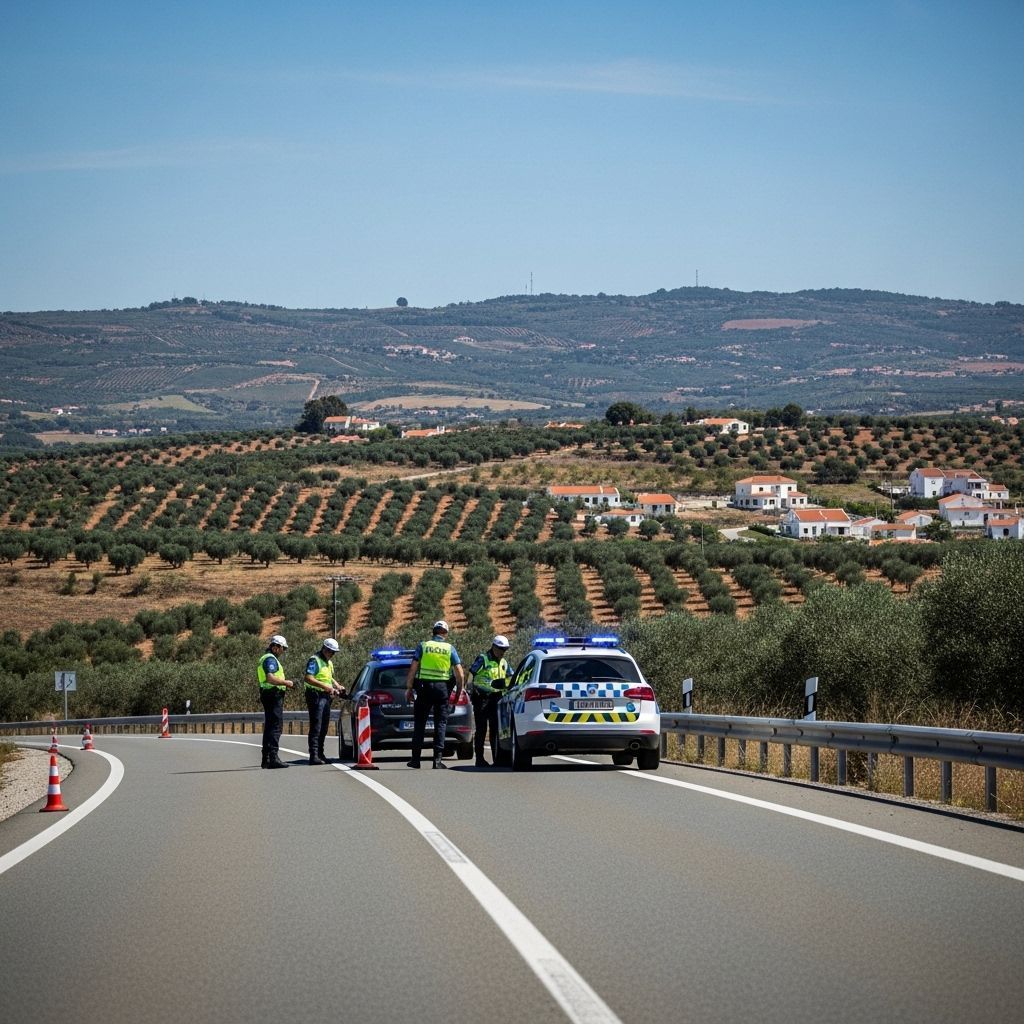
The Portugal Public Security Police (PSP) faces a staffing crisis that unions say the government is masking with misleading math. While Prime Minister Luís Montenegro touts a reinforcement of 400 new officers for Lisbon and Porto's metropolitan commands this year, the country's largest police union warns the numbers don't add up—and that Portugal's streets will actually see fewer officers patrolling them by year's end.
Why This Matters
• Net loss of officers: 900 retirements projected in 2026 against only 570 graduates plus 683 new recruits (subject to further reductions).
• Real-world impact: The union predicts "unprecedented operational emptying" of police capacity in Lisbon and Porto.
• Allocation strain: Government plans simultaneously assign 200 officers to municipal forces and 300 to airports—commitments that compete with street patrol needs.
The Union's Numbers Challenge
The Associação Sindical dos Profissionais da Polícia (ASPP/PSP) released a blistering statement accusing the government of a "mathematical error" or, more pointedly, a "narrative of convenience" that ignores ground-level realities. The core of their argument: you can't call it reinforcement when departures exceed arrivals.
Here's the arithmetic the union laid out: Portugal's government has committed to placing 200 new PSP officers in Lisbon and Porto's municipal police forces, another 300 at airports, and the headline 400 for metropolitan commands. That's a theoretical intake of 900 officers. But the training pipeline can't deliver those numbers. One academy cohort finishing this month graduates just 570 students, and a recent recruitment competition approved only 683 candidates—a figure the union says will shrink further as applicants drop out or fail vetting.
Meanwhile, 900 PSP professionals are eligible for retirement in 2026, a wave of departures driven by an aging force. Nearly half of Portugal's 19,661 police officers are over 45 years old, with the largest concentration in the 50-54 age bracket. Successive governments have blocked roughly 5,000 officers eligible for early retirement from leaving, a stopgap measure that has temporarily masked the hemorrhaging of personnel but done nothing to address the underlying crisis.
The union's conclusion: the government is engaging in "scarcity management," not genuine reinforcement, and the result will be a net staffing deficit that leaves Portugal's urban centers more vulnerable.
What the Government Says
Prime Minister Montenegro's office has framed the 400-officer deployment as part of a broader security modernization strategy. Officials point to two training courses concluding in the first and second halves of 2026 as the source of the new officers, with 200 assigned to Lisbon's metropolitan command and 200 to Porto's.
Beyond raw numbers, the government is banking on a reorganization of PSP stations in Lisbon, Porto, and Setúbal designed to free up approximately 500 officers currently stuck in administrative roles and redirect them to street patrols. The rationale: technology and process digitization can replace human hours spent on paperwork, boosting operational capacity without hiring a single new recruit.
The Portugal Ministry of Internal Administration has also highlighted a surge in recruitment interest. More than 4,000 candidates applied for the latest PSP entrance exam—the highest figure in five years—and the next training course, slated to begin in late June, is expected to enroll 800 trainees. Officials argue this signals renewed public interest in police work and validates recent reforms to admission criteria.
What This Means for Residents
For anyone living in Lisbon, Porto, or their surrounding metropolitan areas, the gap between political messaging and operational reality has tangible consequences. Fewer officers on the street translates directly into longer response times, reduced visible patrols in high-crime neighborhoods, and diminished capacity for proactive policing.
The ASPP/PSP has documented what it calls "widespread abuse in cutting rest days," a practice that results in officer exhaustion, burnout, and compromised public safety. When a force is chronically understaffed, individual officers shoulder impossible caseloads, and mistakes multiply. The union warns that 2026 could see the largest operational deficit in PSP history, a scenario with immediate implications for anyone relying on police services.
Residents should also understand the knock-on effects of reallocating officers to municipal forces and airports. While those deployments address specific security needs—Lisbon and Porto municipal police require PSP support to manage local enforcement, and airport security has been a priority since passenger volumes rebounded post-pandemic—they come at the expense of traditional beat patrols and rapid-response units. The government's pledge to redeploy 500 administrative staff to street duty may offset some losses, but union officials are skeptical that technology alone can replace experienced personnel.
The Broader Staffing Crisis
Portugal's police staffing problem isn't new, but it accelerated sharply in 2025. The PSP lost 437 officers that year, with 895 departures against only 458 new hires—the steepest decline among Portugal's security forces. Roughly 100 officers per year request voluntary discharge or suspension from the PSP, a figure that underscores low morale and dissatisfaction with working conditions.
The Sindicato Nacional dos Oficiais de Polícia (SNOP) and other professional associations have called for structural reforms, not incremental fixes. Their wish list includes:
• Career valorization: Competitive salaries, improved benefits, and a serious effort to dignify police work as a profession.
• Long-term hiring targets: The PSP director proposed in 2025 that Portugal needs 3,500 to 5,000 additional officers over the next 5-15 years to reach an optimal force of 23,500 to 25,000.
• Infrastructure investment: Completing 50 planned upgrades to PSP and GNR (National Republican Guard) facilities, plus sustained spending on equipment and technology.
• Civilian administrative staff: Hiring non-police personnel for clerical and logistical roles to free sworn officers for operational duty.
• Mental health support: Establishing psychological services, trauma prevention programs, and expedited healthcare access for active officers.
Experts also urge the government to stop blocking early retirements, a policy they say is unsustainable and demoralizing. Forcing 5,000 officers to remain on duty when they're eligible to leave creates a culture of resentment and does nothing to attract younger recruits.
The Political Backdrop
The spat between the ASPP/PSP and Montenegro's administration is part of a longer-running dispute over 2024 agreements on career advancement and salary supplements that the union claims have not been honored. The ASPP has organized protests, including plenaries at Lisbon Airport, and has threatened further demonstrations if negotiations stall.
For the government, the challenge is balancing fiscal discipline with the urgent need to rebuild police capacity. Training and equipping a new officer costs tens of thousands of euros, and expanding the force by several thousand would require sustained budget increases at a time when Portugal faces competing demands on public spending. The administration's bet is that streamlining operations and leveraging technology can buy time while recruitment catches up to attrition.
The union, however, insists that half-measures will only deepen the crisis. "What the government calls reinforcement," the ASPP statement concluded, "is actually a managed decline."
What Happens Next
Residents should watch for concrete outcomes in the coming months. The 570 graduates completing their training course this month will be the first test of the government's deployment plan. If they're distributed as promised—200 to Lisbon, 200 to Porto, with the remainder filling gaps elsewhere—visible patrols in both cities should increase by early summer.
The second cohort, expected to finish training by year's end, will determine whether the government can deliver the full 400-officer commitment. Meanwhile, the reorganization of station duties in Lisbon, Porto, and Setúbal should be underway; if those 500 officers are successfully reassigned to street roles, the staffing picture improves marginally.
But the union's core argument remains unrefuted: 900 retirements in a single year is a structural shock that no amount of spin can paper over. Unless recruitment surges beyond current projections—and unless Portugal makes police work attractive enough to retain experienced officers—the arithmetic points toward fewer, not more, police on the ground.
For now, the debate over Portugal's police numbers is as much about political credibility as public safety. The government insists it's investing in modern, efficient law enforcement. The union says it's watching a slow-motion collapse. Residents, caught in the middle, will judge the outcome not by press releases but by the presence—or absence—of patrol cars in their neighborhoods.