
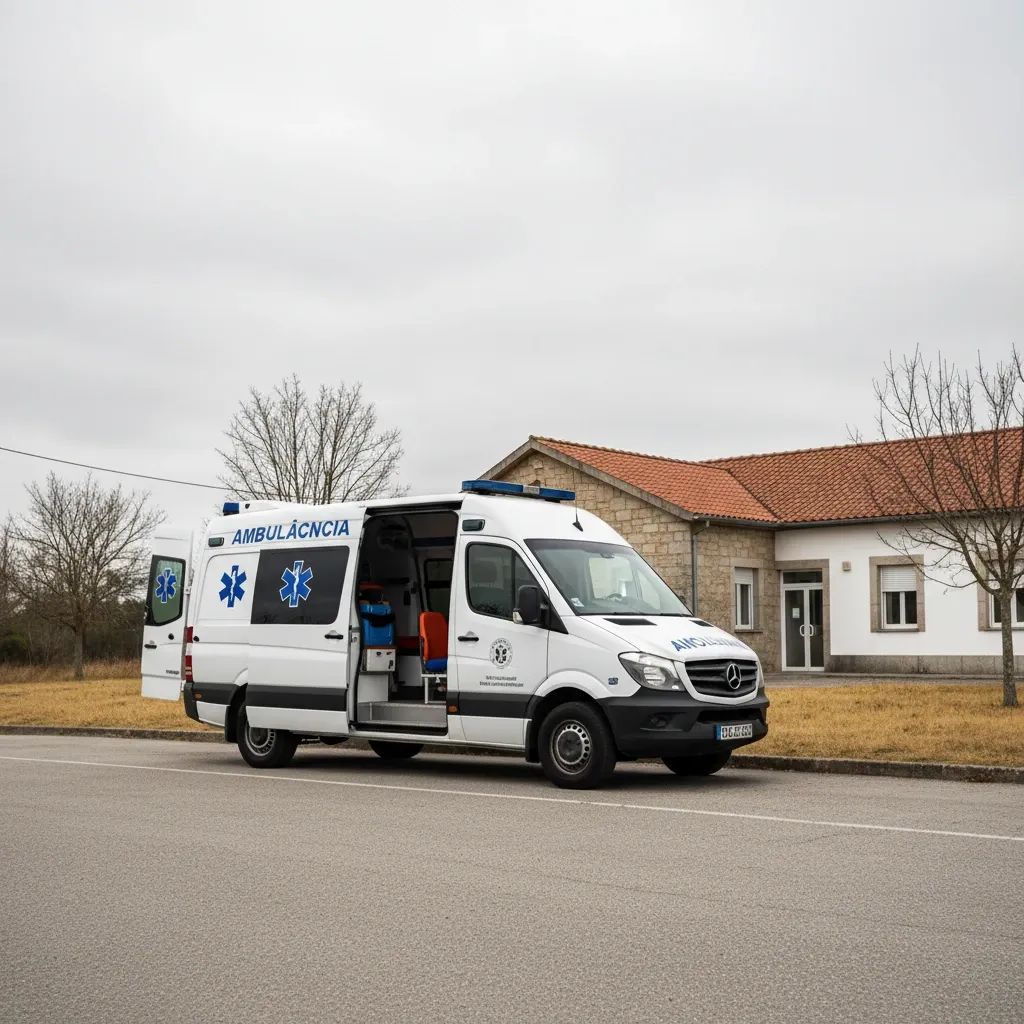
When Dispatch Algorithms Fail: Portugal's Emergency System at a Turning Point
A 48-year-old man collapsed on a street in Caldas das Taipas, Guimarães, on Saturday, July 11, 2026, suffering sudden cardiac arrest. The nearest fire station with full medical equipment and trained personnel sat just 3 to 5 minutes away. That station never arrived. Instead, a dispatcher routed an ambulance from across town—14 minutes distant. By the time it reached him at 13:26, he was dead. This wasn't administrative inconvenience; it was a systematic failure that has forced Portugal's entire emergency medical infrastructure into urgent public reckoning.
Why This Matters
• The 9-minute gap matters for survival: Cardiac arrest patients lose approximately 10% of their neurological survival chances per minute without intervention. The difference between a 5-minute local response and a 14-minute distant one often determines recovery versus death.
• This reveals ongoing systemic dysfunction: Both Portugal's firefighters union and paramedic association characterize the dispatch error as symptomatic of deeper institutional breakdown, not isolated operator error.
• Government has legislated structural overhaul, but timing creates questions: A comprehensive reorganization of INEM was approved in May 2026 and enacted into law in July 2026. However, the Taipas incident occurred on July 11—raising questions about whether reforms had been operationally implemented at the time of the call. Early implementation of new protocols was still underway when this death occurred.
The Dispatch Decision That Went Wrong
The Centro de Orientação de Doentes Urgentes (CODU), Portugal's central emergency dispatch hub, received the cardiac arrest call at 12:52 p.m. The system should have been straightforward. The Bombeiros Voluntários das Taipas—the local volunteer fire brigade—had direct operational responsibility for that neighborhood. Their commander, José Augusto Ferreira, later confirmed the station was fully staffed and equipped that Saturday afternoon.
Yet at 12:55 p.m., the dispatcher activated units from Bombeiros Voluntários de Guimarães, located roughly 9 kilometers away. A Medical Emergency Resuscitation Vehicle (VMER) was also dispatched from the same distant location at the same moment. The dispatch log shows a critical mismatch: the system routed responders away from the nearest resource.
Why? INEM has not publicly explained the routing logic. An internal investigation was announced but findings remain undisclosed as of mid-July 2026. The Health Ministry, led by Ana Paula Martins, signaled it would await formal clarification from INEM's leadership before issuing public analysis. That restrained response may reflect genuine investigation protocol or political calculation—avoiding premature judgment of an institute undergoing institutional transition.
What is documented: by 13:05 p.m., when the VMER team finally arrived, the man was already in irreversible decline. Clinical confirmation of death came at 13:26. The local crew that could have arrived within five minutes never received a dispatch order.
Professional Groups Reject "Isolated Incident" Framing
The Fénix National Association of Firefighters and Civil Protection Agents issued an urgent statement demanding immediate institutional accountability, explicitly rejecting any suggestion this represented a one-off dispatcher error. The association emphasized that pre-hospital emergency response is a core state function—not something that should depend on "management failures, coordination breakdowns, organizational limitations, or decisions that compromise the fundamental principle of delivering adequate, timely, and technically appropriate care."
"When an emergency system fails, a delayed ambulance is only part of the problem," the statement read. "What fractures is citizen confidence, population safety, and public institutional credibility." The association called the pattern revealing: INEM exists in a state of profound institutional and operational fragility, the accumulated result of strategic underinvestment, absent structural reform, and inability to handle contemporary pre-hospital demands.
ANTEM, the National Association of Emergency Medical Technicians, issued parallel warnings characterizing the Taipas death as "another alarming indicator" of systemic collapse within Portugal's Integrated Medical Emergency System. ANTEM rejected the premise that INEM's problems are episodic or occasional, arguing instead that they reflect years of erratic decision-making and structural degradation without remedy.
Both organizations demanded three specific outcomes: public disclosure of the dispatch decision process; publication of INEM's investigation conclusions; and an independent external audit of the institute's operational capacity.
The Backdrop: Years of Documented Dysfunction
The Taipas incident did not occur in vacuum. An independent technical audit published in July 2025 covering the period 2021–2024 documented severe operational constraints. The report found that 73.4% of ambulance downtime resulted from insufficient staffing rather than vehicle maintenance failure. It also flagged command deficiencies, control breakdowns, and mission drift within INEM's governance structure.
More recently, during the first five months of 2026, INEM failed to meet its eight-minute response target in roughly 40% of priority-one emergency calls. Average arrival times stretched to approximately 14 minutes—precisely the window that proved fatal in Taipas.
On the day of the Taipas death itself, Portugal's pre-hospital emergency technician union (STEPH) reported a parallel crisis: INEM's newly upgraded computer systems at dispatch centers experienced a major failure. Call handlers reverted to manual logbooks. At one point, 57 emergency calls were queued awaiting triage. The union alleged that one ambulance crew was pulled from active service to reinforce telephone reception. INEM categorically denied these specific allegations, but the timing underscored the operational instability surrounding infrastructure modernization.
What Changed in July 2026: The Legal Overhaul Takes Shape
Confronted with mounting evidence of systemic failure, the Portuguese Government approved comprehensive restructuring of INEM in May 2026, formally enacted into law in July 2026. The new legislation grants INEM the legal status of Public Institute of Special Regime, permitting greater operational autonomy, elevated compensation authority for staff recruitment, and reformed governance architecture.
The clinical governance shift is fundamental. Under previous rules, the INEM board president had to be a physician. The new structure eliminates that requirement, instead mandating a dedicated clinical director and nursing director—a model borrowed from Portugal's local health unit networks. This intentionally broadens decision authority beyond medical-only perspectives to encompass administrative efficiency and operational sustainability.
Dispatch center operations undergo transformation. The CODU facilities are now formally positioned as the "true operational brain" of emergency medical coordination. New staffing models station hospital physicians at dispatch centers on part-time secondment, and nursing staff expansion enables implementation of Manchester Triage protocols—a standardized five-level system used across Europe to classify emergency urgency. Enhanced clinical input at dispatch is designed to reduce human error in unit selection.
Artificial intelligence enters the emergency chain. The reformed legal framework mandates AI-driven decision support for call handlers. Predictive algorithms analyze real-time location data, crew availability, and clinical urgency to recommend optimal vehicle dispatch. The technology is theoretically engineered to override subjective routing errors and enforce geographic logic.
Response hierarchy is standardized nationwide. A formal decree (Despacho nº 5816/2026) codifies three unified response levels—Basic Life Support (SBV), Immediate Life Support (SIV), and Advanced Life Support (SAV)—all coordinated through centralized CODU command. The framework ensures that clinical severity determines resource intensity, not dispatcher preference or organizational drift.
Private operators enter low-priority transport. For low-urgency calls that can tolerate up to 120-minute delays (non-emergent transfers, routine transports, scheduled appointments), the Government has opened market participation to qualified private operators using ambulances with visual signals but no sirens. This reallocation frees public resources for genuine emergencies.
Workforce is being expanded. Facing what officials described as operating "at the threshold of survival" due to staffing shortages, the Government launched hiring campaigns for emergency nurses and paramedics. Vacancies in dispatch centers and intermediate care stations had directly constrained operational capacity.
Implementation: Law to Practice Remains Unproven
Here lies the critical question: How much institutional change has actually translated into daily operations? Legislation and decrees are essential but insufficient. Dispatch staff require training in new protocols and AI tools. Hospital physicians must coordinate schedules for dispatch center rotations. Newly hired nurses need onboarding. Private ambulance operators must meet certification standards. The Taipas death occurred weeks after the formal enactment of reforms, yet implementation was still in early stages. That timeline gap exposes the challenge: policy reform and operational transformation operate on different schedules.
The new prioritization framework implemented January 2, 2026, eliminated the rural-urban distinction in response time targets, theoretically creating uniform standards across the country. Whether that change improved actual outcomes remains unverified. Early indications suggested improved average response times in the first months of 2026, but the 14-minute average for priority-one calls persisted—suggesting structural capacity constraints may limit improvement regardless of protocol changes.
What This Means for Residents Beyond Lisbon
For people living outside Portugal's major urban centers, the Taipas case raises a tangible question about emergency security: If dispatch algorithms fail to route you to the nearest help, will you receive adequate care? In theory, systems should match patients with the fastest available qualified resource. In practice, routing errors, outdated dispatch logic, understaffed dispatch centers, or software misconfigurations can override optimal decision-making.
Rural and small-town residents face particular vulnerability. Geographic redundancy—multiple ambulance services, fire brigades, and hospitals—protects urban populations. Peripheral communities often operate on thinner margins. If dispatch systems fail to recognize local fire stations as primary responders, patients in these areas experience longer delays than those in Lisbon, Porto, or Braga.
The Taipas incident occurred in the Braga district in northern Portugal, between Porto and the Spanish border—a region with established fire brigades but whose dispatch coordination depends on CODU's centralized algorithms. When those algorithms fail, geography—normally a protective factor—becomes irrelevant.
The Investigation and Accountability Question
INEM's internal investigation has not yet released findings. The Health Ministry has not announced whether an independent external verification will be commissioned. That silence carries weight. Fénix and ANTEM both explicitly demanded independent assessment, yet neither organization has announced agreement that investigation protocols were satisfactory or timelines were acceptable.
The broader accountability question remains unresolved: Who bears responsibility when dispatch routing decisions prove fatal? The Fénix statement contained pointed language: "Whoever holds leadership responsibility within an institution of this scale equally bears the duty to assume the consequences of decisions made and results achieved." That formulation implicitly called for accountability at INEM's senior management level, not deflection to individual dispatcher error.
Moving Forward: Technology and Culture
The July 2026 reforms represent genuine structural response to documented deficiency. AI-assisted dispatch systems, Manchester Triage protocol implementation, and clinical staffing at dispatch centers are evidence-based interventions. Yet they assume that institutional culture will evolve to support them. Technology cannot solve problems rooted in coordination breakdown, competing agency interests, or insufficient systemic investment.
The Integrated Medical Emergency System coordinates multiple actors—fire brigades, ambulance services, hospitals, dispatch centers, and regulatory bodies. When that coordination fails, patients suffer. The Taipas death crystallizes the stakes. A man died not from medical accident or unavoidable circumstance, but because dispatch logic placed distant responders ahead of adjacent ones.
Whether the reforms announced in July 2026 create genuine operational transformation or represent symbolic response to professional pressure will become evident over the next 12 months. For residents, the question is immediate: When you or someone you know needs emergency care in rural or peripheral Portugal, will the system that arrives be the nearest qualified help, or will dispatch algorithms again fail to route responders by geographic logic?
The Portuguese Government and INEM leadership have signaled institutional change. The investigation findings, when released, will indicate whether they view Taipas as correctable operator failure or symptomatic institutional dysfunction requiring deeper intervention. That distinction will determine whether public confidence in emergency medical safety can be restored.