Germany's economy has shown signs of stabilization that offer cautious optimism for Portugal-based investors and exporters tracking European industrial demand, as the country's business confidence index unexpectedly rose in May 2026 despite ongoing energy shocks tied to the conflict in Iran. The uptick—driven by improved current conditions and reduced pessimism about the near-term outlook—suggests Europe's industrial engine may be stabilizing, though analysts warn the recovery remains precarious and uneven across sectors.
Why This Matters
• Export Outlook: Germany is Portugal's third-largest export destination, absorbing around €8 billion annually in goods. The stabilization signals potential order recovery for Portuguese automotive suppliers (concentrated in northern and central regions), textile manufacturers, and footwear producers, sectors heavily dependent on German industrial demand.
• Regional Employment: Sustained German weakness would impact employment in Portugal's northern industrial belt and central manufacturing hubs, regions where automotive and textile export supply chains employ thousands of workers.
• Energy Benchmark: Germany's energy costs often foreshadow price trends in the Iberian Peninsula, where gas and electricity contracts are typically indexed to Central European hubs. Portuguese households and businesses can monitor German baseload electricity prices and Dutch TTF gas futures as early indicators of retail energy bill changes.
• Investment Climate: The Ifo Business Climate Index, which rose to 84.9 points from a revised 84.5 in April, defied analyst forecasts of a drop to 84.2, offering a rare positive data point for portfolio managers with Eurozone exposure.
The Numbers Behind the Surprise
Germany's Ifo Institute, a closely watched barometer of corporate sentiment, reported that both the current conditions sub-index (up from 85.4 to 86.1) and the expectations sub-index (rising from 83.5 to 83.8) contributed to the May gain. The improvement was broad-based, touching services, trade, and logistics, though construction remained an outlier in negative territory.
Meanwhile, preliminary data from S&P Global and Hamburg Commercial Bank painted a more nuanced picture. The composite PMI inched up to 48.6 from 48.4, staying below the 50-point threshold that separates expansion from contraction. The services PMI climbed to 47.8 (from 46.9), beating expectations but still signaling shrinkage. Most concerning, the manufacturing PMI slipped to 49.9—the lowest in four months—after spending April in expansion territory at 51.4.
Energy Crisis Casts Long Shadow
The uptick in confidence comes against the backdrop of what the International Energy Agency has termed "the largest supply disruption in the history of the global oil market." The closure of the Strait of Hormuz—through which roughly 20% of the world's crude oil and substantial volumes of liquefied natural gas transit—has sent Brent crude past $100 per barrel in recent weeks, more than double the levels seen at the start of the year.
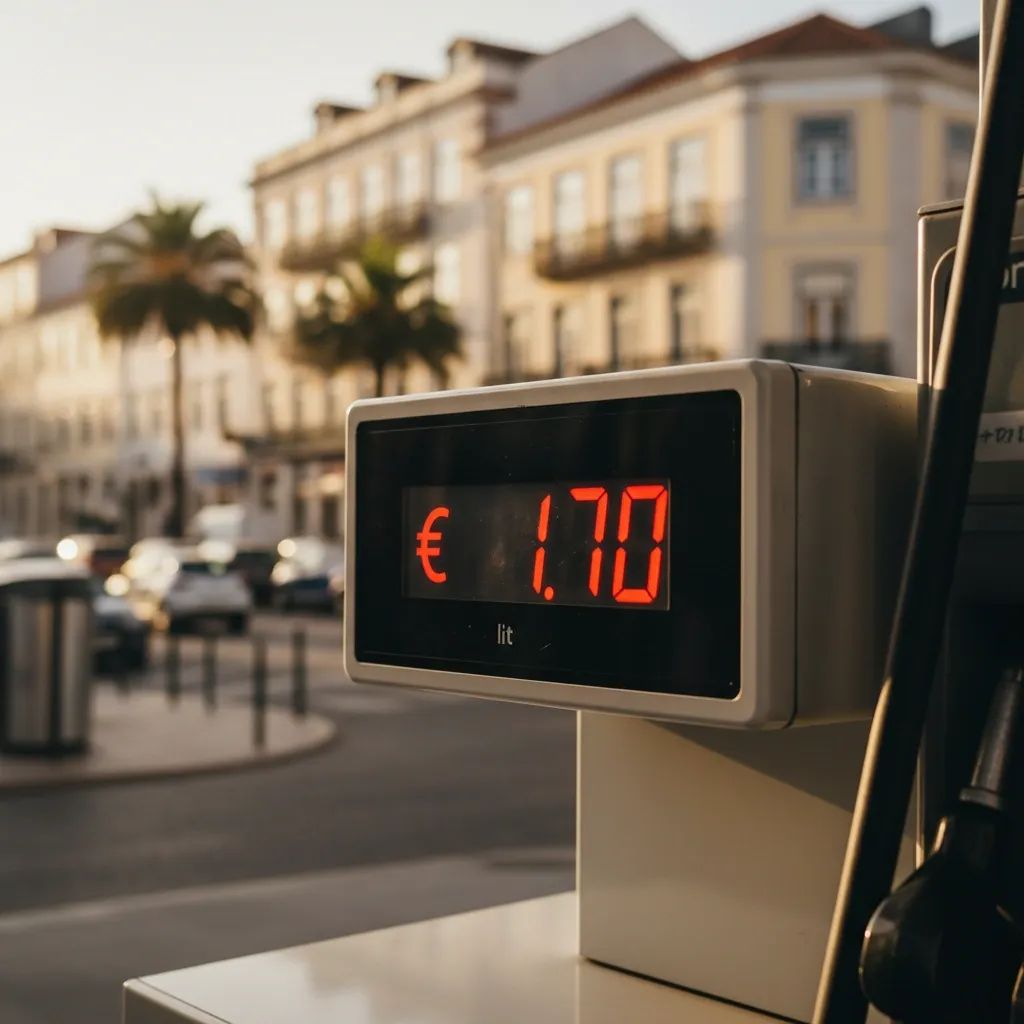
For German industry, the pain is acute. Gasoline prices surged past the symbolic €2 per liter mark, the highest since the 2022 energy crisis, while Dutch TTF gas futures nearly doubled in mid-March. Portugal's interconnected energy grid means these shocks ripple southward: Iberian wholesale electricity prices track movements in German baseload contracts, and LNG terminals in Sines compete with German buyers for cargoes from the Atlantic basin.
For Portuguese residents and businesses monitoring energy costs, the practical takeaway is this: watch Dutch TTF futures and German electricity day-ahead prices on financial platforms like Bloomberg or your energy supplier's website. Energy price impacts typically reach Portuguese household bills within 4-6 weeks of wholesale market movements, though contracts indexed to monthly or quarterly averages show delays of 1-3 months. If German industrial demand remains depressed, competition for LNG cargoes eases, potentially moderating bill increases in the second half of 2026.
Industrial producers in Germany—particularly in chemicals, steel, and glass—report that 83% of firms are feeling the squeeze from fuel shortages and inflated raw material costs. Production remains nearly 10% below late-2019 levels, with energy-intensive sectors down roughly 20%. The same dynamics threaten Portuguese manufacturers that rely on German intermediates or serve German clients.
What This Means for Portugal-Based Businesses and Workers
Trade Exposure and Employment: Germany is Portugal's third-largest export destination, absorbing around €8 billion annually in goods. The automotive supply sector—concentrated in the northern regions around Guarda and Covilhã, and central areas around Covilhão—faces the most direct exposure, with thousands of workers employed in component manufacturing. Beyond automotive, Portuguese textile exporters (particularly in the Centro region) and footwear producers (centered in the north) also depend significantly on German orders. A sustained German slowdown would ripple through employment in these regions. Conversely, if stabilization persists, order books could recover by mid-2026.
Trend Context: Portuguese exports to Germany have shown volatility—tracking closely with German industrial cycles—making May's confidence uptick a potential turning point if sustained through summer and autumn.
Tourism Spillover: German tourists represent one of the top source markets for the Algarve and Lisbon. The Ifo data showed the hospitality and logistics climate, while still strained, is no longer "catastrophic" as it was in April—a positive signal for the summer booking season and employment in Portugal's hospitality sector.
Financial Markets: Portuguese government bonds tend to track German Bund yields closely. Any extended German recession could push the European Central Bank toward rate cuts, easing borrowing costs for Lisbon's Treasury but also signaling weaker growth across the bloc.
Energy Costs for Residents: If German demand for gas remains subdued, it could ease competition for LNG spot cargoes arriving at Sines, potentially moderating retail energy bills for Portuguese households and businesses in the second half of 2026. Monthly wholesale energy indices are publicly available through Portuguese energy regulator ERSE's website.
Fragile Foundations
Despite the headline improvement, forecasters remain cautious. The European Commission's spring outlook projects German GDP growth of just 0.6% in 2026 and 0.9% in 2027, following two years of outright recession and anemic 0.2% growth in 2025. Inflation is expected to hit 2.9% this year before easing to 2.7% in 2027, while the unemployment rate is forecast to tick up to 4%.
The German government itself has slashed its 2026 growth projection from 1% to 0.5%, citing geopolitical shocks and elevated commodity prices. Exports, a traditional pillar of German prosperity, are expected to stagnate after contracting 0.4% in 2025. The International Monetary Fund holds a slightly rosier view, maintaining a 1.1% growth estimate for this year, but warns of "persistently challenging" medium-term prospects driven by rapid aging and sluggish productivity gains.
Sectoral Snapshot
Services: The uptick in the services PMI to 47.8—though still contractionary—reflects easing restrictions and recovering demand in hospitality and professional services. Firms reported a less dire current situation and marginally improved six-month expectations.
Manufacturing: The drop to 49.9 underscores ongoing headwinds: order backlogs are thinning, new export contracts remain weak, and input cost inflation persists. Industrial sentiment improved slightly in the Ifo survey, but the PMI suggests actual production and orders are losing steam.
Construction: This sector remains in deep malaise, with the Ifo index registering the only month-on-month decline. High financing costs, regulatory bottlenecks, and weak commercial real estate demand continue to weigh.
Trade and Logistics: Retailers and wholesalers turned less pessimistic, bolstered by consumer spending on services rather than goods. Logistics operators saw sentiment stabilize as supply chain bottlenecks from the Strait of Hormuz closure began to ease with alternative routing through the Cape of Good Hope, albeit at higher freight costs.
Risks Ahead
The European Central Bank has warned that a prolonged conflict in Iran could trigger stagflation—stagnant growth paired with rising prices—and push major energy-dependent economies, including Germany, into a technical recession by year-end. For Portugal, such a scenario would mean:
• Tighter fiscal space: Slower German growth crimps EU budget contributions and cohesion funding, potentially affecting regional development projects.
• Credit tightening: Portuguese banks with exposure to German corporates could see non-performing loan ratios creep upward.
• Emigration uptick: Historically, German labor market weakness has reduced opportunities for Portuguese skilled workers seeking higher wages abroad.
• Regional employment pressure: Northern and central Portuguese manufacturing regions could face increased unemployment if German industrial orders contract sharply.
Conversely, if energy prices stabilize and supply chains normalize, Germany's deep industrial base and strong balance sheets position it for a quicker rebound than southern European peers—a dynamic that could create new export opportunities for Portuguese suppliers if German firms shift procurement strategies or build redundancy into supply chains.
The Bigger Picture
Germany's tentative improvement in May is less a sign of robust recovery than a pause in decline. The composite PMI has now spent six consecutive months below 50, and the Ifo expectations index, while less negative, remains historically depressed. For Portugal-based stakeholders—whether exporters, investors, workers, or policymakers—the message is clear: watch German industrial orders, energy futures, and ECB policy signals closely.
For Portuguese exporters, particularly in automotive and textiles, monitor German manufacturing PMI and new export orders data monthly—these lead actual order placements by 6-8 weeks. For workers in export-dependent regions, track German unemployment and manufacturing employment trends as an early warning system. For residents concerned about energy costs, monitor Dutch TTF natural gas futures and German day-ahead electricity prices available on financial news platforms.
The health of Europe's largest economy remains a leading indicator for the Iberian Peninsula's own growth trajectory, and the current reprieve may prove fleeting if geopolitical turbulence persists or global demand weakens further.