
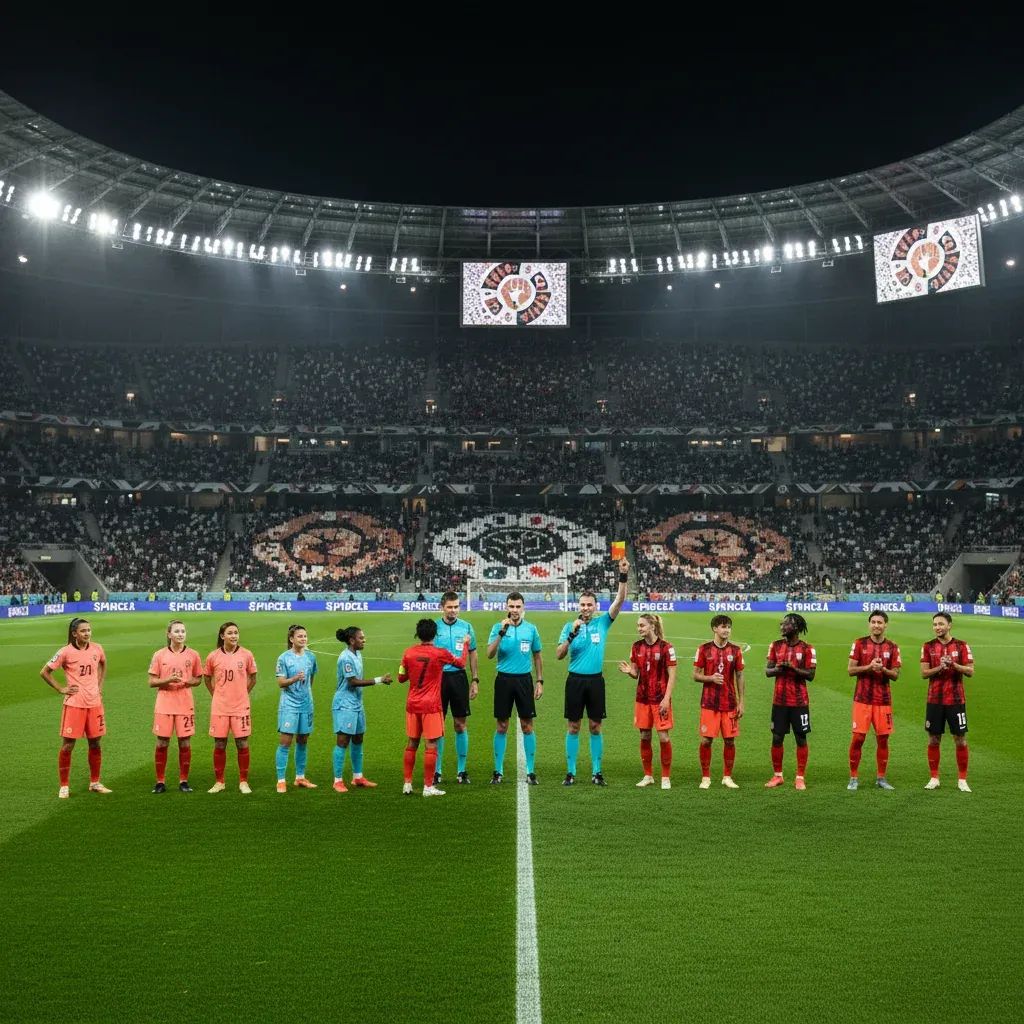
International observers and European football authorities are closely monitoring a governance crisis unfolding at FIFA that could reshape how political interference in global sports is perceived and regulated. A disciplinary decision involving US striker Folarin Balogun has exposed procedural irregularities and alleged White House intervention that UEFA now describes as crossing "a red line" in international football governance.
Why This Matters
• Precedent-setting moment: A single FIFA official reversed a World Cup suspension after direct presidential intervention—the first time in over 100 documented cases.
• Legal implications: UEFA and the European Commission have signaled potential regulatory action, which could affect how FIFA-sanctioned tournaments interact with European law.
• Governance credibility: The International Olympic Committee (IOC) is investigating whether the incident violates principles of sports autonomy that underpin global competition frameworks.
Unilateral Reversal Defies Committee Structure
Mohammad Al-Kamali, chairman of FIFA's Disciplinary Committee, acted alone when he suspended Balogun's one-match ban for a probationary period of one year, allowing the striker to play against Belgium in the Round of 16 on July 6. The committee is composed of 18 members, yet none were consulted before Al-Kamali—an Emirati legal advisor appointed in May 2025—issued his ruling.
According to records reviewed by The Times, this marked the first unilateral decision in more than a century of documented FIFA disciplinary cases. While FIFA regulations technically permit the committee chair to act independently under extraordinary circumstances, the absence of written justification or internal consultation has fueled accusations of procedural abuse.
Balogun had received a direct red card for serious foul play during the US team's Round of 32 clash with Bosnia and Herzegovina. Under Article 14 of FIFA's Disciplinary Code, such infractions typically carry an automatic one-match suspension. Instead, Al-Kamali invoked Article 27, which allows disciplinary measures to be deferred during a probationary period—a mechanism rarely applied mid-tournament and never without committee review. This article is typically reserved for cases involving player rehabilitation or circumstances requiring extended monitoring, making its application to Balogun's mid-tournament suspension highly irregular.
Trump's Call and the White House Dossier
The decision came shortly after US President Donald Trump telephoned FIFA President Gianni Infantino to request a review of the red card. Trump later confirmed the contact but insisted he had merely asked for the incident to be re-examined. "I didn't tell them what to do," he said. "I just asked them to take another look."
However, multiple sources report that the US administration prepared a detailed file criticizing Brazilian referee Raphael Claus, who issued the card, and forwarded it to FIFA headquarters in Zurich. Marco Rubio, the US Secretary of State, publicly called the expulsion a "disgrace," signaling Washington's intent to contest the ruling at the highest diplomatic level.
Infantino defended FIFA's independence, stating that "judicial bodies act autonomously and apply the Disciplinary Code based on regulations and specific case facts." Yet the lack of transparency surrounding Al-Kamali's decision—no published reasoning, no committee vote—has left that claim vulnerable.
UEFA and the European Backlash
The fallout has been swift and significant. UEFA issued a formal condemnation, branding the FIFA decision "unprecedented, incomprehensible, and unjustifiable." The European football body warned that the episode threatens the credibility of international competition and undermines the principle that sport must remain free from political interference.
The Belgium Football Federation, whose team faced Balogun in the Round of 16 (ultimately winning 4-1 and eliminating the US), filed an appeal with FIFA's Appeals Committee. The appeal was rejected as "inadmissible," but Belgium has vowed to continue pushing for regulatory reform within FIFA's governance structure.
The European Commission's Sports Commissioner, Glenn Micallef, emphasized that disciplinary decisions in sport must be made "exclusively by sporting authorities, without any form of political interference." Members of the European Parliament have called for a formal inquiry into whether the White House exerted undue influence, and the International Olympic Committee is reportedly reviewing the case for broader implications on sports governance autonomy.
Javier Tebas, president of Spain's LaLiga, characterized the Balogun affair as "the tip of the iceberg" in a governance model that has steadily eroded FIFA's credibility. Even Sepp Blatter, the disgraced former FIFA president, criticized the decision—a rare alignment of voices across the football establishment.
Implications for Portugal and European Football Governance
For Portugal-based football fans and residents, this case carries direct significance. If national governments can successfully lobby for favorable disciplinary outcomes at FIFA, the competitive integrity of tournaments monitored by European regulatory bodies—including the European Championship and UEFA competitions—becomes vulnerable to political pressure. This precedent could affect how Portuguese clubs, players, and the Portuguese Football Federation navigate international competitions if similar interference becomes normalized. Additionally, European regulatory responses to this incident may reshape FIFA's governance structure in ways that impact how Portugal participates in global football administration.
England Defender Faces Harsher Fate
The contrast with another disciplinary case has intensified the controversy. Jarell Quansah, a defender for England, was handed a two-match suspension after receiving a red card for a similar studs-up challenge against Mexico in the Round of 16. Unlike Balogun, Quansah's appeal was not entertained, and the full suspension was enforced under Article 14 of the Disciplinary Code.
Quansah missed England's quarterfinal victory over Norway (2-1) and will sit out the semifinal against Argentina, scheduled for 20:00 (Portugal time) on Wednesday, July 16. He can only return if England reaches the final, set for Sunday, July 19.
The discrepancy in outcomes—Balogun cleared to play within 48 hours, Quansah banned for two matches—has fueled accusations of double standards and raised questions about whether FIFA's disciplinary framework can survive political pressure from powerful member federations.
What This Means for International Sports Governance
The Balogun case represents a critical test of the autonomy of international sports bodies in the face of state-level intervention. Legal experts note that FIFA's statutes explicitly prohibit government interference in football matters, a principle enshrined in the organization's recognition by the IOC. Violations can result in suspension of national federations, as happened to Kenya and Zimbabwe in recent years. Whether FIFA will apply the same standard to the United States remains an open question.
The incident also recalls a 1962 precedent, when Brazil's prime minister successfully appealed a suspension for Mané Garrincha during the World Cup in Chile. That case, however, involved committee deliberation and a transparent review process—elements conspicuously absent in the Balogun affair.
Looking Ahead: Spain, France, and the Path to the Final
While the disciplinary issues continue to develop, the tournament itself moves forward. Spain and France meet in the first semifinal on Tuesday, July 15 at 20:00 (Portugal time), with the winner securing a place in the final. England's clash with Argentina follows 24 hours later.
As of now, neither FIFA nor the White House has issued a formal statement addressing the allegations of unilateral decision-making or external pressure. The coming weeks will reveal whether European regulatory bodies follow through on their warnings, potentially reshaping FIFA's governance structure and setting precedents for how international sports bodies respond to political interference.