

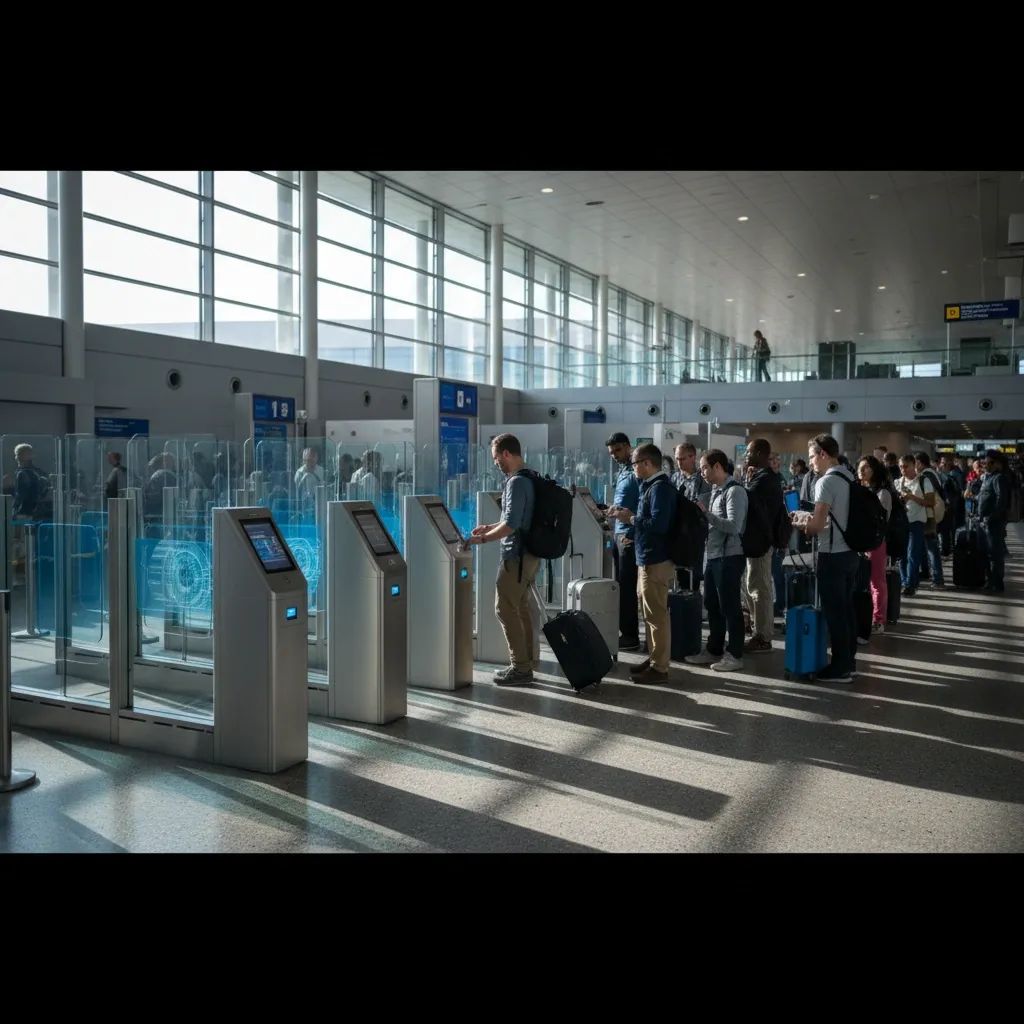
The Portugal National Police (PSP) will deploy 45 additional officers across Lisbon and Faro airports starting Monday to manage what officials predict could be 75,000 international arrivals per day during Easter week. The announcement, made this week ahead of Easter weekend (April 5), comes as Portuguese authorities race to avoid a repeat of the chaos that gripped Lisbon's Humberto Delgado Airport over the winter holidays, when passengers endured waits exceeding eight hours at immigration checkpoints.
What This Means for Residents
If you're traveling in or out of Portugal during Easter week, expect significantly more staff on duty and faster lanes, but also brace for continued friction from the European Union's Entry/Exit System (EES), which is now fully operational after its December suspension. The biometric data collection requirement—fingerprints and facial scans for all non-EU travelers—remains the primary bottleneck, even with expanded infrastructure.
Who Is Affected by EES Delays
Before reading further, here's who will experience delays:
• EU/EEA/Swiss passport holders: Not subject to EES; should experience minimal delays
• Non-EU travelers (including UK, US, Canada, etc.): Must complete biometric enrollment; expect significantly longer wait times
• Portuguese residents with non-EU passports: Subject to EES on each entry
Key takeaways:
• Reinforcements begin March 24: 30 border-trained officers in Lisbon, 15 in Faro.
• New processing zone opens in Lisbon: 10 additional manual desks plus automated e-gates.
• Estimated daily volume: 75,000 passengers per day, 80% concentrated in Lisbon and Faro.
• EES fully active: Biometric checks still in effect; expect longer processing times than pre-October 2025 norms.
Why the Urgency
Easter traditionally ranks among Portugal's three busiest travel periods, alongside summer and Christmas. The Ministry of Internal Affairs (MAI) confirmed that both airports face "significant surges in international traffic" requiring "rigorous management of human, technological, and infrastructure resources." The ministry noted that the PSP's Easter contingency plan would be finalized by the end of this week, with rollout commencing Monday.
The emphasis on Lisbon and Faro is strategic: together, these gateways handle roughly 80% of Portugal's international passenger flow. During peak weeks, that translates to three-quarters of a million people moving through immigration in just seven days—a volume that has repeatedly strained capacity since the PSP assumed border control duties from the dissolved Foreigners and Borders Service (SEF) in 2023.
Lessons from the Winter Meltdown
December's immigration crisis serves as the blueprint for this contingency response. When the second phase of the EES went live on December 10, 2025—mandating biometric enrollment for all third-country nationals—processing times tripled overnight. Passengers arriving from outside the Schengen zone reported waits of six to nine hours, forcing Portugal to suspend the EES entirely at Lisbon airport for three months.
The system was gradually reintroduced in January 2026, and the MAI confirmed in March that it is now "fully active" nationwide. However, the underlying challenge remains: each traveler subject to EES must complete a questionnaire, scan their passport, provide fingerprints, and have a facial image captured—a process that averages 70% longer than the old stamp-and-go method, according to Airports Council International (ACI Europe).
The Coordination Web
The PSP stressed that "all passenger control positions" will be operational during Easter and that the agency is coordinating closely with ANA–Aeroportos de Portugal (the national airport operator) and the Agency for Integration, Migrations, and Asylum (AIMA). The new control zone at Humberto Delgado is intended to distribute passenger loads more evenly and prevent bottlenecks in the arrivals hall.
In addition to the 45-officer surge, 60 PSP agents who completed specialized border-guard training in January were deployed to Lisbon starting in late February. A further contingent of 50 Frontex officers—26 assigned to Lisbon, 10 to Faro—are working alongside Portugal's National Unit for Foreigners and Borders to bolster capacity.
Digital Workarounds and Self-Service Kiosks
To mitigate the EES drag on processing speed, Portuguese airports have installed self-service biometric kiosks that allow travelers to complete data capture before reaching a manned desk. Portugal also adopted the Frontex-developed "Travel to Europe" mobile app in March 2026, which enables pre-registration via smartphone—users can scan their passport chip via NFC and fill out the travel questionnaire in advance.
Despite these tools, aviation industry groups warned the European Commission in February that summer peak season could still produce waits exceeding four hours at major hubs. The EU has granted member states "flexibility" to partially suspend EES operations for an additional 90 to 150 days after the system's April 10, 2026 full rollout deadline, effectively allowing extensions until early September if volumes prove unmanageable.
Legal and Operational Context
The PSP inherited border control responsibilities when Portugal dissolved the SEF in 2023, a restructuring that coincided with the EU's phased deployment of the EES. The system launched on October 12, 2025 across the Schengen Area, immediately triggering complaints about queue times. By mid-October, Lisbon passengers were logging waits over 90 minutes; by December, those had ballooned to multiple hours.
The EES is designed to replace manual passport stamps with a digital registry, monitor overstays, enforce the 90-in-180-day rule for short-term visitors, and detect identity fraud. Since implementation, it has flagged 4,000 overstay violations. The system also serves as the foundation for the forthcoming European Travel Information and Authorization System (ETIAS), a visa-waiver pre-clearance program scheduled to launch in the fourth quarter of 2026.
What Travelers Should Expect
If you're flying into Lisbon or Faro during Easter week, here's what you need to know:
• Allow extra time: Plan to arrive at the airport 3 hours before international flights (versus the standard 2 hours) during Easter week to account for EES processing.
• Use the app: Download "Travel to Europe" from the iOS App Store or Google Play Store. If you're a non-EU traveler subject to EES, pre-filling your data can significantly reduce wait times at the border.
• Check your terminal: Visit ANA's website (ana.pt) or check your airline's app for updates on the new control zone location at Humberto Delgado and revised passenger flow routes.
• Monitor official channels: The PSP and MAI have committed to real-time updates if conditions deteriorate; follow their social media accounts or check airport signage for live queue information.
• EU passport holders: If you hold an EU, EEA, or Swiss passport, you are not affected by EES delays and can expect standard processing times.
Broader Implications
The Easter operation is a stress test for Portugal's post-SEF border architecture. If the reinforced staffing and expanded infrastructure prevent a repeat of December's chaos, the model may become standard for high-traffic periods. If queues spiral again, pressure will mount on both Lisbon and Brussels to revisit the EES rollout timeline—or at least its implementation at Portugal's busiest airports.
For now, the 45 additional officers, 10 new desks, and coordinated command structure represent Portugal's most ambitious attempt yet to balance EU security mandates with the reality of mass tourism and business travel. Whether that balance holds will be evident by the end of next week.


