
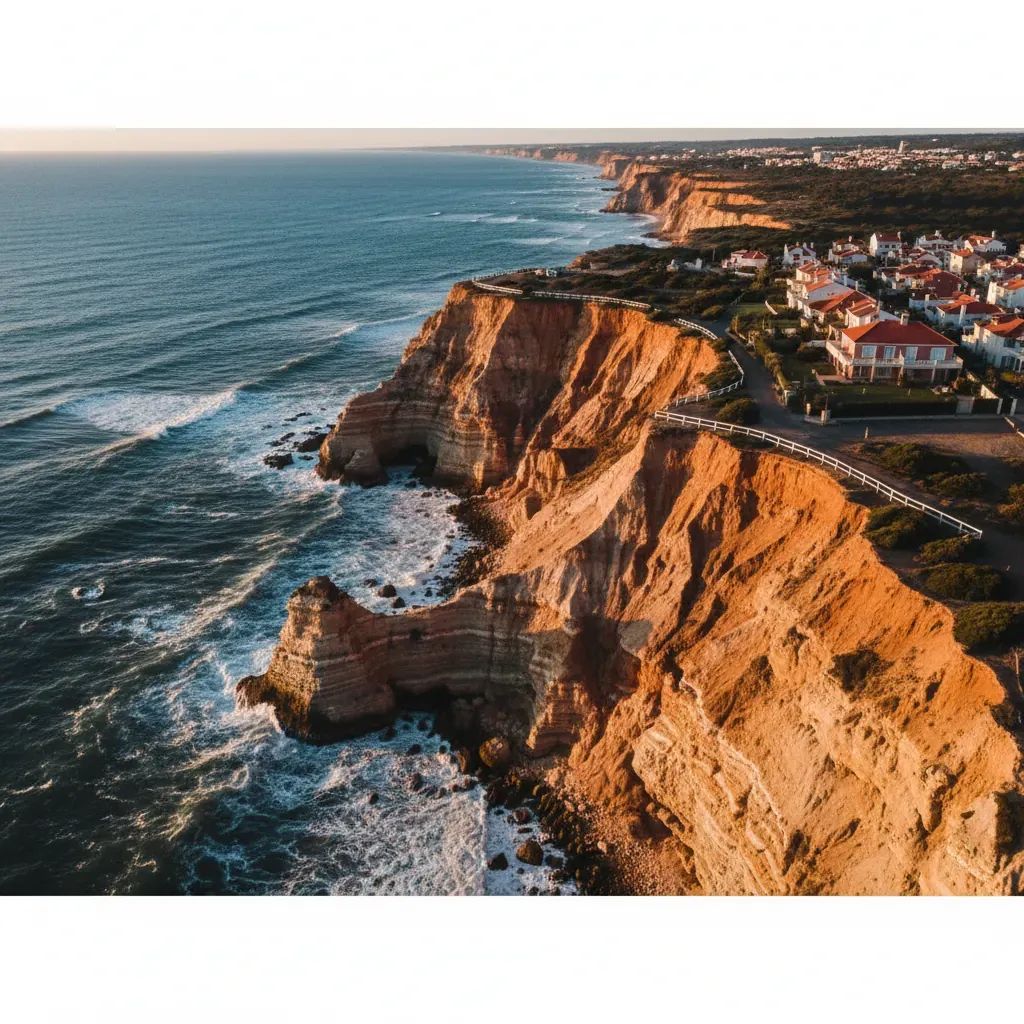
A 24-year-old man pulled from a cliff base at Salir do Porto on Sunday demonstrated something Portugal's fragmented coastal safety system actually accomplishes when it functions as designed: a rapid mobilization that delivered an injured person from remote terrain to surgical care in under two hours.
Why This Matters
• Integrated rescue response proved effective — 31 personnel, multiple services, and an INEM helicopter from Évora executed a technically difficult extraction and transport in roughly 90 minutes once the alarm was raised.
• Cliff risk remains dispersed and under-resourced — Portugal lacks centralized tracking of unstable zones, and safety infrastructure depends heavily on municipal budgets that vary widely by region.
The Response That Worked
When the Lisbon Maritime Search and Rescue Coordination Center received notice of a person down at 15:02 on Sunday, a chain of decisions and movements had to execute flawlessly. The victim lay at the base of cliffs near Salir do Porto in the Caldas da Rainha municipality — difficult terrain by definition, terrain where rescue crews measure success in minutes saved.
The Nazaré Lifeboat Station launched first. Maritime Police units from Nazaré followed. Volunteer firefighters from both Caldas da Rainha and São Martinho do Porto — the latter just three kilometers south — converged simultaneously. The INEM helicopter, which maintains a forward position in Évora rather than waiting in Lisbon, took to the air. By the time rescuers reached the man, his condition was clinically serious: multiple rib fractures and chest trauma requiring immediate evaluation at a major hospital capable of managing thoracic injury.
On-site stabilization occurred. Transport proceeded to the pier at São Martinho do Porto, where the helicopter waited. The aircraft delivered him to Hospital de Santa Maria in Lisbon, which maintains specialized trauma capacity. The operation succeeded not through luck but through protocol — years of refinement about which organizations respond, in what sequence, and who performs which function.
That model works. It worked Sunday. It does not work, however, everywhere or for everyone.
Practical Guidance for Coastal Users
Authorities advise anyone accessing remote cliff areas to check current maritime bulletins, respect all posted signage, and notify someone of intended location and return time. Mobile coverage throughout the Oeste shoreline remains patchy — that limitation can delay emergency communication critically. Visible, bright clothing matters. Never work alone in cliff terrain. Avoid positioning yourself at cliff tops or bases where visible cracks, loose rock, or recent weathering indicate structural compromise.
For those engaged in fishing or other coastal activities, consult current regulations before departure and verify which zones remain open. Operating outside permitted areas carries both legal consequences and increased enforcement presence.
The Broader Cliff Landscape
Portugal's Atlantic shoreline is fundamentally unstable. Over five years through October 2024, 182 cliff incidents resulted in 36 deaths and 119 injuries. In 2024 alone, through mid-September, 32 people fell or were struck by rockfall. That extrapolates to 6-7 incidents nationally per month — many minor, some severe, many unreported.
The Oeste region, where Salir do Porto sits, occupies a particularly vulnerable stretch. Between Alcobaça and Sesimbra, researchers in 2022 identified 11 beaches with documented cliff instability. The causes are straightforward: natural Atlantic-facing erosion, winter storm damage, water infiltration weakening internal rock matrices, and concentrations of human activity placing pressure on narrow access routes.
The Portugal Environment Agency (APA) defines hazard zones by calculating 1.5 times the cliff height as the theoretical radius of rockfall or collapse impact. That framework determines where warning signage appears — in theory. Implementation depends on municipal budgets and staff availability. Some coastal areas possess comprehensive marking; others lack visible warning infrastructure.
Infrastructure Challenges and Implementation Gaps
The Portugal Directorate-General for Natural Resources, Security and Maritime Services (DGRM) has been monitoring progressive instability at São Martinho do Porto and proposing protective netting and defined safety perimeters. Progress remains halted in planning phases.
The machinery governing coastal protection is genuinely complicated. The APA handles environmental review. DGRM manages maritime infrastructure. Municipal governments approve local interventions. Maritime Police enforce access restrictions. That distribution of authority, while addressing legitimate institutional separation of concerns, produces delays that leave residents and coastal users navigating unresolved hazards.
The Broader Beach Safety Picture
The incident Sunday occurred at an isolated cliff base without lifeguard coverage, contingent on someone with a functioning phone triggering alert activation. That dependence on circumstance is unsettling when scaled nationally. Over five years through April 2026, Portugal recorded 76 beach-related deaths. In 2025 alone, 18 people died at beaches; 8 of those occurred at unmonitored beaches without lifeguard presence. That statistic illuminates the role of response time: monitored locations see faster intervention.
As summer season approaches in July and August — traditionally driving sharp increases in coastal visitor numbers — civil protection commands typically intensify patrols and awareness campaigns. Resource constraints, however, limit continuous monitoring across hundreds of coastal access points. The equation is precarious: Portugal maintains excellent maritime rescue capacity at coordinated sites, but many remote cliff areas remain functionally unmonitored until emergency occurs and someone alerts authorities.
Medical and Investigative Outcomes
Hospital de Santa Maria will not disclose current patient status under Portugal's medical privacy protocols. Thoracic fractures involving multiple ribs frequently necessitate surgical stabilization and extended respiratory support, particularly if lung tissue sustained traumatic injury. Recovery timelines range from weeks to months depending on fracture severity and whether complications develop.
The Maritime Police will conduct routine incident review examining factors including whether safety equipment was deployed, weather conditions, tidal factors that created unstable footing, and whether cliff-specific hazard awareness played a role.
What Sunday's Rescue Revealed
The young man survived because every component of Portugal's integrated maritime rescue, emergency medicine, and civil protection system performed its assigned function. That capacity does not eliminate cliff risk; it improves survival odds for people caught in serious terrain. His extraction succeeded not through exceptional circumstances but through a system that exists precisely to handle this scenario.
That fact deserves recognition. It also deserves to be stated plainly: the system functions well at coordinated sites with reliable communication. Dispersed, remote cliff areas across the Oeste and elsewhere remain inadequately mapped, inconsistently signaled, and dependent on accident to trigger intervention. Until funding and jurisdictional alignment address that structural reality, cliff accidents will continue — and some will end differently.


