
The Thread That Binds Guimarães to the World
The Portugal-based Contextile 2026 has turned war’s debris into bedding, children’s backpacks into memorials, and abandoned life vests into silent witnesses — not as decoration, but as testimony. In Guimarães, Ai Weiwei’s latest interventions transform textiles from battlefields and refugee routes into domestic objects, forcing a quiet reckoning: what we discard defines us more than what we celebrate. This isn’t art for show. It’s a community-made cry for repair.
Why This Matters
• Ukrainian military uniforms were shredded, spun into yarn, and woven into bedspreads bearing Ai Weiwei’s raised middle finger — a gesture of defiance turned into domestic comfort, produced by Guimarães-based Lameirinho.
• 420 children’s backpacks and 200 life vests, some still caked in Mediterranean mud, flank each other in the CIAJG, memorializing the cost of war and migration without a single word.
• Guimarães’ dual identity as Contextile host and European Green Capital 2026 turns every textile into a policy statement — sustainability isn’t a slogan here, it’s stitched into the fabric of public space.
• Public works like “Camouflage” on the Plataforma das Artes and “Net” in UNESCO-listed Couros don’t ask you to visit — they ambush you on your way to the market.
From Uniform to Bedspread: A Portuguese Collaboration
No distant studio. No imported materials. This is local transformation. Ai Weiwei didn’t just arrive with ideas — he came with discarded Ukrainian army uniforms, brought back from his 2025 filming trip, and handed them to Lameirinho, a small textile company nestled in Guimarães’ industrial district. For weeks, workers there mechanically unstitched, cleaned, and spun each fiber into new thread. The result? Not just fabric, but narrative: each bedspread carries both the weight of combat and the soft hope of rest. The middle finger woven into it? Not vulgarity — it’s a punchline to a war machine that turns people into statistics.
In Portugal, where textile heritage stretches back centuries, this collaboration isn’t novelty — it’s legacy. Local hands, not foreign technicians, became co-authors of one of the most talked-about artworks of the year.
Memory in Threads, Not Monuments
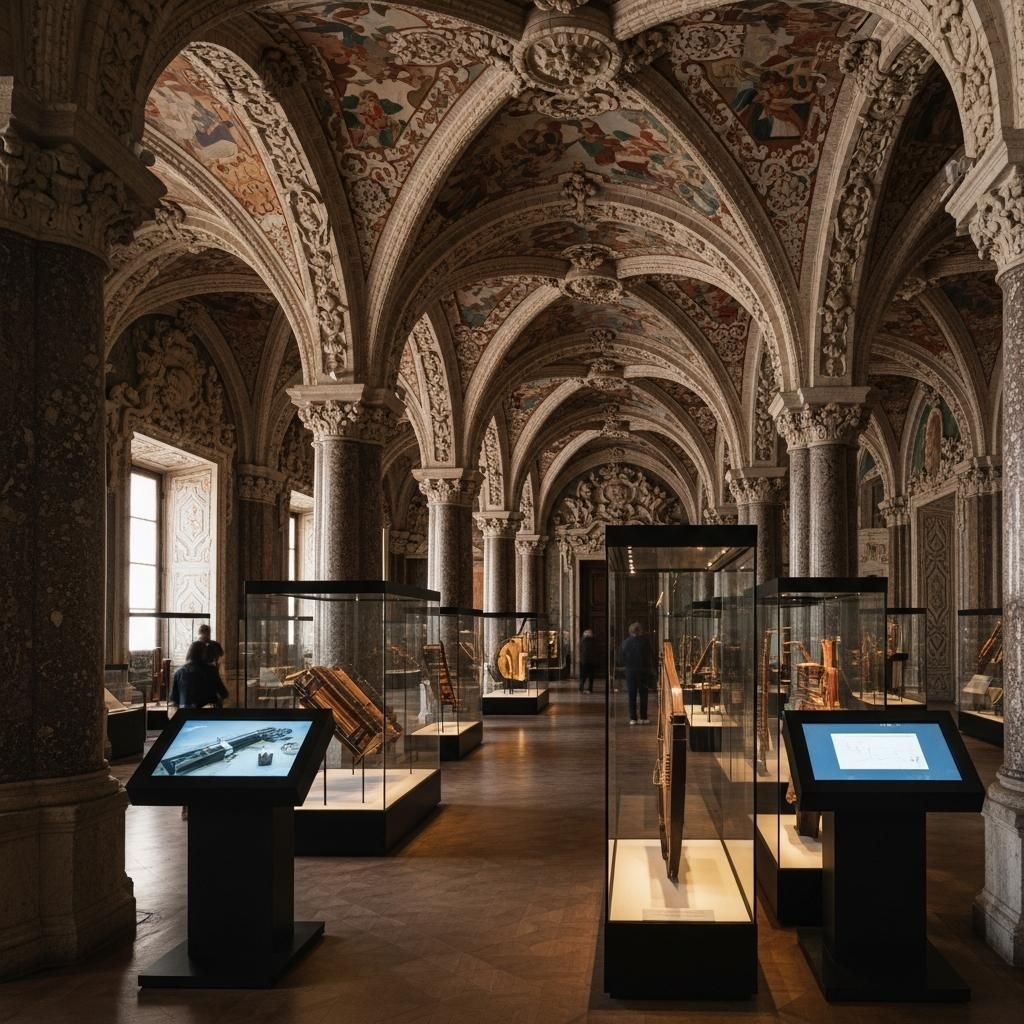
Walk into the CIAJG, and you’ll find no titles, no curator’s notes. Just walls. One side holds 420 children’s backpacks — identical in size, different in wear, each a silent placeholder for a life cut short, echoing Ai Weiwei’s 2008 Sichuan quake memorial. Opposite, 200 orange life vests, frayed, stained, some still holding the salt of a broken sea. Between them, six abandoned suitcases. No narration needed.
These aren’t symbols. They’re fragments of real histories. A 12-year-old’s schoolbag. A vest pulled from the body of a man who never reached Lampedusa. In a Europe struggling with migration fatigue, Ai Weiwei doesn’t ask you to feel sorry. He makes you face the physical proof.
Art That Lives on the Sidewalk
Contextile isn’t confined to galleries. In Couros, a UNESCO site once home to tanneries, a net of camouflage fabric hangs above the old stone lanes — not to obscure, but to question. What does it mean to cover history with the same material once used to hide from it? In the Plataforma das Artes, “Camouflage” stretches like a shroud over civic benches. Locals nap beneath it. Tourists snap photos. No one is told to leave.
Even the municipal market joins. Here, oversized rugs woven by a Taiwanese artist, hand-stitched with folk patterns, sit beside stalls of fresh cheese and olive oil. Art isn’t separated from life — it’s woven into it.
Weaving the Green: When Art Becomes Policy
Guimarães wasn’t chosen as European Green Capital 2026 by accident. And Contextile isn’t just a side event — it’s its beating heart. Under the banner “Tecer o Verde” (Weaving the Green), the biennial became a living lab: artists partnered with recycling centers, schools, and textile engineers to remake waste into meaning. Plastic bottles became tapestries. Scrap fabric turned into sculptural landscapes. Even the exhibition catalog was printed on recycled paper.
For residents, this means something deeper: sustainability is no longer a distant European goal. It’s a daily practice — visible in public parks, market stalls, and bed sheets made from war uniforms. Portugal’s industrial past is being reimagined not through innovation alone, but through memory, craft, and quiet rebellion.
What This Means for Residents
For Guimarães locals — and for Portugal — Contextile 2026 is proof that cultural relevance isn’t imported. It’s crafted here. A small textile firm collaborated with one of the world’s most politically charged artists. A city with limited international fame now hosts an exhibition that draws visitors from across Europe.
This isn’t tourism. It’s transformation. Every train from Porto stops in Guimarães. Every exhibit is free. Every installation is on sidewalks or historic sites — no ticket, no queue. In a country where public culture often feels disconnected from daily life, this biennial insists: art belongs where you live, work, and walk.
The world hangs by a thread. Here, in this northern Portuguese city, people are learning how to weave it back together — one stitch, one uniform, one life vest at a time.