
Portugal's Motorsport Crossroads: 70 Teams, Four Days, and €193 Million at Stake
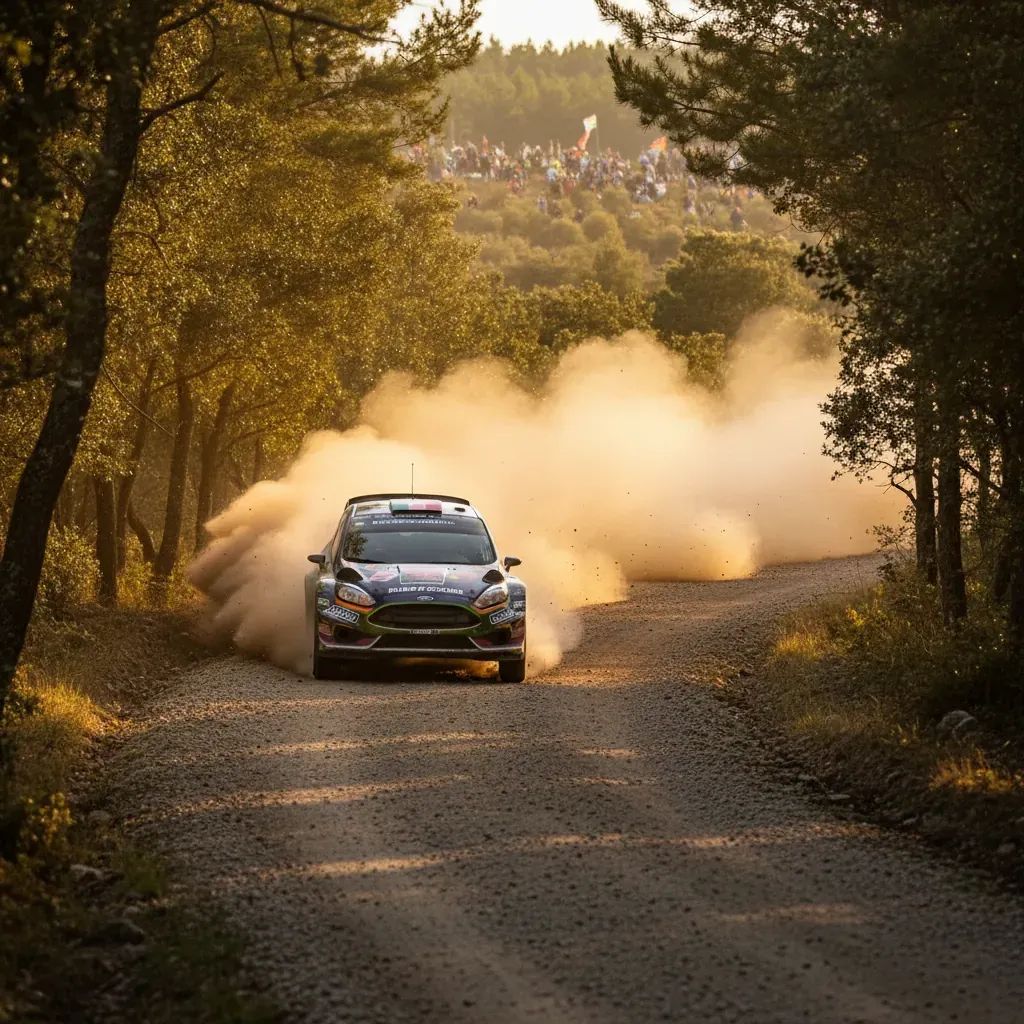
The Vodafone Rally of Portugal begins in earnest this week after Wednesday's preparatory shakedown, transforming central and northern regions into a temporary motorsport epicenter. Between May 7 and 10, residents across Coimbra, Águeda, Arganil, Amarante, and Fafe should prepare for rolling road closures, noise that echoes through valleys until midnight, and an estimated 1 million spectators funneling through forest stages where competitors will contest 23 timed special stages totaling 345 kilometers. This is the sixth round of the 2026 World Rally Championship, and it carries economic weight equivalent to several weeks of ordinary commercial activity compressed into 96 hours.
Why This Matters
• Road disruptions peak Friday-Saturday: Nine districts across Centro and Norte will experience rolling closures; the Automóvel Club de Portugal (ACP) website provides real-time stage schedules and alternative route maps.
• Economic injection: The 2025 edition injected €193 million into regional economies—€103 million in direct spending plus €89 million in indirect media value. The Portuguese state collected €22.5 million in tax revenue from the event alone.
• First-time tourism effect: Roughly one-third of international visitors (32.7% in 2025) visit Portugal for the first time through rally attendance, with average stays exceeding regional norms by nearly 0.5 nights, translating extended hospitality spending.
The Championship Picture Before Racing Begins
Elfyn Evans, the Welsh driver piloting a Toyota Yaris, carries a 2-point championship lead into Portugal—a margin thin enough to vanish across a single difficult day. His nearest rival, Japanese teammate Takamoto Katsuta (also Toyota), sits just behind, followed by Finland's Sami Pajari and Norway's Oliver Solberg, both similarly equipped with Toyota machinery. This clustering reflects Toyota Gazoo Racing's dominance: four drivers occupy the top six positions in the standings, a numerical advantage that historically translates into constructors' championship security but can also create internal complexity when multiple teammates battle for scarce podium finishes.
Sébastien Ogier, the 42-year-old French maestro, represents the season's primary disruptor. Ogier holds the all-time Portuguese record with 7 victories, a feat unmatched by any contemporary driver. His first-ever WRC victory occurred in Portugal in 2010—a symbolic beginning that shaped his entire career trajectory. Last week's Canary Islands Rally triumph suggests momentum entering this week. Though currently sixth in points and 43 points adrift of Evans, Ogier's track record on Portuguese gravel remains unparalleled; his 2025 victory here proved he remains capable of dominance on terrain that punishes hesitation and rewards surgical precision.
Hyundai Motorsport's Thierry Neuville, the 2024 world champion, sent an unmistakable statement during Wednesday's shakedown at the Baltar Autodrome in Paredes. Neuville clocked 3 minutes 51.2 seconds over the 5.72-kilometer test loop—the fastest time of the afternoon by 0.3 seconds over Pajari and 0.6 seconds ahead of championship leader Evans. The Belgian's sharpness suggests Hyundai's engineering package remains competitive despite numerical disadvantage. Adrien Fourmaux (Hyundai), currently fifth in the championship, rounds out the primary contenders, joined by experienced Dani Sordo, 52, whose age masks decades of gravel-road mastery accumulated across multiple continents.
The Competitor Landscape: Factory Teams and Ambitious Privateers
Seventy cars are registered for this edition—a mix of factory-backed professionals, semi-factory teams, and privateer operations competing across multiple categories. The WRC2 category features Yohan Rossel (France, Lancia) leading the standings after two consecutive victories to begin the season, though his brother Léo Rossel, who shares equal points with Yohan, is not registered for Portugal. Italy's Robert Daprà (Skoda) trails in third and will seek to narrow the gap should the Rossel partnership falter.
The WRC3 class pits Gil Membrado against Matteo Fontana in a domestic-focused battle where vehicle regulations differ but terrain difficulty remains identical. Junior WRC leadership belongs to Sweden's Calle Carlberg, pursued closely by Turkey's Ali Türkkan. Both young drivers view Portugal as critical development ground before the calendar progresses to Scandinavia's technical forests and Eastern Europe's rapid, challenging layouts.
Portugal's Domestic Battlefield: Rodrigues, Araújo, and National Prestige
For Portuguese motorsport aficionados, the Campeonato de Portugal de Ralis (CPR) transforms this event into a dual championship—international points matter, but so does proving national superiority. Rúben Rodrigues (Toyota) currently leads the Portuguese standings by 5 points over the legendary Armindo Araújo (Skoda), a driver whose resume includes three previous victories at this venue (2003, 2004, 2006) and a reputation as one of Portugal's most technically polished drivers. Now in his late 40s, Araújo remains formidable on familiar terrain where accumulated local knowledge often trumps raw pace.
Pedro Almeida (Toyota) occupies third nationally, trailed by José Pedro Fontes (Lancia) in fourth. Chronic challengers for podium positions include Pedro Meireles (Skoda) and Ricardo Teodósio (Citroën), both capable of reshuffling standings if their machinery cooperates. Notably, Takumi Matsushita, a Japanese driver who won CPR's opening round as a one-off guest entry, is not registered for Portugal and will not compete for the national title.
The Shakedown Revealed: Portugal's Rally Culture in Miniature
Wednesday afternoon at the Baltar Autodrome, thousands materialized despite the shakedown being technically a routine warm-up session. Families arrived with coolers, folding chairs, and children, transforming grass embankments into impromptu festival ground—a cultural statement about Portuguese motorsport's grassroots intensity.
Cátia Barbosa, 36, from Gondomar (a suburban ring south of Porto), attended with daughters Vanessa, 16, and Sofia, 4. For Barbosa, rally season represents intergenerational family ritual. She first witnessed competitive rallying in 2012 at the legendary Fafe stage and has made pilgrimages there annually since, though the logistics—group camping, overnight expeditions—complicated introducing youngest children to the sport. The controlled Paredes environment offered alternative entry. "I want to pass this bug to them," Barbosa explained. Her daughter Vanessa added: "From the time I was small, my mother took me to concentrations and the Exponor logistics base. I learned who the drivers were by watching them arrive and depart. This passion has been my whole life."
Nearby stood João Oliveira, 62, from Braga (55 kilometers north of Porto), wearing a jacket emblazoned with "If in doubt, flat out"—the rallying mantra of Colin McRae, Scotland's only world rally champion and two-time Portuguese victor (1998, 1999). Oliveira's credentials stretch beyond 45 years attending over 500 rallies across five continents—Finland, Monaco, Germany, Spain—yet McRae remains unmatched in his estimation. "In 1999, he beat Carlos Sainz by 12 seconds in the final stage," Oliveira recalled. "McRae didn't brake when unsure. He accelerated. That was not normal driving."
This week, Oliveira coordinated logistics for a 15-person caravan comprising friends from Lisbon, Entroncamento, Aveiro, Viseu, Braga, Famalicão, and even Catalonia. The group arranged camping in Arganil (Friday's forest core) and rented a rural lodge in Vieira do Minho (northern base for Saturday's stages). "I attend roughly 10 rallies annually, mostly national championship rounds," Oliveira said. "But the Rali de Portugal is different. The crowd, the terrain, the prestige—it brings out the best in everyone."
A Portuguese-Finnish cultural bridge emerged when two Lisbon residents, Filipe Leal and Filipe Sobral, hosted Toni Kekkonen and Ossi Lammela, who had traveled from Turku, Finland (170 kilometers west of Helsinki) for their maiden Portuguese rally experience. Kekkonen expressed cautious optimism tempered by genuine uncertainty: "Pajari is the best driver, but there are many strong competitors. Nobody knows what will happen. We expect loud engines, fast cars, and dramatic moments."
Thursday to Sunday: The Gauntlet Explained
Thursday begins ceremonially at 2:00 PM when the departure convoy leaves Coimbra's Praça das Cortes in a procession drawing thousands of locals. Competitive action ignites at 3:05 PM with PEC 1 (Águeda/Sever), a 15-kilometer warm-up stage followed immediately by PEC 2 (Sever/Albergaria) stretching 20.24 kilometers. The day concludes with the Figueira da Foz super-special—a 1.93-kilometer floodlit spectacle alongside the Atlantic coastline where single mistakes reshape championship mathematics.
Friday pivots inward into forested hinterlands: Mortágua, Arganil, Lousã, and Góis. Portuguese gravel transitions from sandy and deceptive to hard and rock-strewn. Seven timed stages exceed 100 kilometers of cumulative distance. The Arganil loop (18.62 kilometers) repeats twice, subjecting tires to savage abrasive punishment. Friday's Góis stage (15.66 kilometers) carries historical significance—it has repeatedly reshuffled leaderboards in past editions, rewarding smooth precision and punishing over-aggression.
Saturday escalates dramatically with eight stages clustered around Felgueiras, Cabeceiras de Basto, Amarante, Paredes, and Lousada. The Amarante stage (26.24 kilometers) stands as the rally's longest single test—a merciless forest stretch separating committed drivers from those wavering under fatigue. Each loop repeats once, magnifying mechanical attrition and driver endurance. Evening concludes with the Lousada super-special (3.78 kilometers) under floodlights—another high-profile entertainment spectacle.
Sunday's finale comprises championship-deciding sequences: four stages leading to the legendary Fafe Power Stage (21.26 kilometers). Fafe's Pedra Sentada jump—the rally's most iconic landmark—launches cars skyward at speeds exceeding 160 km/h, often achieving several meters of airtime as wheels lift completely off tarmac. Tens of thousands pack hillsides surrounding Fafe, creating a cauldron of noise and energy that defines the entire Portuguese rally experience.
The Economic and Mediatic Machinery
The 2025 edition injected €193 million into regional economies—€103 million direct spending plus €89 million in indirect media value. Tax revenue collected by the Portuguese state totaled €22.5 million through VAT and fuel duties. Since 2007, cumulative contributions reach €898.9 million—an unmatched figure for any single annual sporting event in Portugal.
The 2015 relocation to northern regions triggered a 16.43% spike in economic impact within a single year (€109.5 million to €127.5 million), demonstrating how geographic proximity to population centers and accommodation infrastructure dramatically amplifies visitor spending.
Approximately 1 million spectators attended in 2025, with 64.5% domestic origin and 36.5% international. Critically, 32.7% of foreign visitors reported visiting Portugal for the first time, suggesting the rally functions as recruitment tool for the country's broader tourism economy. Average stays extended to 2.26 nights—meaningfully above regional averages of 1.9 nights (Norte) and 1.8 nights (Centro), keeping hotels and restaurants operating at peak capacity beyond the rally itself.
Satisfaction metrics reflect strong brand health: 94.8% of domestic and 96.9% of foreign attendees classified Portugal as "good" or "very good." Return-visit intent registers between 79.1%-81.3% in summer and 56.3%-80.6% in winter, translating rally fandom into repeat tourism behavior.
The 2025 edition generated approximately 900 hours of televised coverage broadcast across 100+ countries, while 2024 logged 873 hours 15 minutes (90% live). This global exposure positions the Portuguese rally among the year's most-watched motorsport properties, rivaling Monaco in certain European markets and outpacing smaller championships.
Historical Context: Difficulty, Prestige, and Legendary Victors
The Rali de Portugal ranks among the WRC's most technically demanding fixtures, rivaling Finland's high-speed forests and Monte Carlo's mixed-surface chaos. Portuguese gravel presents deceptive mixture: soft, sandy sections providing minimal grip interleave with rock-strewn areas shredding tires within kilometers. Temperatures frequently exceed 30°C, and dust clouds reduce visibility near-zero on narrow stages.
Only Sébastien Ogier (7 victories across three decades) and Finland's Markku Alén—known as "Senhor Rali de Portugal" (5 victories, 1975-1987)—have conquered this event more than three times. Massimo Biasion of Italy achieved three consecutive victories (1988-1990)—a record unchallenged by any subsequent driver. Michèle Mouton remains history's only woman to win a WRC round outright, triumphing here in 1982—a distinction unmatched four decades later. Kalle Rovanperä became the youngest victor in 2022, at age 21.
Practical Navigation and Impact for Residents
Traffic disruption intensifies daily as competitors move northward. Residents in Coimbra, Águeda, Sever do Vouga, Albergaria-a-Velha, Figueira da Foz, Mortágua, Arganil, Lousã, Góis, Felgueiras, Cabeceiras de Basto, Amarante, Paredes, Lousada, and Fafe should consult the ACP's official guide for precise stage timing and alternative routing. Disruption is intentional and infrastructure-designed—it concentrates viewing, enforces safety, and maximizes psychological impact of competitive spectacle.
For hospitality and retail operators, the financial opportunity window remains compressed but significant. Visitors typically spend €89-€156 daily during attendance, with substantial portions directed toward accommodation, dining, and convenience purchases rather than planned tourism expenditures. Local businesses report peak transactions Friday-Sunday, with Saturday registering maximum revenue concentration.
By Sunday evening, after Fafe concludes and dust settles, championship standings will have shifted—sometimes dramatically. The Portuguese rally has evolved, over five decades, into an integral component of national sporting identity and economic vitality. The countdown has concluded. Racing begins Thursday at 3:05 PM.


