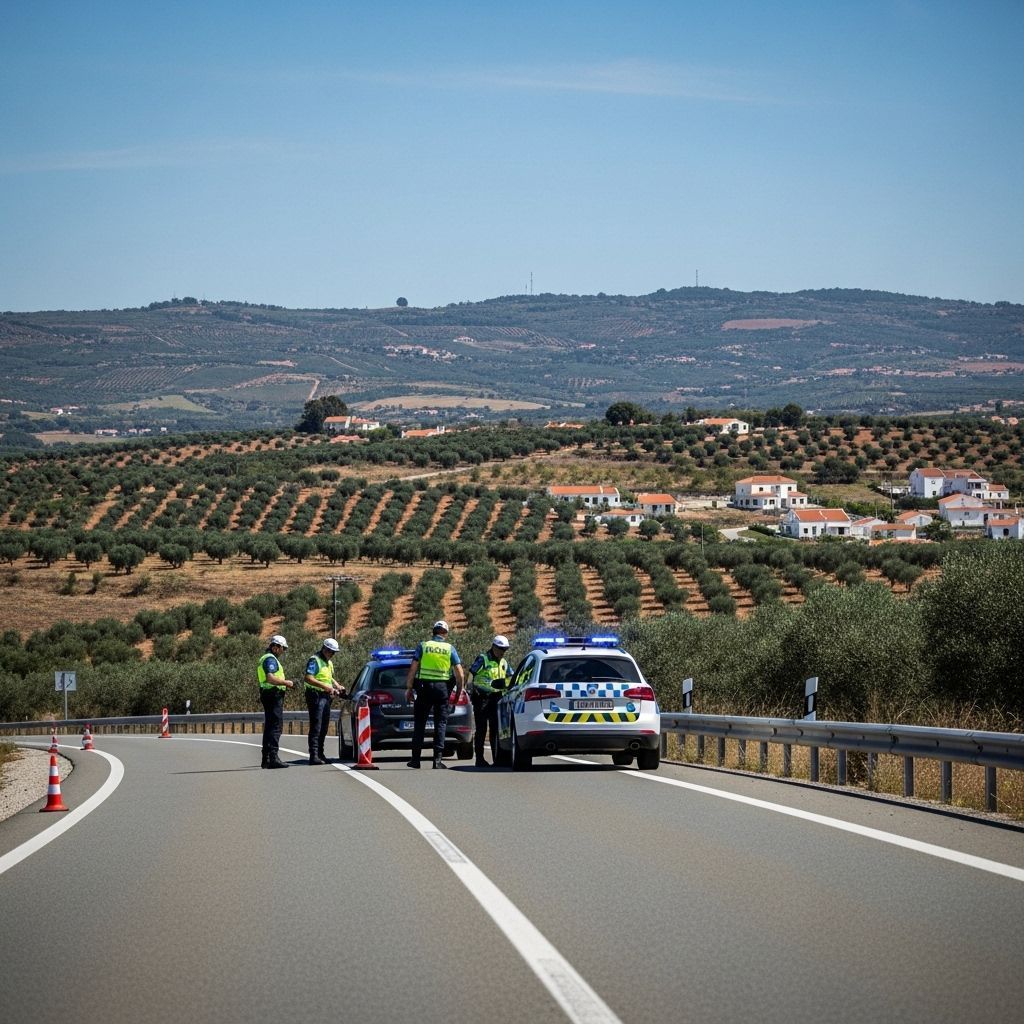
The Portugal Cabinet has pledged to deploy 400 additional PSP (Polícia de Segurança Pública) officers to Lisbon and Porto by the end of 2026, but the nation's main police union is calling what the union characterizes as a mathematical illusion—a promise that masks a net loss in operational strength. As 900 officers retire this year and recruitment pipelines produce a maximum of 1,253 graduates, the announced reinforcement may actually translate into fewer police on the streets, not more, according to union calculations.
Why This Matters
• Union claims net deficit: The ASPP/PSP argues that with 900 retirements versus 1,253 maximum graduates, Portugal faces a potential shortfall of at least 200 officers before any redeployments, though attrition during vetting could reduce final numbers further.
• Competing priorities: The government has already committed 200 officers to municipal forces in Lisbon and Porto, plus 300 to airports—leaving little headroom for the metropolitan commands.
• Operational impact: Police stations in Lisbon, Porto, and Setúbal are being reorganized to free 500 desk-bound officers for patrol duty, a move that may signal chronic understaffing rather than strategic reallocation.
The Government's Plan: 400 Officers, Two Cities
Prime Minister Luís Montenegro announced the reinforcement on May 12 after meetings with Lisbon mayor Carlos Moedas and Porto mayor Pedro Duarte. Under the plan, each city's PSP metropolitan command will receive 200 officers drawn from two training cohorts: 570 cadets graduating May 28 and approximately 683 more finishing by year-end.
Montenegro framed security as "a fundamental pillar of well-being, quality of life, and economic attractiveness" for the capital and Portugal's second-largest city. Alongside the personnel boost, the government intends to intensify Corpo de Intervenção (CI) riot-squad patrols in high-crime zones and reorganize administrative workflows at police stations across Lisbon, Porto, and Setúbal to redirect roughly 500 officers from paperwork to street patrols.
Municipal police forces are also slated for expansion: 100 additional officers in Lisbon and 80 in Porto. A parallel technology push aims to automate bureaucratic tasks, theoretically freeing more sworn personnel for operational duties.
The Union's Math: Scarcity Management, Not Growth
The Associação Sindical dos Profissionais de Polícia (ASPP/PSP) released a scathing statement hours after the announcement, labeling it a "narrative of convenience" built on what the union argues is flawed arithmetic. The union's core argument: you cannot allocate the same officer twice.
According to ASPP/PSP, the government has already earmarked 200 cadets for Lisbon and Porto municipal forces, 300 for airport security, and now 400 for metropolitan commands—a total of 900 positions. Yet the two training classes combined yield a maximum of 1,253 officers (570 + 683), and the union warns this figure "will be reduced further" due to attrition during vetting and physical tests. Subtract the 900 officers retiring in 2026, and the union contends Portugal's PSP ends the year with a net deficit, not a surplus.
"It is impossible to project 200 police to the municipal forces of Lisbon and Porto, 300 to airports, and 400 to metropolitan commands when the government itself admits 900 professionals will retire in the same period," the union wrote. "What is being announced is not reinforcement but scarcity management… the result will be an unprecedented operational emptying."
The union also accused the administration of prioritizing media exposure over structural solutions, citing stagnant wages, blocked pre-retirement approvals, and canceled rest days as symptoms of a devalued career. ASPP/PSP has filed legal challenges over the government's use of annual retirement quotas tied to budget constraints, arguing that officers who meet eligibility criteria—55 years of age or 36 years of service—should not be held hostage to fiscal calendars.
Pre-Retirement Bottleneck: 900 Exits, Two Waves
The Interior Ministry, led by Luís Neves, confirmed in late May that 900 PSP officers would enter pre-retirement in 2026, split into two tranches timed to the graduation of new recruits. This marks the first year since 2015 that Portugal has run two simultaneous police academy classes, a scheduling achievement the government touts as evidence of renewed investment.
But critics note that pre-retirement has become a flashpoint in labor relations. For years, only a handful of officers per year were permitted to retire early despite widespread eligibility, fueling burnout and attrition. The 2026 cohort of 900 retirees represents a policy reversal—yet it also drains the force of experienced personnel in a single year, compounding the challenge of maintaining institutional knowledge during rapid turnover. The sudden release of 900 experienced officers in a single year could affect response quality during the transition period, even as new recruits bring fresh energy to the force.
What This Means for Residents
For those living in Lisbon and Porto, the headline promise of 400 new officers may sound reassuring, but the fine print is less encouraging. If the union's arithmetic holds, the actual increase in visible patrols will depend less on fresh academy graduates than on the success of administrative reforms that pull desk officers into the field.
The reorganization of station services in Lisbon, Porto, and Setúbal is designed to liberate 500 officers for street duty—potentially a larger operational gain than the 400-officer deployment. However, shifting personnel from paperwork to patrols assumes that technology upgrades and process automation can absorb the administrative load, an assumption not yet proven in practice.
Residents should also note that municipal police expansions (180 officers combined) and airport security assignments (300 officers) will compete for the same talent pool. Portugal's police recruitment struggles are well-documented: applications to the 25th Agent Training Course (CFA), which opened April 27 and closes June 11, have lagged behind previous years, reflecting career devaluation and demanding entry requirements.
Research on police staffing effectiveness shows that raw headcount alone is a poor predictor of public safety outcomes. Training quality, civilian oversight, and data-driven deployment typically matter more than gross personnel figures. Portugal's challenge mirrors debates across Europe, where proposals to expand forces have stalled over questions of efficiency versus capacity. The government's emphasis on Corpo de Intervenção patrols in Lisbon and Porto's high-crime zones suggests a tactical focus, but success will hinge on whether those deployments are guided by crime analytics or other operational considerations.
The Political Backdrop: Mayors and Metrics
The timing of Montenegro's announcement, ahead of mayoral re-election campaigns and amid rising constituent concerns over property crime, gives the pledge added political significance. Security has become a focal point in his discussions with Moedas and Duarte, both of whom face re-election pressures. Promising 200 officers to each city addresses those concerns, even though those officers won't arrive until late 2026 and may be offset by retirements elsewhere.
The government has also signaled a willingness to invest in technology and intelligence systems, potentially reducing the time officers spend on manual reporting. If implemented effectively, this could multiply the impact of each sworn officer—a force multiplier that shifts the conversation from headcount to operational hours on patrol.
Yet the ASPP/PSP's broader critique remains unaddressed: career stagnation, blocked pre-retirements, and low morale undermine recruitment and retention alike. Until those structural issues are resolved, Portugal risks entering a cycle where each graduating class barely offsets departures, leaving the force perpetually short-staffed.
Bottom Line: A Numbers Game With Real Consequences
The pledge of 400 officers for Lisbon and Porto is arithmetically plausible but operationally fragile, according to union calculations. With 900 retirements, a maximum of 1,253 graduates, and competing deployments to airports and municipal forces, the net change in metropolitan police strength may be modest at best, negative at worst.
For residents, the more tangible shift may come from the reorganization of station workflows and the redeployment of 500 existing officers to patrol duties—if technology and process reforms deliver as promised. In the meantime, the standoff between the government and the police union underscores a deeper tension: can Portugal modernize its security apparatus without first valuing the professionals who staff it?
The answer will become clear not in press conferences but on the streets of Lisbon and Porto, where crime statistics, response times, and public confidence will ultimately render the verdict on whether 2026 marks a turning point or merely another chapter in a long-running staffing crisis.