

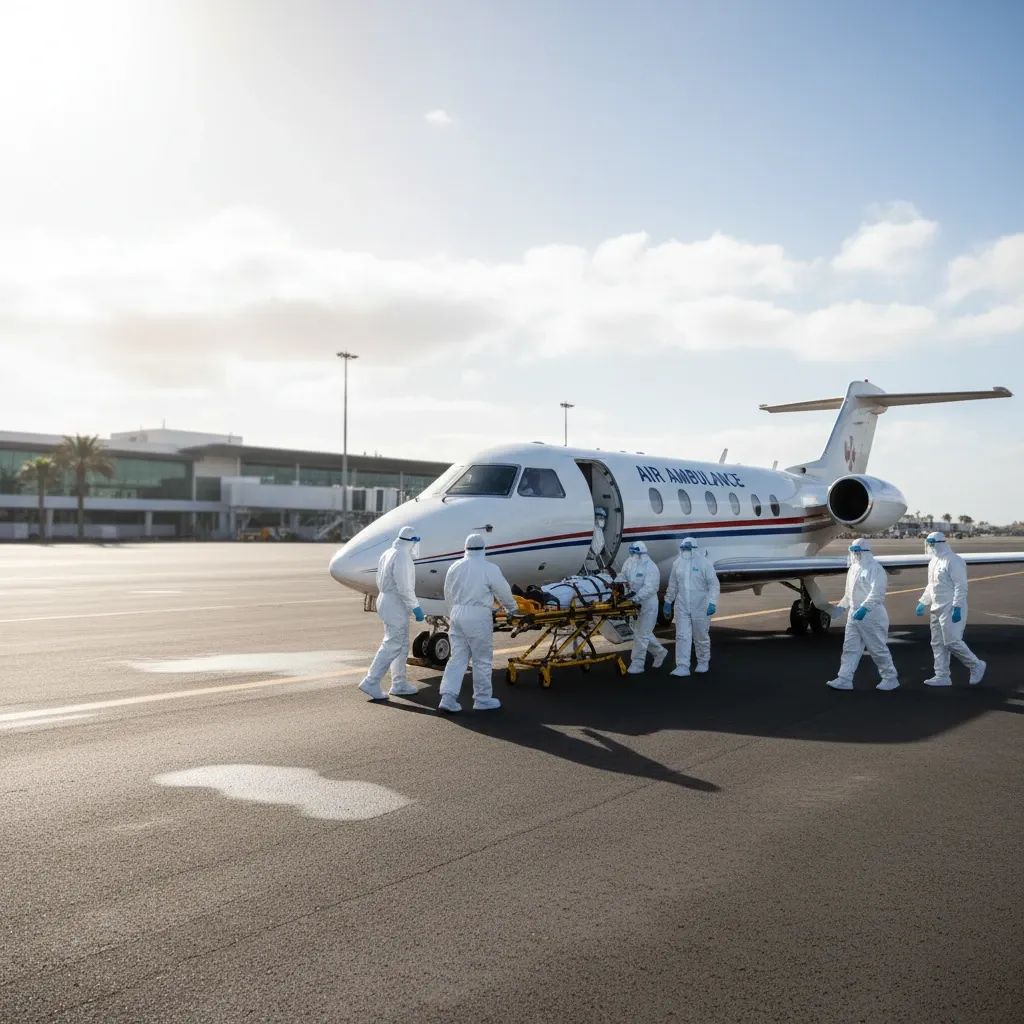
The Spanish Health Ministry completed a complex medical evacuation operation in Tenerife on May 10-11, 2026, after the cruise ship MV Hondius arrived carrying 147 people following a deadly hantavirus outbreak. In an operation Spanish authorities described as "unprecedented," passengers wearing full protective suits were transported through isolated corridors and loaded directly onto aircraft on the tarmac, prevented from any contact with local populations. Three passengers died and at least six others were infected during the voyage.
Among those evacuated was at least one Portuguese national, who was repatriated to the Netherlands along with other passengers, according to Spanish authorities.
Why This Matters:
• Travel Safety: The incident exposes vulnerabilities in cruise health protocols, particularly for voyages departing from South American ports where rodent-borne viruses are endemic.
• Atlantic Shipping Routes: The ship passed through Cape Verde before reaching the Canary Islands, demonstrating how infectious disease events in remote ocean regions can affect coordinated international responses.
• Transmission Risk: The Andes hantavirus strain detected aboard is the only known hantavirus variant capable of limited person-to-person transmission, a characteristic that complicates containment efforts.
• Public Health Response: The World Health Organization (WHO) and European Centre for Disease Prevention and Control (ECDC) coordinated the operation, establishing protocols for future maritime health emergencies.
The Evacuation Sequence
The MV Hondius anchored at the industrial port of Granadilla shortly after dawn on May 10, 2026, following a transatlantic voyage that began in Ushuaia, Argentina in early April. The ship had stopped at Saint Helena and Cape Verde before Spanish authorities granted permission for it to dock—over the objections of the Canary Islands regional government, which initially resisted the plan due to local concerns.
At 7:45 a.m. local time, a medical team from Spain's Foreign Health Service boarded the vessel to conduct final health assessments. By 9:30 a.m., the first passengers—clad in full protective suits and masks—descended into small boats that ferried them to the dock. From there, military vehicles transported them along a 10-kilometer isolated corridor to Tenerife South Airport, where repatriation flights were waiting on the tarmac.
The operation prioritized speed and containment. Passengers and crew were not permitted to leave the ship until their designated aircraft was prepared for immediate departure. No one walked through public terminal areas. The first group evacuated consisted of 14 Spanish nationals, who were flown to the Gómez Ulla Military Hospital in Madrid for quarantine and monitoring. Subsequent flights carried passengers to the Netherlands, Germany, Switzerland, and other European nations. The final repatriation flight, scheduled for the afternoon of May 11, was bound for Australia and carried six individuals of various nationalities.
Approximately 30 crew members remained aboard to sail the vessel to the Netherlands, where the ship is registered and owned by the company Oceandrive. Spanish Health Minister Mónica García emphasized that none of the people currently aboard showed symptoms of illness, but acknowledged the gravity of the situation given the virus's six-to-eight-week incubation period.
Understanding the Andes Hantavirus
Hantaviruses are typically zoonotic diseases transmitted by rodents through aerosolized urine, feces, or saliva. Most strains do not spread between humans. The Andes virus, however, is a documented exception. Endemic to Chile and Argentina, it is the only hantavirus strain known to transmit from person to person, though transmission is inefficient and typically requires prolonged close contact—shared beds, intimate partners, or direct exposure to respiratory secretions.
The virus causes Hantavirus Cardiopulmonary Syndrome (HCPS), which begins with flu-like symptoms—fever, fatigue, muscle aches—and can progress to severe respiratory distress and fluid accumulation in the lungs. The fatality rate in the Americas is approximately 40%, though this figure reflects severe cases requiring hospitalization; early detection and supportive care improve outcomes substantially. Infected individuals are most contagious during the prodromal phase, the initial days when symptoms resemble a common cold.
In the MV Hondius outbreak, the WHO confirmed six laboratory-verified cases out of eight suspected infections. Three passengers died. Four others were hospitalized in South Africa, the Netherlands, Germany, and Switzerland. One British passenger in Johannesburg was reported in critical but stable condition. An asymptomatic evacuee returned to Germany for observation. The infection is believed to have originated before embarkation, likely in Argentina or Chile, where passengers may have encountered infected rodents during pre-cruise excursions or accommodations.
What This Means for Travelers and Residents
For anyone in Portugal considering cruises to South America or the South Atlantic, this incident underscores the importance of scrutinizing health and pest control protocols before booking. The cruise industry has historically managed common shipboard illnesses effectively but has limited experience with zoonotic diseases originating in remote ecosystems. The MV Hondius departed from Ushuaia, a gateway to Antarctica and Patagonian wilderness where rodent populations carry hantavirus reservoirs.
International health authorities, including the WHO, ECDC, and U.S. Centers for Disease Control and Prevention (CDC), have issued updated guidance for cruise operators. Key recommendations include:
• Enhanced Rodent Control: Comprehensive pest management programs, particularly for ships docking in South American ports where hantavirus is endemic.
• Environmental Hygiene: Rigorous cleaning protocols, avoiding dry sweeping that could aerosolize virus particles, and ensuring adequate ventilation.
• Symptom Monitoring: Active health surveillance for passengers and crew, with immediate isolation of anyone exhibiting respiratory symptoms.
• Contact Tracing: Identifying and monitoring individuals exposed to confirmed cases, even those who disembarked before the outbreak was identified.
• Infection Control Training: Adoption of hospital-grade infection prevention practices, including use of medical masks and respiratory etiquette.
The WHO has classified the overall public health risk as low, noting that the Andes virus does not spread as efficiently as airborne pathogens like measles or COVID-19. The risk remains moderate only for individuals who shared confined spaces with infected passengers during the voyage. Authorities tracked passengers who disembarked in Cape Verde and Saint Helena, expanding surveillance across multiple jurisdictions.
Practical Guidance for Portugal-Based Travelers
If you're based in Portugal and considering South Atlantic or Antarctic cruises, several practical steps can reduce risk:
Before Booking:
• Request detailed information about pest control programs, particularly for ships docking in Argentina, Chile, or other South American ports.
• Verify that the cruise operator has established protocols for identifying and isolating passengers with respiratory symptoms.
• Check whether travel insurance covers outbreak-related scenarios or cruise cancellations due to infectious disease.
Pre-Departure:
• Review your pre-cruise accommodations, especially in high-risk regions. Request information about pest control measures at hotels or lodges.
• Monitor Portuguese health authority guidance from the Direção Geral da Saúde (DGS) for any specific recommendations regarding cruise travel to these regions.
• Consider consulting your physician if you have underlying health conditions that may complicate hantavirus or other infectious diseases.
During the Voyage:
• Report any flu-like symptoms to the ship's medical staff immediately, even if they seem minor.
• Maintain good hygiene practices and avoid close contact with anyone showing respiratory symptoms.
• Follow all crew instructions regarding health protocols or isolation procedures.
Regional and Political Context
The arrival of the MV Hondius in Tenerife sparked local protests and political tension. Residents of the Canary Islands voiced concerns about potential virus transmission, despite assurances from Spanish and international health officials. The central government in Madrid overruled regional objections, invoking maritime safety obligations and humanitarian duty to provide medical assistance.
For Portugal, which maintains close ties with Cape Verde and other Atlantic archipelagos, the incident illustrates how maritime health crises can test governance structures and emergency response coordination across island communities.
Long-Term Implications for Cruise Safety
The MV Hondius outbreak represents an instructive case study for the cruise industry. Unlike the 1993 Sin Nombre hantavirus outbreak in the Four Corners region of the United States, which involved direct rodent exposure in rural cabins, this incident highlighted contamination risks before embarkation rather than aboard the ship—a distinction that shifts focus to pre-cruise accommodations and excursions.
Some epidemiologists have noted the presence of "superspreaders" in past Andes virus outbreaks, such as the 2018-2019 cluster in Epuyén, Argentina, where certain individuals infected more than two secondary contacts. Voluntary isolation measures proved effective in reducing transmission. On the MV Hondius, the confined quarters likely facilitated spread among passengers sharing cabins or common areas.
The cruise industry may adopt stricter pre-boarding health declarations and enhanced screening for travelers returning from high-risk regions. For Portugal-based travelers, this could mean additional health documentation or medical checks for cruises departing from or transiting through South American ports.
The Bottom Line
The MV Hondius incident serves as an important case study for the global cruise sector and passengers alike. While the Andes hantavirus remains rare and difficult to transmit between humans, its 40% fatality rate in severe cases and documented person-to-person transmission capability merit serious consideration. For anyone in Portugal planning South Atlantic or Antarctic voyages, the lesson is straightforward: inquire about pest control measures at your accommodation before departure, verify the operator's infection response protocols, and report any illness to ship medical staff promptly. The WHO and ECDC have established new benchmarks for maritime health emergencies, but prevention begins with informed decisions before boarding.


