

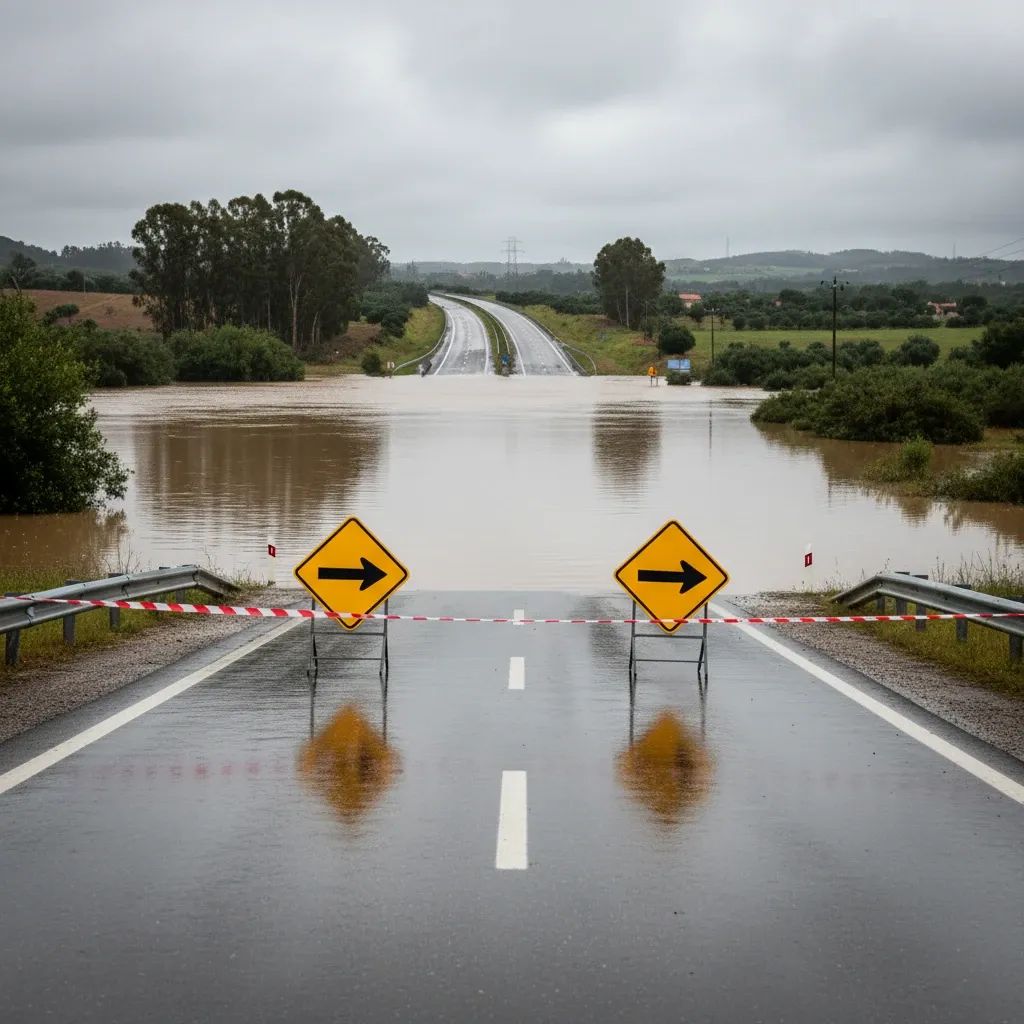
The Portugal Republican Guard (GNR) has shut more than 100 roads after a fortnight of nonstop winter storms, a move that is rerouting commuters and triggering a short-term toll holiday on several motorways.
Why This Matters
• A14, IC9 and IC1 closures sever key Atlantic-to-interior corridors used by holidaymakers and freight.
• Toll-free detours on the A8, A17, A14 and A19 run until 10 February, shaving up to €9 off a Lisbon-Porto round trip.
• 400 M€ repair budget already approved; expect rolling night-time works through spring.
• 68 municipalities under calamity status face stricter parking bans near riverbanks and hillside roads.
What Happened—and Where
Three successive depressions—Kristin, Leonardo and Marta—drenched the country, saturating soils and pushing rivers such as the Mondego and Sado over their banks. Floodwater and landslides forced blockades on the A14 between Coimbra and Figueira da Foz (Maiorca exit plus Casal do Raposo and Ferrestelo junctions). Farther south, the IC9 is cut near Alcobaça and Vale dos Ovos, while the IC1 in Grândola is under water between Isaías and the IC33/IP8 roundabout.
Beyond the headline routes, drivers now face restrictions on 77 national roads (EN) and 66 municipal arteries, from the Beira Interior hills to the Algarve’s low-lying Guadiana valley.
Detours & Toll Relief
To keep the supply chain moving, the Portugal Infrastructure Authority (IP) and the Finance Ministry slapped a temporary toll waiver on the A8, A17, A14 and A19 for vehicles entering or exiting the flood zone. Freight operators are diverting via the EN335 or hopping over to the A17 to skirt the closed A14 stretch. Local councils have installed yellow detour signs at parish boundaries; ignore them and navigation apps will loop you back into gridlock.
How Fast Can Repairs Happen?
Lisbon released a €400 M emergency tranche to IP, part of a larger €2.5 B restoration package that also covers rail embankments. Crews have already laid 110 t of cold asphalt and stabilised two A14 embankments, but engineers warn that ongoing rain keeps talus slopes fragile. Current best guess: major motorways reopen in phases before Easter, while lower-volume municipal lanes could stay one-way into early summer.
What This Means for Residents
• Commuters between Coimbra and the coast should budget an extra 20–40 min each way or switch to the regional train, which is running but packed.• Small firms moving goods from Oeste horticultural hubs may claim fuel and delay allowances under the government’s calamity decree—paperwork opens next week at Finanças portals.• Landlords whose access roads remain blocked can defer IMI property tax by a quarter without penalty; municipal officers will issue eligibility letters.• Home insurers classify these floods as an act of nature; photograph damage and file within 8 days to avoid payout reductions.
Travel-Safety Checklist
Check Infovias GNR or the Proteção Civil live map before driving; radio reports lag by an hour.
Pack a high-visibility vest, phone power bank and basic tools—rescue teams prioritise life-threatening calls.
Never cross water over axle depth; a 30 cm flow can sweep a two-ton car. Police fines for rule-breaking reached €250 last week.
Park well away from eucalyptus stands; saturated roots make them topple without warning.
Historical Perspective
Portugal is no stranger to catastrophic floods—1967’s Lisbon deluge killed 700, while the Douro overflow of 1876 cut Porto off for weeks. What makes 2026 different is its geographic spread: closures stretch 300 km from Aveiro to the Alentejo, testing a motorway grid that rarely goes dark all at once. Climate scientists at the University of Lisbon note that only six rain-free days were recorded between early December and now, the longest wet streak in modern archives.
The Road Ahead
IP planners are already mapping elevated causeways and smart drainage on the A14 corridor, projects likely to surface in next year’s Public Investment Plan. Meanwhile, the Portugal Civil Protection Authority urges residents to stay home when red alerts pop up—each avoided trip eases strain on overstretched responders and speeds the nation’s return to business as usual.


