

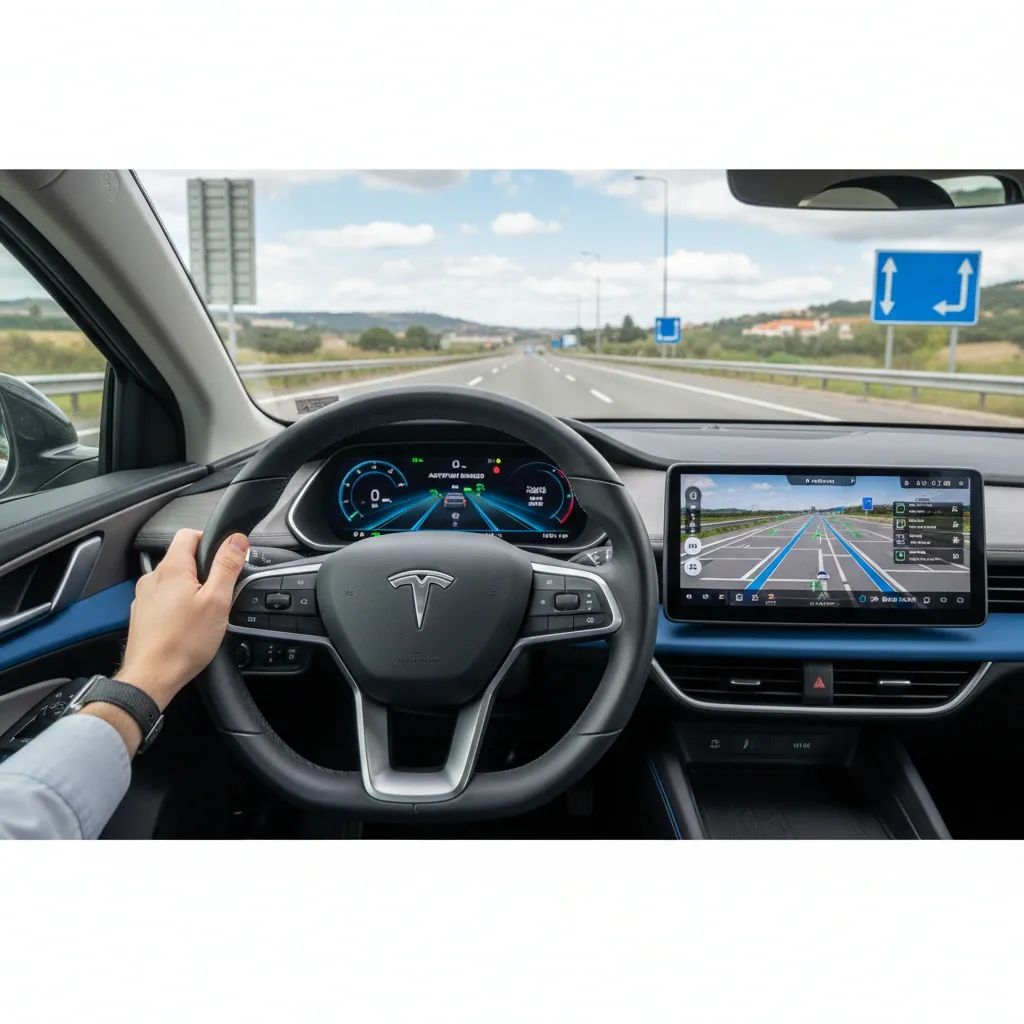
The Tesla Full Self-Driving system has received regulatory clearance to operate on public roads in the Netherlands, marking the first time the technology has been authorized for consumer use anywhere in the European Union. For residents across the continent—including Portugal—the approval carries significant implications for pricing, availability, and the broader shift toward automated driving on European roads.
Why This Matters
• Pricing now public: A one-time purchase costs €7,500 for Full Self-Driving (Supervised), with €3,500 for Enhanced Autopilot. Monthly subscriptions are available at €99 for basic Autopilot users and €49 for those already holding Enhanced Autopilot.
• Portugal could follow: The Dutch regulatory approval may facilitate broader EU authorization through mutual recognition processes, with potential availability in Portugal dependent on European Commission coordination.
• Driver remains liable: Despite its name, Full Self-Driving (Supervised) is classified as a Level 2 assistance system—the driver stays legally responsible at all times and must actively monitor the vehicle.
• Hardware dependency: Only vehicles equipped with Hardware 4 (HW4) can access the approved system; older Hardware 3 (HW3) vehicles are not supported.
What the Dutch Approval Means
The Dutch Road Vehicle Authority (RDW) has granted Tesla authorization to deploy its Full Self-Driving (Supervised) technology on public roads across the Netherlands. This represents a significant regulatory milestone, as the RDW is one of the EU's primary type-approval bodies. The approval is expected to support Tesla's request for EU-wide mutual recognition, which would streamline deployment across other member states without requiring repeated validation processes in each country.
The European Commission will coordinate the next steps in expanding authorization across member states. Individual EU countries retain discretion over final approval timelines and implementation requirements. The UN/ECE regulatory framework continues to evolve to support autonomous vehicle deployment across Europe, though specific dates for broader rollout remain uncertain.
Pricing Structure for European Markets
Tesla has announced the following purchasing options for the Netherlands, which are likely to serve as reference points for other EU countries:
• One-time purchase: €7,500 for Full Self-Driving (Supervised); €3,500 for Enhanced Autopilot
• Monthly subscription: €99 per month for drivers with basic Autopilot; €49 per month for those who already own Enhanced Autopilot
The availability of outright purchase options alongside subscription models gives European consumers flexibility in how they access the technology.
What Full Self-Driving Actually Does—And Doesn't Do
Full Self-Driving (Supervised) is classified as a Level 2 advanced driver-assistance system (ADAS). This means the driver must keep hands on the wheel, eyes on the road, and remain fully responsible for safe operation of the vehicle. The system provides assistance with:
• Urban navigation: Including traffic-light and stop-sign recognition, and assistance with complex intersections
• Highway functions: Lane changes, merging, and on- and off-ramp handling
• Continuous driver supervision: The driver cannot engage in other activities and must remain ready to take control at any moment
Before activating the feature, drivers must confirm their understanding of the system's capabilities and limitations. The system operates within preset parameters calibrated for European road conditions.
Impact on Portugal Residents
Portugal recently enacted decree-law provisions allowing autonomous-vehicle testing on public roads, subject to strict safety and licensing requirements. This regulatory framework signals Portugal's preparedness to participate in the broader EU rollout once mutual recognition and national-level approval processes are completed.
For Portuguese Tesla owners, several practical considerations apply:
• Hardware eligibility: Only vehicles with HW4 can run the approved FSD (Supervised). Owners of older models with HW3 will not have access to this feature.
• Legal liability: Portuguese traffic law holds the driver accountable for all actions of the vehicle. Engaging FSD (Supervised) does not transfer responsibility to Tesla.
• Insurance implications: Insurers may adjust premiums or coverage terms once the system becomes widely available; policyholders should verify whether use of Level 2 automation affects their existing contracts.
• Timeline uncertainty: While EU authorization is progressing, specific rollout dates for Portugal depend on European Commission coordination and national regulatory approvals.
How Competitors Are Responding
While Tesla has achieved the first consumer-facing Level 2 authorization in the EU, European manufacturers are pursuing varied strategies:
• BMW has announced a shift away from Level 3 conditional automation in flagship models, citing high per-vehicle costs and limited real-world advantages. The automaker is focusing instead on Level 2+ "hands-off" highway assistance that maintains the requirement for continuous driver monitoring.
• Volkswagen is investing in Level 4 robotaxi services, testing autonomous vehicles in pilot programs and planning expansion of driverless operations in European cities in coming years.
• Audi is enhancing Level 2 ADAS across its 2026 lineup with improved driver monitoring and navigation features.
These divergent approaches reflect an industry-wide debate about whether to refine supervised assistance systems incrementally or pursue fully autonomous fleet services.
Regulatory Context
Europe's regulatory environment differs significantly from the United States, with stricter requirements for steering-wheel control, lane-change protocols, and driver monitoring. The EU's emphasis on precise, verifiable system behavior has shaped Tesla's design modifications for the European market.
Regulators continue to monitor the safety implications of autonomous assistance systems. The European Transport Safety Council (ETSC) has called for comprehensive monitoring frameworks, including mandatory incident reporting and centralized consumer complaint systems for automated vehicles, as these technologies expand across member states.
What Comes Next
The Dutch approval establishes a precedent for EU-wide expansion, but widespread adoption depends on several factors: regulatory harmonization across member states, insurer willingness to underwrite policies covering Level 2 systems, and public acceptance of shared-road automation.
For now, Portuguese Tesla owners with HW4-equipped vehicles should monitor official communications from Tesla Europe and the Portuguese Institute of Mobility and Transport (IMT) for confirmation of local availability. As automated driving transitions from experimental deployment to consumer availability, the legal, financial, and safety considerations for European residents—including those in Portugal—will continue to develop.


