

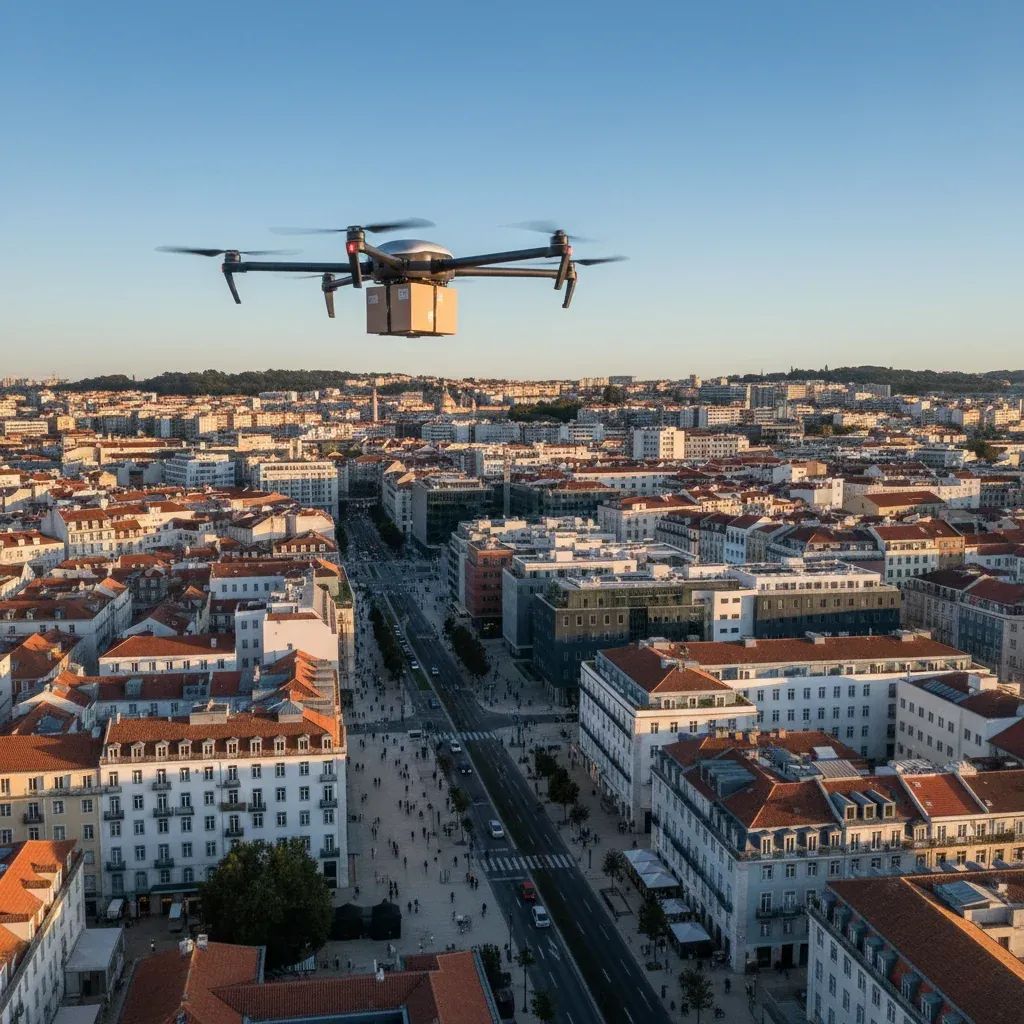
The Portugal logistics sector is watching closely as Ireland becomes Europe's proving ground for a commercial drone delivery revolution—one that could reshape how residents across the continent receive everything from phone chargers to prescription medication. The Uber platform has officially partnered with Manna, an Irish drone delivery startup, marking the first time the ride-hailing giant has integrated autonomous aerial logistics into its European operations. This move sets the stage for potential expansion into Portugal and other EU markets, provided regulatory hurdles and local acceptance follow suit.
Why This Matters
• Ireland as the European testbed: Manna has completed over 250,000 drone deliveries across Dublin, Helsinki, and Dallas, doubling its 2025 volume. Ireland plans nationwide coverage by end-2026.
• Regulatory framework already in place: The European Union Aviation Safety Agency (EASA) harmonized drone rules across all 27 EU member states in December 2020, meaning Portugal's ANAC operates under the same legal structure as Ireland's aviation authority.
• Environmental edge: Studies show electric drones can cut greenhouse gas emissions by 84% and energy consumption by 94% per parcel compared to diesel vans—a significant gain for urban last-mile logistics.
• Noise and privacy friction: Local opposition in Dublin suburbs has stalled hub applications due to noise complaints, a pattern that could repeat in Lisbon or Porto if expansion proceeds.
How the Uber-Manna System Works
Under the partnership, Uber Eats customers in designated Irish zones can order small items—medications, phone accessories, takeaway meals—and receive them via autonomous drone within approximately three minutes. The aircraft fly pre-approved routes, descend to a low altitude above the delivery address, and lower parcels by tether. No human pilot boards; operations are monitored remotely from ground control stations.
Manna's Dublin 15 hub in Blanchardstown alone processes roughly 5,000 deliveries per month, totaling over 60,000 flights from that single node. CEO Bobby Healy has stated his ambition to blanket nearly every Dublin suburb within the next 12 months, which would make the Irish capital the world's largest drone delivery footprint by volume.
For Portugal residents, the relevant takeaway is infrastructure readiness. If Uber and Manna prove the model in Ireland, the same playbook—urban hubs, three-minute radius coverage, integration with existing food and pharmacy delivery apps—could roll out to Lisbon's Parque das Nações, Porto's Boavista, or Braga's outer suburbs within 18 to 24 months, assuming ANAC grants specific-category authorizations under EASA Regulation 2019/947.
Regulatory Landscape: What Portugal Shares with Ireland
Both countries operate under the EASA framework, which divides drone operations into three risk tiers:
• Open Category: Low-risk, visual line-of-sight flights under 120 meters altitude, drones under 25 kg. No prior authorization needed, but registration required for aircraft over 250 grams.
• Specific Category: Medium-risk operations—beyond visual line-of-sight (BVLOS), flights over people, commercial deliveries. Requires a detailed Specific Operations Risk Assessment (SORA) or pre-defined PDRA scenario approval from the national aviation authority.
• Certified Category: High-risk operations such as passenger air taxis or hazardous cargo, subject to full aircraft certification.
Commercial drone delivery in urban areas falls squarely into the Specific Category. That means any operator launching in Portugal must submit a SORA dossier to ANAC, detailing flight corridors, collision-avoidance systems, emergency protocols, noise mitigation, and cybersecurity safeguards. Manna's Irish operations have already navigated this process, giving them a head start if they seek Portuguese authorization.
Portugal's Decreto-Lei n.º 87/2021 integrates the EU regulations into national law, adding administrative procedures specific to ANAC. Operators must also comply with GDPR if onboard cameras or sensors capture identifiable faces or license plates during flight—a non-trivial data-protection obligation that requires impact assessments and data minimization protocols.
What This Means for Residents
If drone delivery expands to Portugal, expect these practical changes:
Faster emergency access: Pharmacies could deliver insulin, epinephrine auto-injectors, or urgent prescriptions in under five minutes, bypassing Lisbon's notorious rush-hour gridlock along Avenida da Liberdade or Porto's VCI.
Lower carbon footprint: Electric drones eliminate tailpipe emissions. A 2019 Nature Communications study found that battery-powered drones generate 84% less CO₂ per parcel than diesel delivery vans. For a country committed to the EU Green Deal, this aligns with national decarbonization targets.
Noise friction in residential zones: Dublin residents near proposed Tallaght and Dundrum hubs have filed objections citing propeller noise. Manna is retrofitting quieter rotors, but expect similar pushback in Cascais, Oeiras, or Matosinhos if hubs are sited near apartment blocks. Planning permission battles could delay rollout by six to twelve months.
Geofencing and airspace constraints: Lisbon Portela Airport's control zone, military training areas near Évora, and protected natural parks like Peneda-Gerês will be off-limits. Urban corridors will require coordination with NAV Portugal, the country's air-navigation service provider.
Price and availability: Uber has not disclosed surcharges for drone delivery, but early adopters in Dallas and Dublin report fees ranging from €1 to €3 per order. Expect premium pricing during the pilot phase, dropping as volume scales.
The Competitive Landscape
Uber is not alone in eyeing European skies. Amazon Prime Air announced plans to deliver 500 million parcels annually via drone by 2030, with expansion into Italy and the United Kingdom already underway. Wing Aviation (owned by Alphabet) operates in Finland and has partnerships in Australia. Zipline, a rival to Manna with hundreds of millions in venture funding, specializes in long-range medical deliveries and has held exploratory talks with EU health ministries.
Closer to home, Portugal's Tekever—known for defense and surveillance drones—has announced major production investments in France and the UK for 2026 and beyond. While Tekever's primary focus remains military and border-security applications, its engineering capacity and European footprint position it as a potential domestic competitor if it pivots toward commercial logistics.
Uber's competitive advantage lies in platform leverage. The company's Uber Eats app already reaches millions of European users, and integrating drone dispatch requires only a software toggle and regulatory clearance. Manna brings proven hardware and flight operations; Uber supplies customer base, payment infrastructure, and merchant relationships. That combination is harder for a pure-play drone startup to replicate.
Environmental Benefits and Safety Trade-Offs
Electric drones powered by renewable energy grids offer a compelling sustainability case. Beyond the 84% emissions reduction per parcel, drones also ease urban congestion—fewer delivery vans double-parking on narrow Lisbon streets or blocking tram lanes in Porto's Ribeira district.
However, safety concerns remain front and center:
Collision risk: Drones must navigate around buildings, power lines, birds, and other aircraft. Advanced GPS, LiDAR sensors, and AI-powered obstacle avoidance are standard, but no system is fail-proof. A 2025 study presented at Brazil's SBRC symposium proposed Stochastic Petri Net models to evaluate collision probability, recharge-point placement, and mission completion rates—metrics that regulators like ANAC will scrutinize before granting BVLOS authorizations.
Cybersecurity: Connected drones are vulnerable to hijacking, spoofing, and malware. EASA mandates encrypted command links and redundant fail-safe protocols, but the threat of criminal misuse—surveillance, contraband smuggling, or worse—requires constant vigilance.
Weather sensitivity: Wind, rain, and fog can ground fleets. Portugal's Atlantic coast sees frequent autumn storms and strong westerly gusts, which may limit operational uptime compared to drier inland regions.
Privacy concerns: Onboard cameras and flight logs can inadvertently capture personal data. GDPR Article 35 requires operators to conduct Data Protection Impact Assessments (DPIA) and implement data minimization—anonymizing video feeds, deleting logs after a set retention period, and notifying residents of overflights.
Expansion Timeline and Next Steps
Manna aims to operate nationwide in Ireland by December 2026. If that milestone is met, Uber has indicated it will evaluate additional European cities. Portugal is a logical candidate: moderate population density in coastal urban belts, strong tech adoption (the country ranks high in EU digital economy indices), and a government actively courting logistics innovation to boost GDP growth.
ANAC has not yet received a formal drone-delivery application from Uber or Manna, according to public records through early 2026. The agency's approval process typically spans six to nine months for Specific Category operations, factoring in SORA review, public consultation, and coordination with NAV Portugal.
For Portugal-based e-commerce platforms, pharmacies, and retailers, the strategic question is whether to partner early or wait. CTT Expresso and other local couriers could find themselves competing with a faster, cheaper, zero-emission alternative—or they could become customers, outsourcing last-mile delivery to drone networks.
What Residents Should Watch For
Planning applications: If Manna or a rival files for a delivery hub in your municipality, expect public notice periods. In Dublin, residents in Tallaght successfully forced a withdrawn application due to noise and planning irregularities. Portuguese law grants similar consultation rights under Decree-Law 87/2021 and municipal planning codes.
Noise assessments: Manna is rolling out quieter propellers in response to complaints. Ask your Câmara Municipal to require decibel limits and operational curfews (e.g., no flights before 8:00 or after 22:00) as conditions of approval.
Insurance and liability: Who pays if a drone crashes onto your balcony or damages your car? EASA requires operators to carry third-party liability insurance, but coverage minimums vary by member state. Portugal's insurance regulator, ASF (Autoridade de Supervisão de Seguros e Fundos de Pensões), has not yet published specific guidelines for drone-delivery claims. Clarify this before the first hub opens.
Job displacement: Traditional couriers, moto-delivery riders, and last-mile drivers may face reduced hours if drones capture 10% to 20% of small-parcel volume. Labor unions and gig-economy advocacy groups are already raising concerns in Ireland; expect parallel debates in Portugal.
The Road Ahead
Uber's Irish drone partnership is a clear signal that aerial delivery is moving from trial phase to commercial scale in Europe. For Portugal, the opportunity lies in early regulatory engagement—balancing innovation incentives with community protection, privacy safeguards, and environmental standards. The technology exists, the legal framework is harmonized, and the infrastructure investment is modest compared to traditional logistics. What remains uncertain is public acceptance, local planning cooperation, and whether the promised benefits—speed, sustainability, cost savings—outweigh the friction of noise, privacy, and job disruption.
Residents should monitor ANAC's authorization pipeline, municipal planning portals, and Uber Eats app updates in the coming quarters. If Ireland's experiment succeeds, Lisbon, Porto, and Faro could see their first commercial drone deliveries before the end of 2027.


