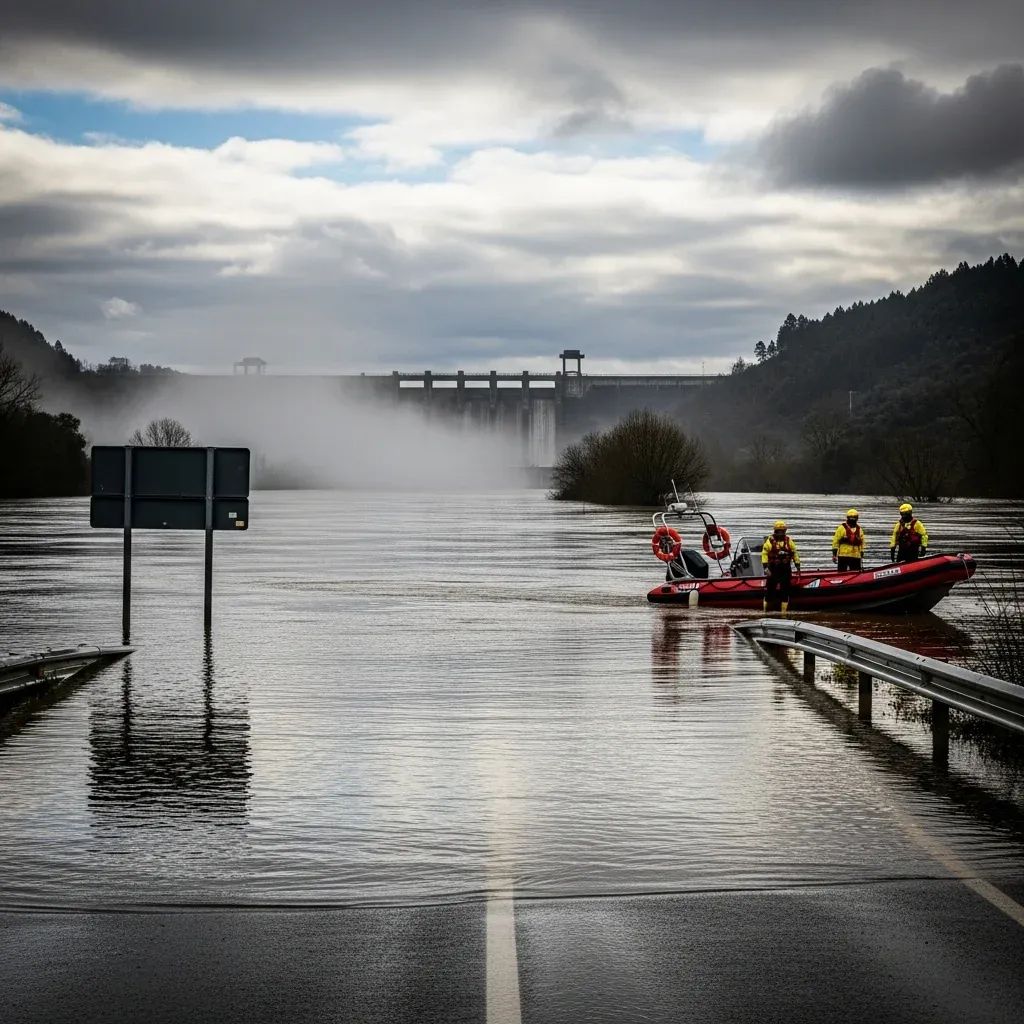
The Portugal Civil Protection District Commission of Santarém downgraded its Tagus River flood emergency plan to blue alert on February 21, marking the lowest risk level after weeks of unprecedented flooding across central Portugal.
Why This Matters:
• Monitoring shifts to 24-hour intervals — authorities are scaling back emergency operations as river flow at Almourol dropped to 1,498 m³/s, down from a catastrophic peak of 9,057 m³/s on February 6
• More than 100 roads remain damaged or flooded in Santarém district, especially across the Lezíria floodplain where standing water may persist for weeks
• The alert system progression: Yellow (January 24) → Red (February 5) → Yellow (February 16) → Blue (February 21)
What the Blue Alert Means for Residents
The Médio Tejo sub-regional Civil Protection Command confirmed that while the river has returned to its normal channel in the middle Tagus basin, the Lezíria floodplain still has extensive areas underwater. David Lobato, the sub-regional commander, noted that authorities expect to return to normality in the coming days, allowing full deactivation of the special flood plan.
The four-tier system — blue, yellow, orange, and red — was first activated on January 24 at yellow level as water levels surged. It escalated to red alert on February 5 when flow reached 8,600 m³/s at the Almourol measurement point, driven by massive discharges from Spanish dams Alcántara and Cedillo, which released approximately 7,000 m³/s into the Tagus. Combined with Portuguese tributary flows and intense rainfall across the region, the river crested in the early hours of February 6.
Authorities reduced the alert to yellow on February 16, then to blue on February 21 as upstream dam releases decreased and rainfall subsided.
Slow Retreat of Floodwaters Delays Recovery
While the Tagus is receding, the Portugal Environment Agency (APA) warns that drawdown in flooded zones is considerably slower than the inundation process itself. Water retreat depends on soil infiltration rates and surface drainage capacity, both of which are hampered by saturated ground across the basin.
The Lezíria do Tejo, a historically flood-prone agricultural belt that includes Azambuja, Benavente, and Coruche, remains significantly affected by standing water. Farmland, irrigation systems, and storage facilities sustained damage, and many fields will require time before returning to productive use.
Local authorities emphasize that residents should drive cautiously and use alternative routes that have been cleared. The district commission notes that while fluctuations from Spanish inflows remain possible, the Tagus is not expected to overflow again.
Current Status of Emergency Response
Municipalities across the basin have launched cleanup operations, road repairs, and damage assessments. More than 100 roads in Santarém district require restoration work, with priority given to reopening critical transportation routes.
Two Médio Tejo municipalities — Ferreira do Zêzere and Ourém — have not yet deactivated their local emergency protocols, so the district emergency plan remains active in these areas.
Residents are advised to monitor local municipality signage and official communications as water levels continue to recede and access is gradually restored to affected areas.
Spanish Dam Management and Iberian Coordination
The role of Spanish reservoir management in the flooding has drawn attention. Alcántara and Cedillo dams, located upstream on the Tagus in Spain, released flows exceeding 7,000 m³/s during the storm sequence. When combined with Portuguese basin inflows, the combined discharge pushed the Tagus to levels not seen in many years.
The APA noted that the coordinated releases from multiple sources were necessary to prevent dam failures, but the sheer volume tested downstream flood defenses. Long-term resilience planning will require continued coordination between Portuguese and Spanish authorities to manage upstream releases more effectively and improve early-warning systems.