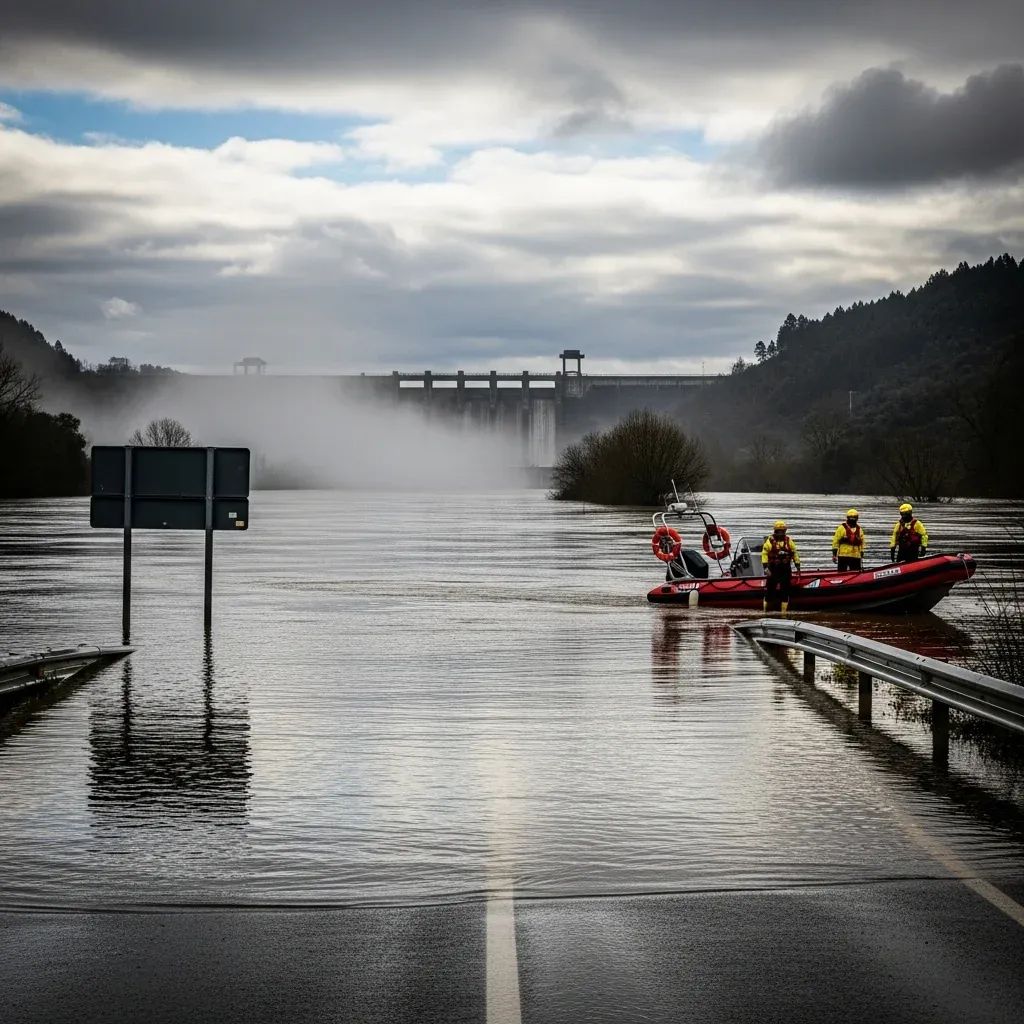
The Portugal Civil Protection Authority has downgraded the Tagus River flood emergency protocol from red to yellow as of the morning of 20 February, marking a cautious shift toward recovery after weeks of sustained high water levels that left the breadbasket Lezíria region underwater and racked up €107.9 million in agricultural damage across Lisbon and Vale do Tejo by mid-month.
The decision, formalized at 09:00 by the Santarém District Civil Protection Commission, reflects a tangible drop in river discharge—from a peak of 9,057 cubic meters per second on 6 February to 2,284 m³/s at the Almourol monitoring station as of 10:00 today. Yet the yellow alert remains in place indefinitely, as dozens of roads stay impassable, farmland sits submerged, and cleanup crews face weeks of work to restore basic infrastructure in eleven municipalities.
Why This Matters
• Economic toll is staggering: The Lezíria do Tejo alone reports €28 million in agricultural losses, with Azambuja leading at €8.7 million, Benavente at €3.7 million, and Coruche at €3 million. Greenhouses, silos, and irrigation systems absorbed €61.9 million in structural damage.
• Travel disruptions persist: Over 100 roads in Santarém district remain closed or hazardous due to submersion, landslides, and washouts. Commuters and freight operators should expect detours and delays for the next several weeks.
• Energy and water services fragile: As of this writing, 11,000 customers remain without electricity, and scattered water-supply interruptions continue in flood-affected zones.
• Agricultural calendar disrupted: Winter cereal sowing was entirely aborted in waterlogged Lezíria and Baixo Sorraia, while root asphyxiation killed early-planted crops and stunted forage growth for livestock.
What the Yellow Alert Means for Residents
David Lobato, sub-regional commander for Mid-Tagus Civil Protection, told the press that the yellow status will hold for "several days, because many constraints remain on roads and completely flooded zones." Translation: Do not assume normal life has resumed. Authorities will maintain permanent surveillance and expect residents to:
• Avoid driving or walking through any standing water—depth and current can deceive, and sinkholes may lurk beneath.
• Keep valuables, machinery, and livestock clear of low-lying parcels until an official all-clear.
• Monitor updates via Civil Protection channels and local media; conditions can shift with upstream releases from Spanish reservoirs.
The alert escalation timeline underscores how fast the crisis intensified. On 24 January, the plan activated at yellow. By 5 February, forecasters anticipated heavy Spanish dam releases and relentless rain, prompting an immediate leap to red as a precautionary measure—even though flows had not yet breached the 10,000 m³/s threshold. That prudence proved justified: peak discharge hit 9,057 m³/s at 01:00 on 6 February, inundating tens of thousands of hectares.
Damage Breakdown: Who Paid the Highest Price
While no fatalities or serious injuries were recorded—a testament to timely evacuations and public compliance—economic and environmental scars run deep. Lisboa e Vale do Tejo Region logged €107.9 million in agricultural claims by 19 February, broken down as follows:
• Permanent crops: €20.8 million (orchards, vineyards).
• Temporary crops: €7.3 million (cereals, vegetables).
• Farm buildings and greenhouses: €61.9 million.
• Machinery and equipment: €8.4 million.
• Livestock deaths: €582,000.
The Lezíria do Tejo, a fertile floodplain historically prone to inundation, bore the brunt. Beyond the headline numbers, farmers report uncontrolled water ingress that breached levees, dumped sediment across fields, and wrecked drip-irrigation networks. Pasturelands for dairy and beef herds saw stunted growth and delayed first cuts, compounding feed shortages. Municipalities across the Comunidade Intermunicipal da Lezíria do Tejo (CIMLT) have formally petitioned the Portugal Cabinet for exceptional aid packages, citing the scale of public-infrastructure damage—collapsed bridges, washed-out culverts, and power-grid failures—that local budgets cannot absorb alone.
The Hydrological Drivers: Three Depressions and Spanish Releases
This flood event was a perfect storm. Three Atlantic low-pressure systems—Kristin, Leonardo, and Marta—rolled through in succession, dumping record rainfall across the Tagus basin. Simultaneously, Spanish upstream dams released substantial volumes: as of today, Castelo de Bode is discharging 568 m³/s, Pracana 78 m³/s, and Fratel 1,596 m³/s, totaling 2,242 m³/s into Portuguese territory.
The flood-control framework hinges on the Albufeira Convention, a 1998 bilateral treaty between Portugal and Spain (revised in 2008 and 2024) that governs shared-river management. The accord mandates seasonal and weekly flow regimes, real-time data exchange, and joint emergency protocols. Yet environmental groups such as proTEJO – Movimento pelo Tejo argue the convention's enforcement is weak, pointing to the Tagus–Segura inter-basin transfer in Spain, which siphons water southward, concentrates pollutants, and complicates flood-discharge calculations.
Commander Lobato credited inter-agency coordination and public discipline for the zero-casualty outcome. "We did everything we had to do, and on time. We practiced civil protection, so to speak. No serious injuries, no similar situations," he stated. The Portugal National Emergency and Civil Protection Authority (ANEPC) and the Portuguese Environment Agency (APA) worked in lockstep with municipal teams, issuing evacuation orders, closing schools, and pre-positioning rescue assets.
What Comes Next: Recovery Timeline and Long-Term Fixes
The shift to yellow does not signal a return to normalcy—it signals a transition from crisis management to recovery. Expect the following phases:
Immediate (next 7–10 days): Road crews will clear debris, shore up embankments, and reopen arterial routes. Power companies aim to restore service to the remaining 11,000 disconnected customers. Water utilities will flush contaminated networks.
Short-term (2–4 weeks): Agricultural extension officers will assess field-by-field damage, certify losses, and fast-track subsidy claims under national and EU rural-development funds. Farmers may attempt emergency spring sowings if soils dry sufficiently.
Medium-term (months): Local governments will repair bridges, culverts, and levees. The Portugal Revenue Department may offer tax deferrals or write-offs for flood-hit enterprises.
Long-term (years): Pressure is mounting for deeper reforms—higher levees, expanded retention basins, stricter floodplain zoning, and a harder look at the Albufeira Convention's discharge protocols. European best practices, such as the European Flood Awareness System (EFAS) operated by the Copernicus Emergency Management Service, provide probabilistic forecasts up to 10 days in advance. Advocates argue Portugal should push Spain to adopt similar predictive modeling and real-time coordination.
Lessons from Abroad: How Other EU River Basins Manage Floods
The Tagus is hardly unique. The Rhine, Danube, and Elbe—all international rivers—face similar challenges. Their playbook includes:
• Real-time telemetry: Germany's Federal Institute of Hydrology feeds live gauge data into a basin-wide dashboard accessible to all riparian states.
• Joint reservoir operations: The International Commission for the Protection of the Rhine coordinates dam releases to flatten flood peaks.
• Cross-border drills: Annual exercises simulate cascade failures, ensuring emergency teams on both sides of borders speak the same operational language.
• Structural upgrades: The Netherlands invested billions in the Delta Works after the 1953 North Sea flood, a multi-decade program that raised dikes, built storm-surge barriers, and reclaimed polders—demonstrating that long-term resilience requires sustained political will and capital.
Portugal's International Committee on Large Dams (ICOLD) membership obliges adherence to global safety standards—structural stability, erosion control, sediment management, and disaster protocols. Yet critics note that the Tagus basin lacks a dedicated binational coordination body akin to the Rhine Commission, leaving enforcement of the Albufeira Convention to intermittent diplomatic meetings rather than a permanent technical secretariat.
Public-Safety Reminders Still in Force
Even under yellow alert, Civil Protection urges vigilance:
• Never attempt to cross flooded roads or footpaths; water depth and current are deceptive, and submerged obstacles can trap vehicles.
• Secure or elevate farm equipment, vehicles, and hazardous materials in flood-prone parcels.
• Clear drainage ditches and gutters to prevent localized backup.
• Keep livestock on high ground and ensure alternative water sources in case wells are contaminated.
• Stay tuned to ANEPC bulletins and local radio; upstream conditions or sudden rain could trigger renewed pulses.
The Santarém District website maintains a live map of road closures, updated hourly. Travelers should consult it before departure and carry emergency kits—water, food, blankets, a charged mobile—if routes traverse rural areas.
Political and Financial Fallout
The €107.9 million damage estimate is preliminary and confined to agriculture; total economic impact—counting tourism losses, business interruption, and infrastructure repair—will climb higher. CIMLT mayors met with the Minister of Territorial Cohesion earlier this week, presenting a joint dossier that calls for:
• Fast-tracked European Solidarity Fund applications (the EU mechanism for major natural disasters).
• Suspension of local-government debt-service payments to free cash for emergency works.
• Accelerated environmental-impact reviews for levee reinforcements and floodplain buyouts.
Opposition lawmakers have demanded an independent audit of the Albufeira Convention's performance, arguing that Spain's reservoir-management decisions prioritized southern irrigation over downstream flood control. The Portugal Ministry of Environment counters that 2024 protocol amendments already tightened daily-flow guarantees at the Cedillo Dam and that further renegotiation risks souring broader Iberian water cooperation.
Climate Context: Are Mega-Floods the New Normal?
February 2026 ranks among the wettest on record for central Portugal, but meteorologists caution against extrapolating a single event into a trend. Nonetheless, climate projections for the Iberian Peninsula anticipate more volatile precipitation—longer droughts punctuated by intense, short-lived deluges—that stress both water supply and flood defenses. The Portuguese Institute for Sea and Atmosphere (IPMA) is integrating machine-learning models to improve medium-range forecasts, while the APA is piloting nature-based solutions—wetland restoration, floodplain reconnection—that absorb peak flows without concrete.
Swiss alpine cantons, facing similar whiplash between drought and deluge, are renegotiating cross-border water treaties with France, Italy, and Austria to codify climate-adaptive sharing rules. Portugal may need to follow suit, framing the next Albufeira revision not merely as a legal housekeeping exercise but as a strategic hedge against an uncertain hydrological future.
The Road Ahead
For now, the yellow alert is a holding pattern—a recognition that the Tagus has retreated but not relented. Farmers will spend the coming weeks tallying losses and salvaging what machinery they can. Engineers will shore up levees and clear culverts. Policymakers will haggle over aid packages and treaty amendments. And residents of the Lezíria will watch the sky, hoping the next Atlantic low steers north.
Commander Lobato's closing words capture the mood: "Nothing is fully resolved. We will still have several weeks of recovery." In a region where the river has always been both lifeline and threat, that cautious realism may be the most honest forecast of all.