

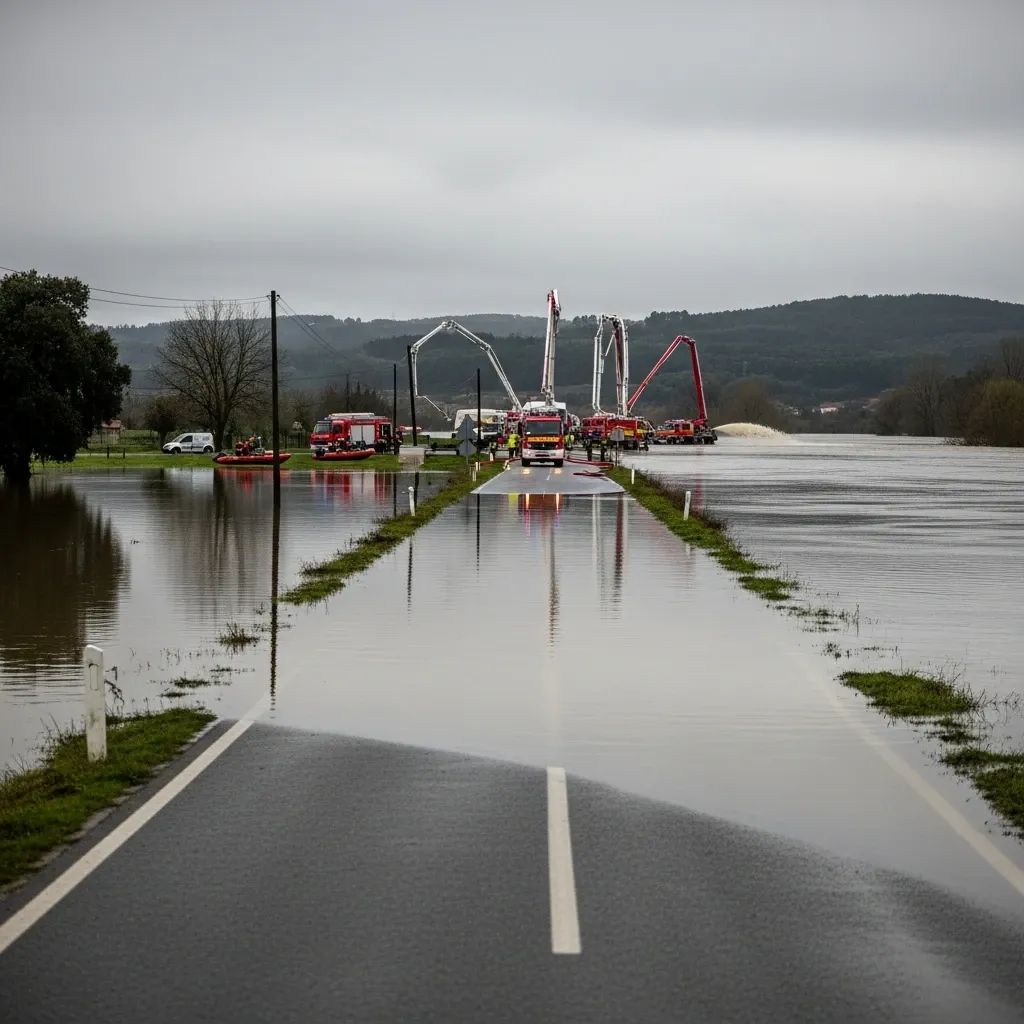
Persistent rain has pushed the Tagus River and its tributaries beyond their winter comfort zone, forcing civil-protection authorities to trigger a heightened flood alert and closing dozens of roads across the Lezíria and Médio Tejo. For drivers, farmers and commuters, the question is no longer whether further restrictions will come, but how long the current disruption will last.
Snapshot – what matters most
• Yellow-level flood emergency (the second-lowest in a five-tier flood-alert scale) in force for the entire Tagus basin, covering 24 municipalities.
• More than 40 road segments either submerged or unstable between Coruche and Abrantes.
• Over 5,400 emergency personnel dispatched since the weekend, according to the National Authority for Emergency and Civil Protection (ANEPC).
• Forecasts suggest elevated river flow through mid-week, with no firm date for reopening key bridges.
Rising water, rising concerns
The national civil-protection command upgraded its special flood plan from blue to yellow status after flow rates at Constância surpassed 1,700 m³/s. That threshold, seldom crossed outside historic events such as 1979, automatically unlocks extra monitoring and manpower. Hydrologists warn that reservoir releases upstream in Spain could keep the Tagus in a swollen state even if rainfall eases.
Unlike the dramatic flash floods that hit northern valleys earlier in the decade, the current episode is a slow-moving hazard. Fields between Santarém and Vila Nova da Barquinha are acting as giant sponges, soaking up water that will only drain once tides and fluvial discharge recede. The result is a patchwork of cut-off villages where tractors replace family cars as the safest way to reach higher ground.
Where the roads disappeared
Drivers from Lisbon heading to the interior will encounter an obstacle course. In Coruche, the detour at Ponte da Escusa and the EN114–EN251 link – better known locally as the Estrada das Meias – are both under water. Upstream, the EN114-2 by Cartaxo resembles a canal rather than asphalt. Farther north, the scenic Ponte do Alviela on the EN365 is closed, forcing residents of Pombalinho to loop through Torres Novas.
Secondary routes have fared even worse:
• Golegã – the CM 1 (Estrada dos Lázaros) and the Boquilobo access road are impassable.
• Rio Maior – four rural lanes, including CM Lobo Morto–Pé da Serra, lie beneath a muddy sheet.
• Torres Novas – EM 570 cut; EM 557-2 sealed off after a minor landslide.
• Azambuja and surrounding hamlets of Carvalhos and Manique report knee-deep water on local streets.
Municipal engineers are inspecting embankments daily, yet with the river still cresting, they can do little more than post barriers and pray drivers respect them.
Emergency machinery in motion
By Monday morning, 5,446 operatives and 2,261 vehicles had dealt with 1,545 weather-related incidents nationwide, most of them in the Tagus corridor. Mobile command units dot the floodplain, coordinating drones that feed real-time imagery to a makeshift control room in Santarém. The Portuguese Environment Agency, EDP and Infraestruturas de Portugal pool hydrometric data to decide when sluice gates upstream can tighten without threatening dam safety.
For residents, the most visible sign of the emergency plan is the convoy of pumps and amphibious vehicles parked beside village squares. Firefighters have evacuated a handful of elderly villagers from single-storey cottages in Golegã, while veterinary teams relocate livestock to improvised pens on higher ground. Authorities repeat a simple mantra: “Stay away from flooded roads, and stop treating riverbanks as disaster theme parks.”
Climate trend behind the crisis
Climatologists at Lisbon University say the Tagus episode fits a wider Iberian pattern: longer dry spells punctuated by short, intense bursts of rain. That volatility, amplified by warmer air masses able to hold more moisture, has nudged civil-protection planners to revise thresholds that once seemed conservative. While the flow this week still falls short of the 1941 or 1979 records, the frequency of medium-scale floods has increased over the past decade, even as dams modulate extremes.
Urbanisation compounds the risk. Santarém’s alluvial plain now hosts logistics parks and photovoltaic farms that sit precisely where the river wants to spread during winter. Every hectare of concrete accelerates run-off, shifting water from roofs to roads in minutes. Experts argue that adaptation – from permeable pavements to flood-ready public transport – must accompany long-promised mitigation measures.
What residents need to do now
Civil-protection bulletins can feel repetitive, but the guidance saves time and, occasionally, lives. Officials urge families to:• Remove vehicles and machinery from known flood zones.• Relocate pets and farm animals to upper floors or friend’s barns.• Never cross waterlogged stretches, whether on foot or in SUVs – 30 cm of fast-moving water can sweep a car.• Keep a battery-powered radio tuned to public-service channels and respect detours, however inconvenient.
Looking ahead
Meteorologists hint at a drier spell mid-week, yet upstream reservoirs remain brimming. Even after rainfall stops, residual flow will take days to recede, meaning the road-closure map is unlikely to shrink quickly. County councils have pencilled in provisional inspections for the first week of February; only then will structural checks on bridges such as the Ponte do Alcaide determine reopening dates.
For now, the Tagus reminds Portugal that behind every postcard sunset at Belém lies a living system with its own rhythm – one the country must learn to respect, adapt to, and, when necessary, out-think.


