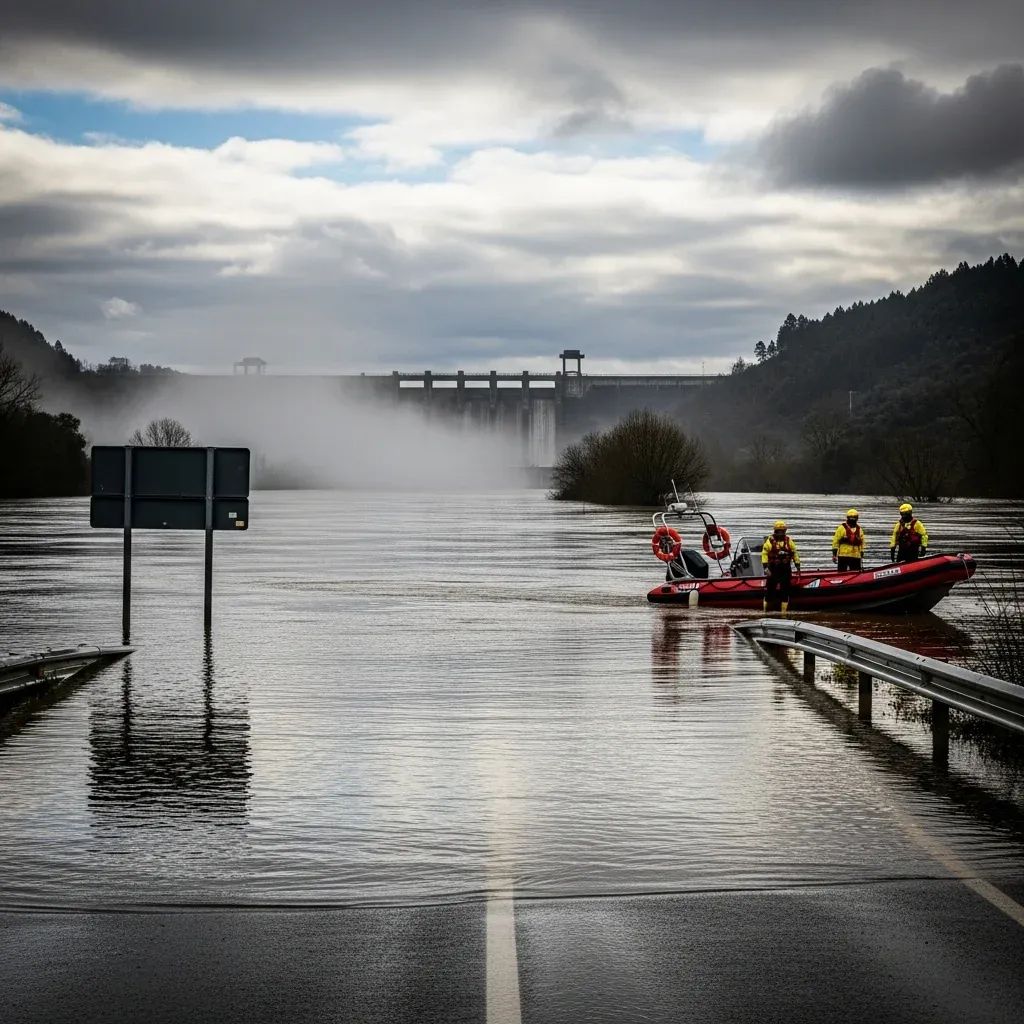
Portugal’s National Emergency and Civil Protection Authority (ANEPC) has raised its flood alert to the second-highest level nationwide, a move that could disrupt commutes, raise household repair costs and force temporary business closures in dozens of municipalities.
Why This Matters
• 68 municipalities remain under a state of calamity until at least 15 February, unlocking fast-track public aid.
• Road closures and school suspensions are already in place along the Mondego, Tejo and Douro basins.
• Home-insurance claims for flood damage often require 48-hour notice to insurers—check your policy now.
• Municipal tax rebates of up to 60 % on IMI (property tax) are available in officially declared disaster zones.
The Weather Pattern Behind the Alarm
A conveyor belt of Atlantic depressions—nicknamed “Kristin,” “Leonardo” and “Marta” by meteorologists—has steered almost uninterrupted moisture over continental Portugal since late January. According to the Portugal Weather and Sea Institute (IPMA), soils are now “near saturation,” meaning even moderate rain can trigger overflows. The agency warns residents in the North and Centre that another 30-40 mm could fall before the Azores High rebuilds next week.
Hydrologists point out that atmospheric rivers have become routine during Iberian winters. These narrow bands transport moisture roughly equivalent to the Amazon’s daily outflow; once they make landfall, mountain ranges such as the Serra da Estrela squeeze out torrents of rain. Combined with snow-melt, the result is rapid river-level spikes, particularly in the Mondego and Tejo catchments.
How Authorities Are Responding
The ANEPC has activated the national emergency plan, synchronising real-time data from 200 river-gauging stations and mobilising more than 7 000 firefighters and GNR officers. Temporary command posts have been set up in Coimbra, Santarém and Peso da Régua to coordinate sandbag distribution and evacuation logistics.
At the local level, municipalities such as Coimbra, Gondomar and Arganil have triggered their own contingency plans. In Coimbra, the downtown Baixa quarter faces a so-called “centennial flood” risk; civil-protection teams have already evacuated dozens of residents from ground-floor flats in São Martinho do Bispo and Taveiro. Schools in the Mondego floodplain have switched to remote classes until further notice.
The government has earmarked €2.5 bn in emergency funds—roughly equivalent to the country’s annual agricultural budget—to repair public infrastructure and compensate households. A dedicated online portal now allows residents to upload photos and GPS-tagged evidence of damage, shaving weeks off the usual bureaucracy.
The Land-Use and Climate Dimension
Portuguese climatologists, including Filipe Duarte Santos, say the frequency of extreme rainfall events has doubled over the last two decades. But researchers also blame decades of poor land-use planning for magnifying today’s losses. Construction in historical floodplains, heavy soil sealing with asphalt, and neglected drainage channels mean that water now runs off surfaces four times faster than it did in the 1980s.
Calls are growing for a nationwide audit of flood-exposed housing stock and stricter rules on riverbank development. The Environment Ministry is studying whether new permit applications within 100 m of major rivers should face mandatory climate-risk assessments, a measure already standard in the Netherlands.
What This Means for Residents
Re-check drainage: Clear gutters and street grates today—municipal services may not reach every side street before the next downpour.
Document property: Insurers increasingly request geolocated images taken before and after an event. A five-minute photo tour of your basement could speed up claims.
Plan commutes: The A1 near Santarém and the IC19 into Lisbon are prone to sudden lane closures. Keep an alternative route—and a full fuel tank—ready.
Stay alert: Sign up for free SMS warnings via the ANEPC “AlertA” system; rural parishes often experience mobile-service blackouts during storms.
Know the rebates: If your council is on the calamity list, file for the IMI discount before 31 March to avoid losing the benefit for 2026.
Outlook for the Rest of February
Forecast models suggest the Azores High will strengthen from 16 February onward, nudging frontal systems north and bringing a spell of calmer weather—though light showers may persist in the Minho and Douro Litoral. Even then, saturated soils mean the flood threat will linger at least another week.
Emergency planners caution that Portugal is only midway through its winter wet phase. With reservoirs already above 85 % capacity, even average rainfall in March could push several dams to their spill thresholds. The civil-protection agency therefore urges continued vigilance: “Assume that the risk is not over just because the sun comes out for a day or two.”