
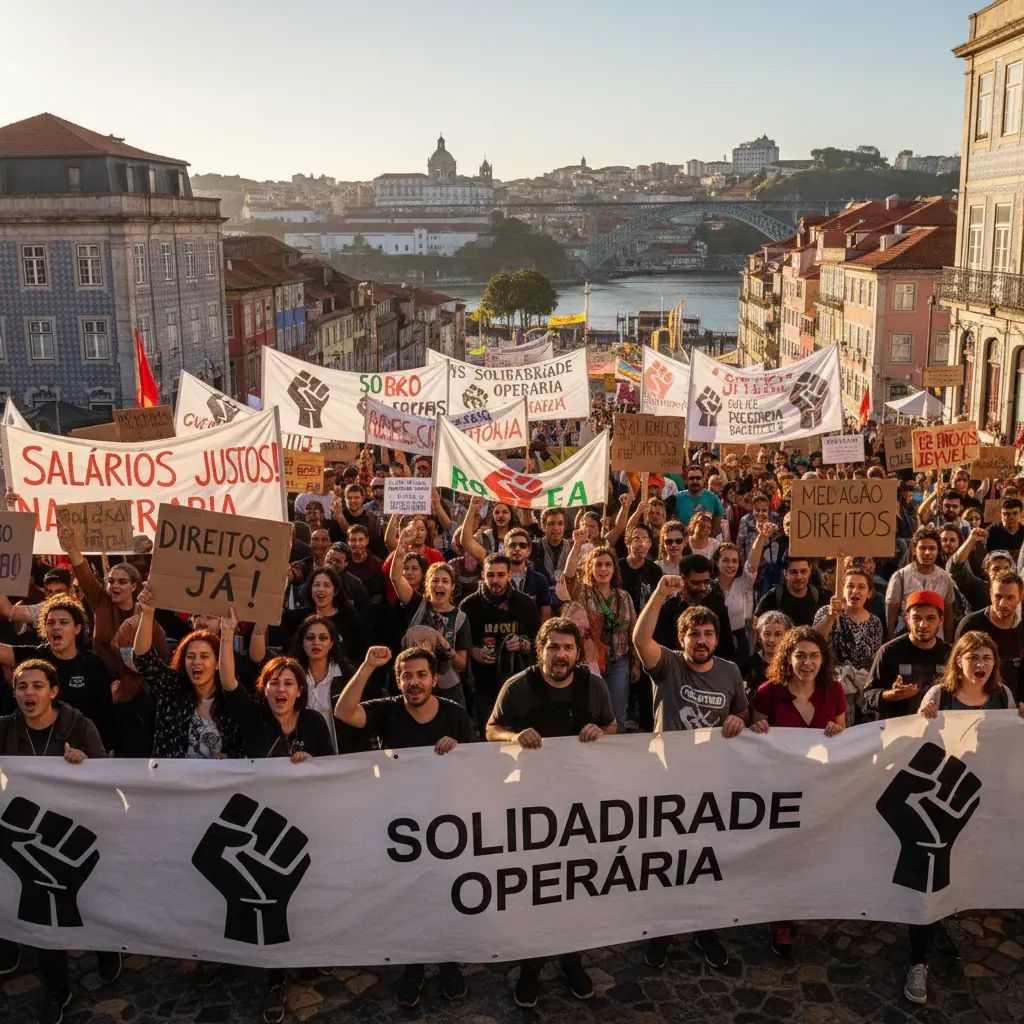
The Portugal Cabinet and employer confederations are pushing to finalize the country's contentious labor law overhaul before Parliament's April deadline, signaling that eight months of negotiations have exhausted both political capital and public patience.
Why This Matters
• Over 100 proposed changes to Portuguese labor contracts, working hours, and dismissal protections could reshape daily work life for millions of employees and businesses.
• The government intends to submit legislation to Parliament by end-April, regardless of whether unions and employers reach consensus.
• Key sticking points remain unresolved: individual hour banks, outsourcing caps, fixed-term contract durations, and compensation for wrongful dismissal.
• The UGT national secretariat meets 9 April to ratify or reject any compromise, creating a hard stop for negotiators.
Employers Signal Negotiation Fatigue
As labor ministry talks resumed Tuesday morning in Lisbon, Confederation of Portuguese Business (CIP) president Armindo Monteiro told reporters the country has grown "a bit tired" of the drawn-out process surrounding the "Trabalho XXI" reform package. Monteiro expressed hope that the government, the UGT union federation, and the four employer groups—CIP, CCP, CTP, and CAP—would close the file within hours.
"We expect to conclude this process today, because we believe Portugal is somewhat weary of this negotiation," Monteiro said, adding that once talks wrap, his confederation will propose a formal wage-growth roadmap aimed at lifting both salaries and economic output. The CIP chief referenced Prime Minister Luís Montenegro's targets announced in early December 2025 of €1,600 monthly minimum wage and €3,000 median salary, stating that business is ready to "contribute to making that possible."
The coalition government—led by the Social Democratic Party (PSD) and the Democratic and Social Centre (CDS-PP)—introduced the 100-plus-article draft in July 2025. Since then, more than 50 plenary, trilateral, and bilateral meetings have taken place, with 76 articles now agreed upon, including 24 proposed by the UGT.
CGTP Remains on the Sidelines
Notably absent from recent sessions is the General Confederation of Portuguese Workers (CGTP), the country's largest union bloc. The government argues the CGTP "self-excluded" by demanding the proposal be withdrawn entirely, while the confederation accuses Labor Minister Rosário Palma Ramalho of deliberately steering discussions into bilateral forums that bypass the Permanent Commission of Social Concertation (Concertação Social)—Portugal's official tripartite forum where government, unions, and employers negotiate labor policy—where CGTP holds a statutory seat.
In public statements, CGTP officials called the exclusion a violation of constitutional rights and warned that any reform enacted without input from the majority union is illegitimate. The group organized a general strike in December 2025 and continues to demand 35-hour workweeks without wage cuts and 25 days of annual paid leave—proposals at odds with the government's flexibility agenda.
What This Means for Residents and Employers
If enacted, the reform will directly affect employment contracts, schedules, and job security for workers across Portugal. As of late March 2026, eight months after the initial proposal, the most contentious measures—still under negotiation—include:
Fixed-Term Contracts and Precarity
The draft extends the maximum duration for definite-term contracts from two to three years and for indefinite-term contracts from four to five years. It also broadens circumstances under which employers may use fixed-term hiring, such as for long-term unemployed or pensioners re-entering the workforce. This approach is more flexible than France's automatic contract transfer model during outsourcing, but more restrictive than Spain's recent reforms, which cap wrongful-dismissal payouts at 33 days' pay per year. Labor advocates warn this will normalize precarious work, while business groups argue the flexibility is essential for competitiveness.
Individual Hour Banks Return
A proposal to reintroduce individual hour banks—abolished in previous reforms—would allow employers and individual employees to agree on extending the workday by up to two hours, banking a maximum of 150 hours annually. France caps average weekly hours at 48 with strict enforcement, while Germany's Arbeitnehmerüberlassungsgesetz mandates an 11-hour daily rest period—protections absent from Portugal's proposal. Critics see hour banks as undermining collective bargaining and enabling unpredictable schedules; proponents frame it as a tool for mutual flexibility in small firms.
Outsourcing Caps Face Rollback
The government has floated lifting restrictions on outsourcing, a move the UGT lists as a "red line." Under current law, employers face limits on replacing permanent staff with subcontracted workers. France enforces automatic contract transfers during outsourcing that qualifies as a business transfer, whereas Portugal's approach could expand temporary staffing agencies' footprint but risks fragmenting worker protections across supply chains.
Wrongful-Dismissal Compensation
Employers have pressed to maintain or reduce compensation for unlawful dismissal, currently pegged at 14 days' pay per year of service, while unions demand an increase to 15 days. Spain's recent reforms cap wrongful-dismissal compensation at 33 days' pay per year with a 24-month ceiling, whereas France uses an unpredictable sliding-scale approach called the "Macron barème." For a Portuguese employee with ten years' tenure, the gap between 14 and 15 days equals nearly half a month's salary.
Strike Minimum Services
A parallel track of the reform would tighten minimum-service requirements during strikes in essential sectors, simplifying the process by which authorities can compel skeleton staffing. Transport and health unions have mobilized against the clause, arguing it neuters collective action.
Concessions on the Table
Minister Ramalho hinted that the final text will differ significantly from July's draft. Government sources say concessions under discussion include:
• Three additional leave days tied to workplace attendance bonuses, aimed at rewarding reliability without penalizing parents who take sick leave for children.
• Continuous workday guarantees for parents of children under 12, restricting split shifts that complicate childcare.
• Six-month parental leave when both parents share 60 extra days beyond the mandatory 120, paid at 100% salary—a measure designed to encourage paternal uptake.
• Permission for employees to "buy" up to two extra vacation days annually by accepting proportional salary reductions, a German-inspired flexibility tool.
Employers have also secured government backing for IRC corporate tax deductions equal to the full cost of wage increases above 4.7%, plus deductions up to 20% for companies offering health insurance.
How This Affects You: Key Changes at a Glance
For residents navigating the reform, here's what could change:
| Aspect | Current Law | Proposed Change | Impact Timeline ||--------|-------------|-----------------|-----------------|| Fixed-term contracts | Max 2 years | Max 3 years | Late 2026 or early 2027 || Dismissal compensation | 14 days/year of service | Likely remains 14 days (unions seek 15) | Late 2026 or early 2027 || Individual hour banks | Abolished | Reintroduced (max 150 hrs/year) | Late 2026 or early 2027 || Parental leave | 120 mandatory days | 120 + up to 60 shared days at 100% | Late 2026 or early 2027 |
Timeline and Political Stakes
As of late March 2026, the UGT federation's national secretariat convenes 9 April to ratify any deal struck in concertation. Without unanimous union backing, the government has pledged to incorporate "relevant contributions" from social partners into a bill it will send to the Assembly of the Republic by month's end.
President Marcelo Rebelo de Sousa intervened earlier this month, urging both sides to resume good-faith talks after employers threatened to walk away. Last week's four-hour session prompted both unions and business leaders to acknowledge a "different attitude" and "greater willingness," though neither side detailed concrete breakthroughs.
Even if Parliament passes the bill, implementation will require secondary regulations and collective-agreement amendments, meaning most provisions would take effect only in late 2026 or early 2027. Observers note that Article 59 of the Portuguese Constitution guarantees workers the right to participate in labor legislation, a provision the CGTP invokes to challenge any reform adopted without its input.
Productivity or Precarity?
The Portuguese Industrial Association (AIP)—a business confederation representing manufacturing and industrial sectors—reviewed all 132 proposals and classified 89 as "irrelevant" to productivity, 34 as "generally positive," and nine as contrary to flexibility goals. AIP's lukewarm verdict underscores a recurring critique: that the reform prioritizes symbolic gestures—such as the "right to disconnect" clauses for remote workers—over structural changes to training, innovation, or wage-setting institutions.
Trade unions echo this skepticism from a different angle, arguing that flexibility without safeguards erodes purchasing power and, paradoxically, slows economic growth by reducing household consumption. CGTP economists point to studies showing that precarious contracts correlate with lower productivity, as workers lack incentives to invest in firm-specific skills.
The government counters that outdated rigidities deter foreign investment and constrain entrepreneurs, citing Portugal's middling rank on OECD employment-protection indices. Minister Ramalho has framed the package as a pragmatic update rather than a philosophical shift, designed to accommodate hybrid work, parental equality, and the gig economy without dismantling core protections.
What Happens Next
If negotiators strike a deal in the coming days, the UGT secretariat's 9 April vote becomes the decisive hurdle. A "no" would send the government to Parliament with a unilateral bill, risking street protests and opposition amendments. A "yes" would allow the coalition to claim tripartite legitimacy, easing passage through committee.
Regardless of the outcome, employers and employees should prepare for a transitional period. HR departments will need to update contracts, payroll systems, and internal policies, while works councils and union branches will scrutinize collective agreements for compatibility with new statutory floors and ceilings.
For residents navigating job offers, contract renewals, or workplace disputes, the practical takeaway is simple: read the fine print carefully over the next six months. Whether Portugal emerges with a modern, balanced labor code or a patchwork compromise will depend as much on regulatory guidance and court interpretation as on the text legislators ultimately approve.


