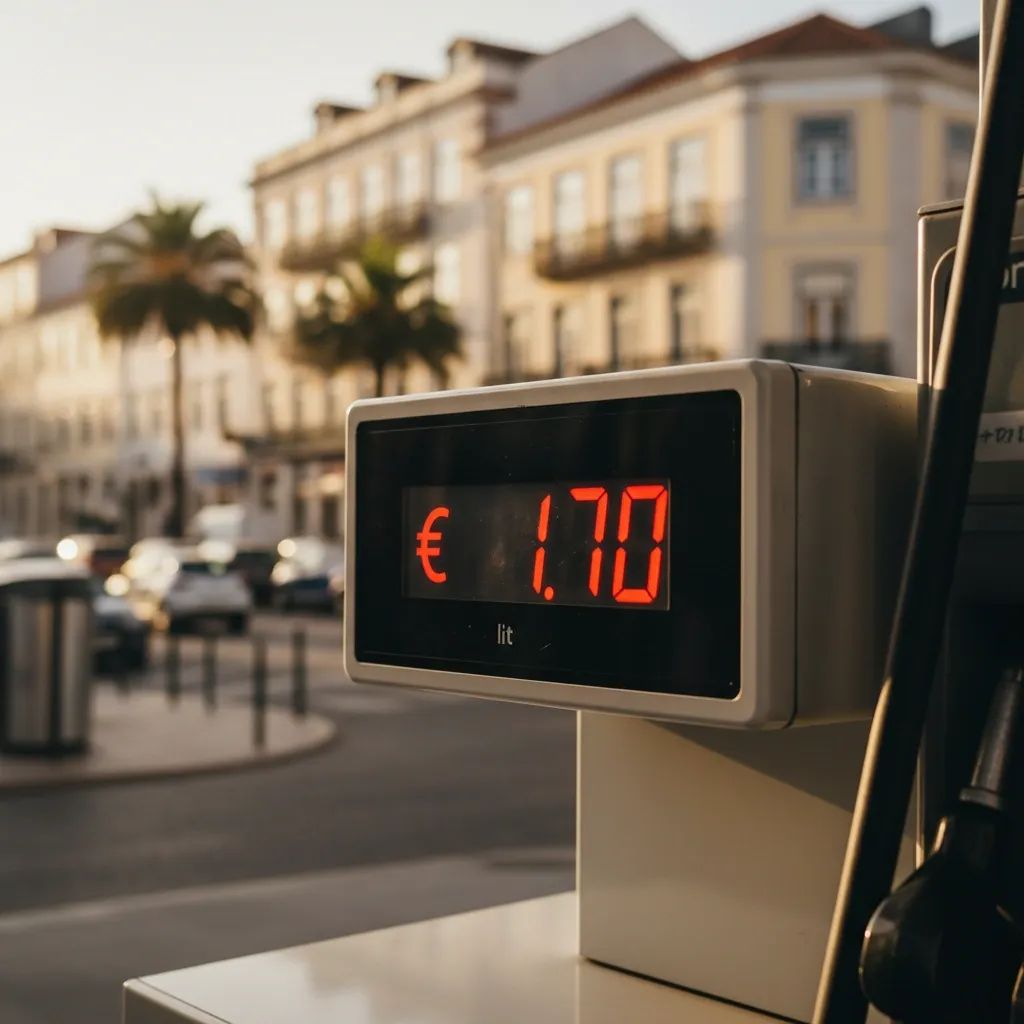
Fuel prices in Portugal are set to jump by €0.08–€0.12 per liter within weeks as Brent crude oil climbed to 108.55 USD per barrel this Friday—marking a 65.95% surge compared to last year. The spike follows the collapse of diplomatic talks between Washington and Tehran, creating what energy analysts call an "unprecedented supply shock" for European markets.
The Portugal energy sector is bracing for prolonged crude price volatility, with analysts forecasting the 105–115 USD range to persist at least through the third quarter unless diplomatic breakthroughs materialize. By Friday close, the North Sea crude benchmark stood at 108.55 USD, marking a 9.21% gain over the past month alone.
Why This Matters for Your Wallet:
• Fuel costs: Sustained Brent above 105 USD translates directly to higher petrol and diesel prices at Portuguese pumps. A typical mid-size vehicle traveling 15,000 kilometers annually now faces an estimated €150–€200 additional annual fuel cost compared to early 2025.
• Home heating: Home heating oil users—particularly common in the interior and northern regions—are likely to see winter bills rise 12–18% if prices remain elevated through autumn.
• Food and goods: Energy-intensive sectors—manufacturing, logistics, agriculture—face margin compression, potentially feeding into consumer prices for food and goods by 3–5% before harvest season.
• Public transport: CP (Comboios de Portugal) and municipal bus fleets operate on razor-thin margins and have already signaled the need for fare adjustments or state subsidies. Parliamentary debates are expected in June to discuss potential compensatory measures from the Portugal Ministry of Finance.
• Investment risk: Global equity markets, including Portugal's PSI-20 (the country's main stock index), remain sensitive to energy shocks. Investors with exposure to energy-intensive equities should monitor hedging disclosures.
Diplomatic Impasse Triggers Market Shock
Late Sunday, U.S. President Donald Trump declared Iran's negotiation response "TOTALLY UNACCEPTABLE" in a public statement, effectively halting progress on de-escalation talks aimed at ending the ongoing conflict. Tehran's five-point proposal—submitted earlier in the weekend—demanded the immediate lifting of all U.S. economic sanctions, the end of the naval blockade on Iranian ports, and exclusive Iranian control over the Strait of Ormuz. The latter condition proved particularly contentious, given that roughly 20% of global crude oil and significant volumes of liquefied natural gas transit the narrow waterway daily.
The U.S. Department of the Treasury responded by expanding sanctions targeting Iran's "ghost fleet" of tankers and its petroleum sales network to China. Washington also refused to renew a temporary sanctions waiver—originally issued in March to release approximately 140 million barrels of Iranian crude already at sea—that expired in April. The hardline stance reflects the Trump administration's insistence that Iranian access to nuclear weapons remains a "red line" in any negotiation framework.
Strait of Ormuz Chokepoint Drives Supply Crunch
The Strait of Ormuz remains effectively closed through the end of May, according to the U.S. Energy Information Administration's short-term outlook published on May 7. A gradual reopening is expected in June, but throughput is unlikely to return to pre-conflict levels before year-end. This bottleneck has drained global oil inventories at a rate of 8.5 million barrels per day during the second quarter, creating an unprecedented supply shock.
Iran's own crude production fell sharply in April to 2,854,000 barrels per day—down from 3,065,000 bpd in March. OPEC output, heavily affected by the conflict and the Ormuz closure, plunged to 18.98 million bpd in April, a 34% drop compared to February. The IEA now projects a global supply deficit of 1.78 million bpd this year, even as it revised downward its demand forecast to 104 million bpd.
Portuguese importers and refineries, which rely on seaborne deliveries from Middle Eastern suppliers, are already exploring alternative sourcing routes—including increased West African and North Sea cargoes—but at a premium. The Portugal Petroleum Regulatory Authority confirmed that strategic reserves remain above the EU-mandated 90-day threshold. Portugal currently holds approximately 4.7 million cubic meters of strategic petroleum reserves—sufficient for roughly 93 days of net imports at current consumption rates. Importantly, Portugal has never needed to activate emergency releases from these reserves since the system was established in 1993, though the EU came close during the 2022 energy crisis following Russia's invasion of Ukraine. Any prolonged disruption could force rationing or emergency releases later in the year.
Price Scenarios: From Relief to Crisis
Razan Hilal, senior analyst at Forex, outlined three plausible trajectories for crude prices over the next quarter. In the diplomatic breakthrough scenario—where Washington and Tehran reach a compromise allowing partial Ormuz reopening and limited sanctions relief—Brent could retreat to a range of 81–91 USD per barrel. This outcome would provide material relief to Portugal's consumer price index, which has climbed 4.2% year-on-year through April, with energy accounting for nearly a third of the increase.
Conversely, a "political escalation extreme" scenario—involving direct military strikes on Iranian energy infrastructure or a widening of the conflict to include Saudi or Emirati facilities—could propel Brent back toward 115 USD or higher. Historical precedent supports this: in July 2008, Brent peaked at 147.50 USD amid similar geopolitical turmoil in the Persian Gulf. Trading Economics' macro models estimate Brent at 103.40 USD by end-June and 116.69 USD within 12 months, assuming current tensions persist without major resolution.
A middle-ground scenario—characterized by frozen negotiations, sporadic incidents, and gradual Ormuz reopening—would likely anchor prices in the 105–110 USD band through autumn. This is the baseline working assumption for most Portuguese financial institutions and corporate treasury departments.
Practical Steps for Residents
For Portuguese households, the energy price surge translates into immediate budget pressures. Beyond fuel and heating costs, logistics firms report per-kilometer diesel costs up 14% since February, which will eventually translate to higher delivery charges for online shopping and retail goods.
Public transport alternatives: Consider switching to public transport passes or carpooling arrangements, as many employers are exploring these options to reduce fuel expenses for employees.
Investment considerations: Investors exposed to energy-intensive equities should consider shifting toward defensive positions such as utilities with inflation-linked tariffs or renewable energy portfolios, which offer partial insulation from fossil fuel price shocks.
The Portugal Ministry of Finance has not yet announced specific compensatory measures, though parliamentary debates in June will likely address potential relief programs or subsidies for affected sectors.
Global Context and Historical Precedent
Middle Eastern geopolitical shocks have consistently driven Brent volatility. The 2003 Iraq invasion added a 4–8 USD per barrel risk premium in the months preceding conflict. More recently, the October 2023 Israel-Hamas escalation pushed Brent 4% higher within 48 hours, nearing 90 USD. The current Iran-U.S. standoff is more severe in supply impact: the March strikes on Iranian infrastructure propelled Brent from 78.22 USD to 103.14 USD within two weeks—a 42% surge.
The IEA notes that Brent broke through 100 USD in late March following joint U.S.-Israeli strikes on Iranian refineries and the Qatari LNG terminal. By mid-May, the benchmark had touched 107.31 USD on the Intercontinental Exchange, with intraday peaks above 113 USD during acute supply fears.
Energy Transition: A Longer-Term Solution
The sustained price shock has intensified discussion around Portugal's energy transition roadmap. Renewable energy advocates argue that solar and wind projects—now cost-competitive even at elevated fossil fuel prices—deserve accelerated permitting and grid integration. The Portugal Environment Ministry is reviewing proposals to fast-track 800 MW of new solar capacity in the Alentejo and offshore wind pilots off the Algarve coast.
However, financing constraints remain a challenge. Rising interest rates and inflation have increased project costs by 18–22% since 2023, offsetting some of the competitive advantage gained by cheaper renewables. The European Investment Bank has pledged €1.2 billion in green energy financing for Portugal through 2027, but tangible relief from renewable energy projects is unlikely before 2028–2030 at the earliest.
For now, Portugal remains dependent on imported crude and refined products for approximately 42% of primary energy consumption, leaving the economy exposed to external shocks. The current crisis underscores the strategic rationale for energy diversification, though short-term solutions will depend on diplomatic developments and government support measures.