

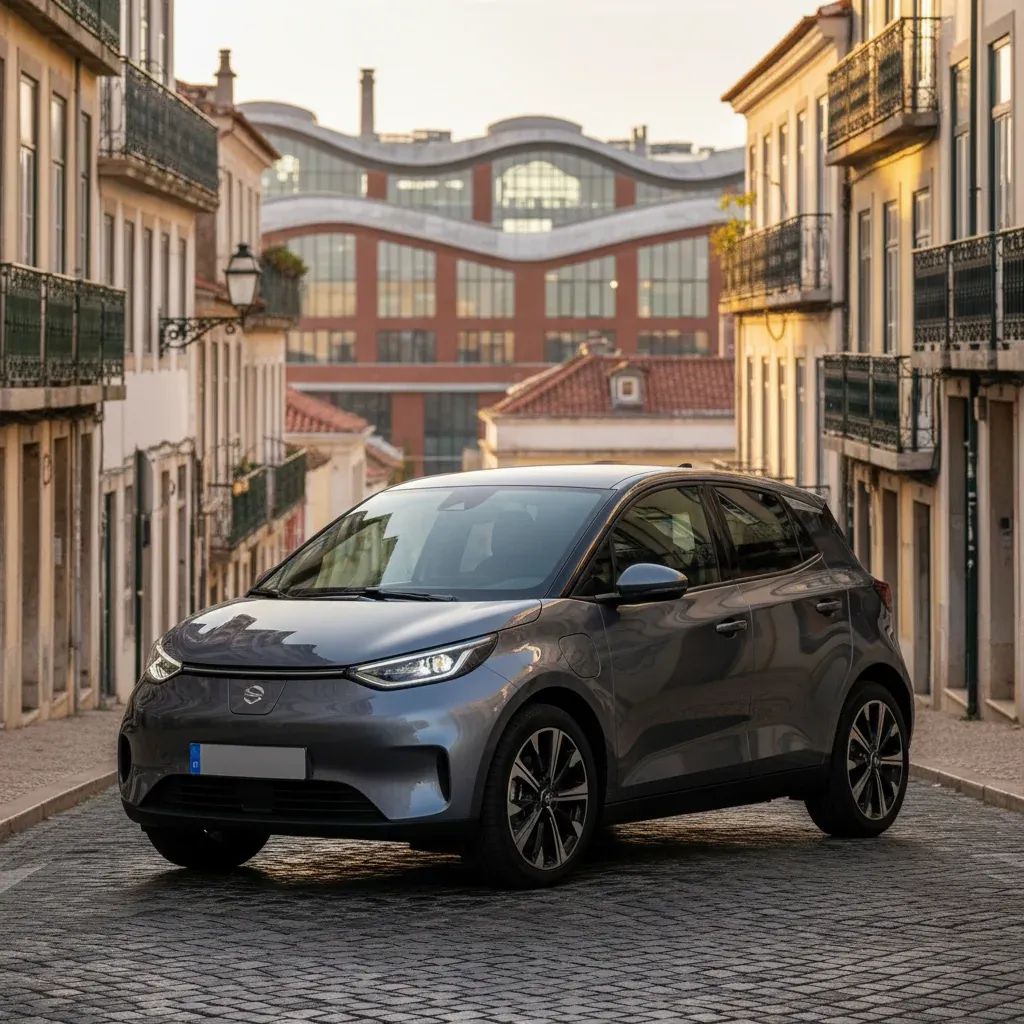
Spain-based automaker Ebro is launching a compact electric utility vehicle (EV) aimed squarely at Portugal's urban and suburban commuter market, with production starting by the end of 2026 and availability expected by winter 2026 into early 2027. The move positions the brand—already selling hybrid SUVs in Portugal through partnership with Grupo MCoutinho—to directly compete with the wave of affordable Chinese EVs flooding European markets.
Why This Matters
• Local assembly advantage: Built in Barcelona's Zona Franca factory, the model offers a European-made alternative to Asian imports, potentially simplifying service and parts logistics for Portuguese owners.
• Target price positioning: While the brand hasn't disclosed pricing, analyst estimates based on Ebro's existing Portuguese lineup (S400 HEV starting at €29,240) suggest a positioning in the €28,000-€32,000 range in a market where most electric offerings still hover above €35,000.
• Infrastructure timing: The prototype arrives as Portugal accelerates EV charger rollouts in urban centers, making the promised 400 km range more practical for daily use.
• Dealer expansion: Ebro aims for 20 service points by 2028, critical for drivers worried about maintenance access outside major cities.
Built for the Daily 50 km Grind
The five-door, five-seat prototype measures 4.2 meters in length—compact enough to navigate Lisbon's narrow streets but spacious enough for family duty. With a 2,700 mm wheelbase, the cabin offers more room than typical B-segment compacts. The brand designed the vehicle explicitly around average daily commutes of 50 km, which aligns with recent data showing most Portuguese urban drivers rarely exceed that distance on weekday trips.
Under the hood, a rear-mounted electric motor generates approximately 122 hp (90 kW) and 111 Nm of torque—modest figures that prioritize efficiency over performance. The 0-100 km/h sprint completes in under 11 seconds, adequate for city merges but not sports-car territory. Two battery options will be offered, both targeting around 400 km of range on a full charge, though Ebro cautions these specifications remain provisional until final homologation.
Fast-charging capability allows 30% to 80% replenishment in 20 to 30 minutes using DC rapid chargers, while the charging system supports standard AC protocols—meaning a full overnight charge from a home wallbox. That charging speed sits in the middle of the pack compared to rivals like the MG4 Electric but trails competitors offering faster onboard chargers.
Tech-Forward Interior Matches Price Segment
Inside, the dashboard centers on a 15.6-inch touchscreen running an infotainment system built on Qualcomm Snapdragon architecture—the same chip platform used in premium brands. An 8.88-inch digital instrument cluster replaces traditional dials. The setup supports dual-zone climate control and includes driver-assistance systems that Ebro promises will offer adaptive cruise control and lane-keeping aids as expected in this segment.
A 50-watt wireless smartphone charger with active cooling is integrated into the center console—an unusual detail in this price bracket, where most competitors still rely on wired USB ports. The design emphasizes aerodynamics with flush door handles integrated into the body structure and optimized wheel designs, both aimed at squeezing extra kilometers from the battery.
Racing Against the European EV Clock
Ebro's timeline puts it in direct collision with a crowded 2026 launch calendar. Renault plans to debut its Twingo E-Tech at under €20,000 in spring 2026, while Volkswagen's ID.2 (potentially badged as the ID.Polo) targets a sub-€25,000 price for autumn 2026. Kia's EV2, another urban SUV, arrives in January 2026 priced below €30,000. Even Hyundai joins the fray with the IONIQ 3 hatchback late in the year.
The competitive pressure comes not just from established Europeans but from Chinese automakers like BYD and SAIC's MG brand, which have aggressively priced models like the BYD Dolphin and MG ZS EV already circulating in Portuguese showrooms. Ebro's pitch hinges on offering European production quality and proximity without the premium markup—a gamble that the "Made in Spain" badge carries enough weight to justify its positioning against Shenzhen-assembled alternatives.
What This Means for Portugal Residents
For Portuguese buyers, the Ebro electric utility vehicle represents a middle-ground bet: not the cheapest option, but potentially more serviceable than distant-import rivals. The Grupo MCoutinho partnership launched initial dealerships in cities including Porto, Aveiro, Viseu, Coimbra, Leiria, and Lisboa in the second quarter of 2026, with plans to reach 10 locations by year-end and 20 by 2028. That network density matters because EV ownership relies heavily on accessible service—battery diagnostics, software updates, and warranty claims all require specialized equipment.
The Barcelona production base also shortens supply chains for parts, potentially reducing wait times compared to Asian imports that funnel through Rotterdam or Hamburg. However, the brand's lack of a public charging infrastructure partnership means buyers will rely on third-party networks like Mobi.E or private installations, unlike Tesla or Mercedes, which bundle charging access into purchase agreements.
Platform Roots and Broader Strategy
Underneath, the electric utility sits on a modified Chery QQ3 platform—a detail Ebro downplays in marketing materials but which signals the brand's reliance on Chinese engineering partner Chery Automobile. While this raises questions about true "European" manufacturing, it also explains how Ebro can potentially undercut Volkswagen and Renault, which develop platforms in-house at higher cost.
The electric launch is part of a broader 2026 product offensive. Ebro plans to update its S700 and S800 SUVs with a self-charging hybrid variant for the S700, while the S400 crossover receives upgraded battery packs. A new SUV, tentatively named S500 or S600, is also slated for late 2026. The brand already offers the S900 PHEV 4x4—a seven-seat plug-in hybrid priced from €56,740—targeting families seeking electrification without pure-EV range anxiety.
Final-Year Production Timeline and Market Availability
Ebro's Barcelona Zona Franca facility will start series production by late 2026, with first customer deliveries expected during winter 2026 into early 2027. The brand hasn't committed to specific monthly production volumes.
For Portuguese consumers, the practical calculus hinges on three factors: final pricing (expected in the €28,000-€32,000 range based on analyst estimates and Ebro's hybrid lineup), real-world range after homologation (the promised 400 km often shrinks to 320 km in mixed driving), and service network density (currently concentrated in coastal urban centers, leaving interior regions underserved). Ebro's warranty provisions remain to be fully disclosed for the electric powertrain.
As Portugal pushes toward its 2035 combustion-engine phase-out, the Ebro electric utility could serve as a bridge for cost-conscious drivers hesitant to commit to premium EVs—assuming the brand can deliver on its promises of competitive pricing, adequate service infrastructure, and reliable performance. The next six months will reveal whether Barcelona's assembly lines can meet winter delivery targets, and whether Portuguese buyers see Ebro as a credible long-term player or a transitional brand riding the electrification wave.


