

Why This Matters
• Real costs for islanders: Patients cannot reach specialist care same-day, paying €80–120 in extra overnight costs. Workers spend unplanned nights on connecting islands. Students sacrifice classes due to transport schedules. For a population of 9,000, these daily barriers compound into genuine hardship and are driving people to leave.
• Government mechanisms disrupted by weather: The Azores Regional Government is legally required to visit each island annually. Two cancellations in 2025 (February and April) meant a crucial council session addressing São Jorge's transport petition never occurred—leaving residents' formal requests unaddressed.
• Infrastructure renewal stalled: Airport terminal repairs remain incomplete. Ferry schedules do not enable same-day round trips. Road maintenance is underfunded. A critical Public Service Obligation (PSO) contract renewal later in 2025 will determine whether the island gets better air and maritime service for the next four years.
A Weather System Derails Government Plans
Atlantic storms rarely announce themselves politely. On April 27, 2025, one such system—bringing heavy, sometimes intense rainfall to the Azores—caught the Azores Regional Government mid-journey. The delegation had lifted off from São Miguel that morning, transferred to Terceira to board an interisland flight, and then hit a wall: Lajes Airport remained closed due to wind gusts and zero-visibility conditions. The aircraft could not depart. Officials waited. Hours passed. Eventually, the visit to São Jorge island was scrapped, and the delegation turned back.
This was supposed to be a two-day working visit—the first day for municipal consultations in the towns of Velas and Calheta, followed by a full Regional Government Council session scheduled for April 28. The council meeting mattered because it was meant to formally address a detailed petition submitted weeks earlier by São Jorge's Island Council, laying out the island's chronic transport isolation and requesting concrete government action on air and maritime connectivity.
Instead of deliberating on those requests, ministers and civil servants were stranded, watching weather radar.
The cancellation would have been a minor operational frustration—weather happens—except for one detail: this was the second statutory visit derailed by identical circumstances in 2025. On February 3, a government delegation bound for Graciosa island was similarly grounded by a Portuguese Institute of the Sea and Atmosphere (IPMA) yellow-alert weather warning. Same trigger. Same disruption. Same postponed discussions about infrastructure and investment.
Why These Visits Matter More Than They Appear
The Statute of the Azores, Portugal's foundational autonomous governance law, imposes a formal requirement: the Regional Government must conduct an official visit to every island in the archipelago at least once per calendar year, and these visits should be conducted at the executive level without delegating to departmental ministers—a practice designed to ensure direct, unmediated dialogue between islanders and power.
The current coalition government—PSD/CDS-PP/PPM, in office since 2024—rebranded the model. Officials now frame statutory visits as consultation forums, dropping ceremonial baggage and prioritizing listening. The Pico island visit conducted March 1–3, 2025, exemplified the new approach. President José Manuel Bolieiro and his cabinet met separately with each municipality to discuss real needs: a new health facility for Lajes, regional road rehabilitation, airport expansion feasibility. No formal council session. Instead, bilateral conversations and site inspections.
The São Jorge visit was supposed to depart from that model—the first statutory visit organized around a full Regional Government Council session, bringing ministers into a single room with local representatives to address multisector, structural issues like transport accessibility. Now postponed. Indefinitely.
What São Jorge Officially Told the Government
The petition sitting in regional government offices is not vague. The Council of Island of São Jorge is a statutory advisory body representing residents, municipal governments, and civil society organizations on the island. This memorandum frames accessibility as non-negotiable—not a lifestyle amenity but a structural precondition for economic and social survival.
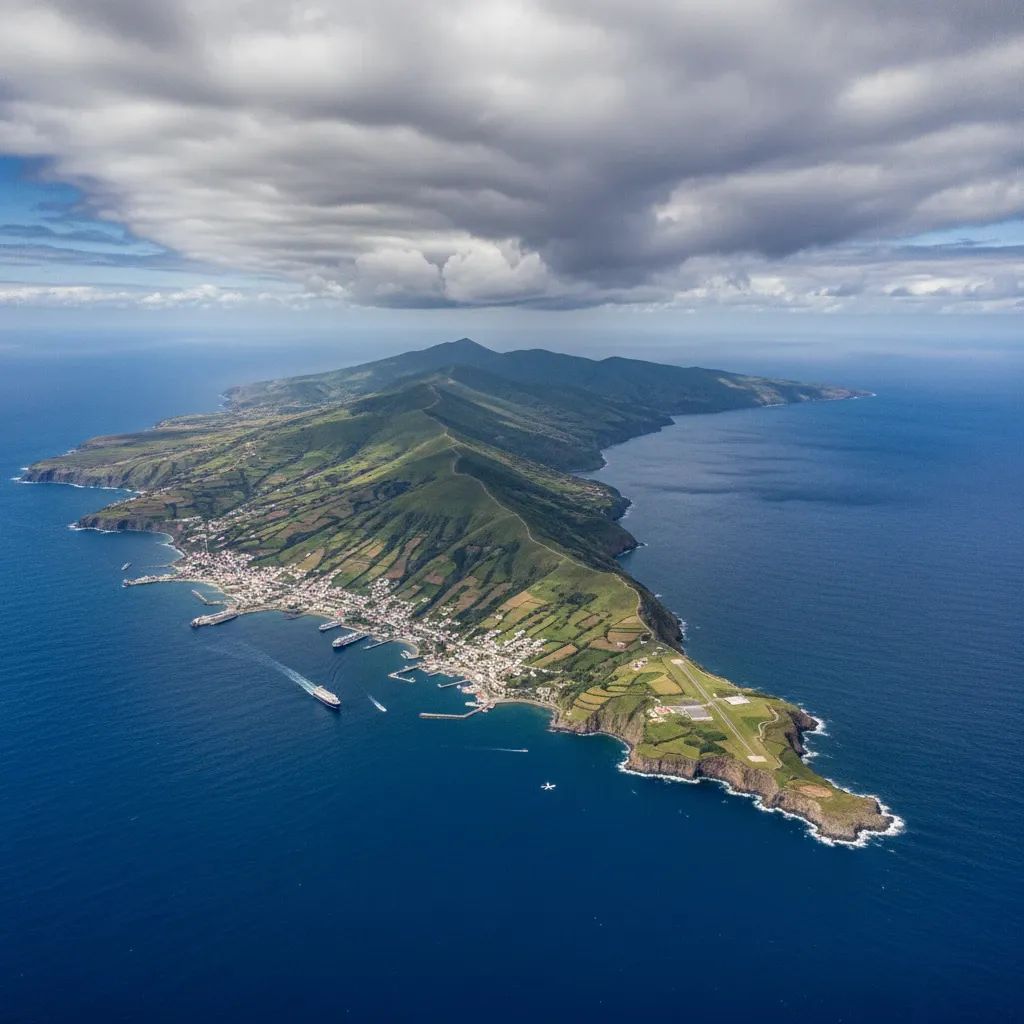
São Jorge has roughly 9,000 inhabitants. They live on an island 42 km long and 10 km wide, separated from other islands by 25 km of Atlantic water and two-hour ferry crossings in good conditions. Getting off the island to access education, medical care, or employment elsewhere requires orchestrating flight and ferry schedules that rarely align. Some days, leaving in the morning and arriving on mainland Portugal the same day is physically impossible.
Medical patients face the arithmetic of isolation. A resident requiring cardiology consultation at a hospital in Ponta Delgada (on São Miguel) cannot depart São Jorge at dawn and return home the same evening. The morning flight arrives mid-morning on Ponta Delgada. Hospital appointments do not exist at 11 AM. Patients either spend the night on São Miguel or transfer back to Terceira and stay there overnight, adding €80–120 to out-of-pocket costs. For chronic patients requiring multiple visits, those night-away charges compound into genuine hardship. Cancer patients undergoing radiation therapy cannot commute daily. Surgeries requiring follow-up consultations turn into multi-day ordeals.
Students enrolled in mainland universities face planning nightmares. University schedules do not bend around ferry windows. A student enrolled in Porto or Lisbon must book travel days in advance, often sacrificing Monday morning classes or Friday afternoon seminars. The island has no flight departing after working hours, so students cannot leave Friday evening after classes; they must depart Thursday, forfeit Friday classes, and then spend euros on accommodation and transport that mainland students do not incur.
Athletes and leisure travelers encounter booking chaos. Weekend tourists arriving for a three-day holiday discover they cannot connect flights and ferries within a single transition day; the island's airport and dock schedules force them to spend an overnight elsewhere, inflating travel costs and eroding the island's appeal relative to other Mediterranean destinations.
Business operators cannot operate reliably. Tourism operators report that international visitor bookings collapse once the customer discovers the transport friction. Small retailers struggle to source inventory consistently because cargo does not arrive on a predictable schedule. Freight transport operates informally, not as a public service with commitments and pricing transparency, meaning goods arrive late or at premium cost.
The island's population has declined roughly 15% over two decades. Residents attribute that exodus partly to despair over transport isolation.
Air Service: The Gaps Are Specific
The petition catalogues air service deficiencies with granular precision, because the problem is not lack of flights generally but rather misalignment between schedules and real human needs.
No evening departures exist. The island's airport closes to scheduled flights after the late-afternoon rotation. A business traveler needing to conduct meetings and return home the same day cannot leave after 3 PM. This effectively prohibits same-day business engagement with mainland companies.
Winter Sundays have no evening flight. During the winter schedule (late October through late March), no flight departs São Jorge on Sunday evening. This means athletic teams cannot return home after Sunday competitions played elsewhere. Weekend tourists cannot catch a Sunday evening flight back, forcing Monday morning departures and Monday morning absences from work.
Seats are perpetually scarce. Year-round, available seats on São Jorge flights remain constrained. Residents report booking weeks in advance or accepting last-minute rejections. This creates a false scarcity—not a supply shortage but an allocation problem where the aircraft deployed is undersized for the route's actual demand.
The terminal itself is degraded. The airport building leaks during heavy rain. Sanitation facilities are outdated. Parking is insufficient relative to peak passenger volume. In early 2025, the regional government launched a tender for terminal renovation—approximately €875,000 in scope—after an initial bidding round attracted no qualified contractors. A reissued tender is more recently posted, but no completion date has been announced.
Connections to the mainland require luck. On certain dates, no valid connection exists between São Jorge's flight schedule and onward mainland flights. A passenger cannot depart São Jorge at 9 AM, arrive in Ponta Delgada at 10:30 AM, and catch a 2 PM flight to Lisbon. This forces overrides—either overnight stays on a gateway island or acceptance of multi-day delays.
The council proposes specific remedies: ensure daily flights to regional gateways (Ponta Delgada, Terceira), add evening-hour departures, introduce a Sunday evening winter flight, and expand parking. All achievable within existing infrastructure constraints, provided the aircraft allocation and scheduling decisions prioritize the route.
Maritime Transport: The Ferry Bottleneck
The Orange Line ferry service connects the Central Group islands—Pico, Faial, São Jorge, Terceira, and Graciosa. The schedules are designed for geographic routing efficiency, not necessarily for passenger convenience. Because of harbor geography and maneuver basin constraints, certain sequences of port calls make technical sense but result in ferry arrival windows that do not permit round-trip journeys within a single day. A passenger departing São Jorge on a 7 AM ferry might not return to São Jorge until 9 PM, making a round-trip far longer than optimal.
The council notes that the Transmaçor operator has introduced larger ferries in recent years, a fleet modernization that boosted capacity but also created maneuvering constraints in the tighter harbor basins of Velas and Calheta (São Jorge's two ports). Larger vessels have larger turning radiuses. The basins, shaped decades ago for smaller ships, now force complex, time-consuming maneuvering that delays departures and complicates docking during heavy weather or high seas.
Cargo transport is ad hoc and expensive. There is no formal public service obligation for freight. Shippers arrange cargo transport informally, competing for rare space on passenger ferries or paying premium rates for specialized cargo ships that do not operate on regular schedules. This creates unpredictability—a retailer ordering stock cannot guarantee arrival dates. Prices reflect scarcity. Food, building materials, and manufactured goods entering the island cost more partly because transport lacks the efficiency of formalized, subsidized service.
The council urges the government to formalize cargo transport as a public service, with contracted operators, defined schedules, and stable pricing. It also requests expansion of the ferry operating window and schedule redesign to enable same-day round-trip journeys.
Roads: The Hidden Vulnerability
São Jorge's two main towns, Velas and Calheta, are connected via a road network that runs through steep, mountainous terrain. During heavy rain and strong winds, these roads become vulnerable to landslides and washouts. A 2024 incident closed the main route between Velas and Calheta for three weeks following storm-driven erosion. That closure created a de facto island-within-island isolation, with residents unable to traverse the island safely.
The petition flags this as an underfunded maintenance and reinforcement challenge. Regional roads receive less investment priority than main arterials on larger islands.
The Critical Moment: PSO Contract Renewal
A critical juncture is approaching as the Public Service Obligation (PSO) contract—which defines which routes are subsidized, aircraft assignments, frequency minimums, and pricing structures for air and maritime services—comes due for renewal. The outcome will lock in flight frequency, aircraft type, and pricing for the coming years.
The CDS-PP, the coalition's most vocal advocate for increased air capacity, has insisted that contract renewal must base aircraft sizing on actual recent demand data. If the PSO contract replicates prior aircraft configurations, capacity will remain undersized for current demand. How that translates into actual budget appropriations remains uncertain.
Climate: Operational Vulnerability
The Atlantic climate system that grounded the April 27, 2025 delegation is part of a broader operational concern. Single-runway airports, characteristic of most Azores islands including São Jorge, are operationally fragile in severe weather conditions. Wind crossings, ceiling thresholds, and surface water drainage determine runway usability minute-by-minute. A wind shift can close the runway for hours, leaving aircraft aloft or diverting to alternative islands. Ferry operations likewise suspend when sea state exceeds operational thresholds, often without advance warning of how long disruption will persist.
The Political Context
The current coalition government emphasizes consultation and institutional collaboration as core governance values. Reframing statutory visits as listening forums rather than ribbon-cutting ceremonies reflects that philosophy. But the approach carries risk: cancellations, even those beyond governmental control, can appear as neglect if rescheduling is indefinite or if alternative forums for addressing islanders' concerns are not quickly convened.
Opposition parties—the Socialist Party, Left Bloc, and Independent Democratic Union—have begun criticizing the São Jorge accessibility crisis as evidence of inadequate support for vulnerable communities. These political dimensions matter because infrastructure spending and regulatory priorities are not purely technical matters—they reflect coalition preferences and electoral calculus.
For residents of São Jorge, the twice-cancelled statutory visit is emblematic of deeper frustration: the island receives formal attention at mandated intervals, yet infrastructure improvements move glacially and transport gaps persist.
Looking Ahead: The Critical Months Ahead
The remainder of 2025 will be critical. The PSO contract renewal process will unfold, involving negotiation among the regional government, national aviation authorities, and operators. A favorable outcome would increase capacity on the São Jorge route and extend operating hours. A neutral outcome would maintain current constraints. An unfavorable outcome would further degrade connectivity.
Simultaneously, maritime service contracts come due for renewal. The regional government has signaled intent to formalize cargo transport, converting ad hoc freight hauling into service-level agreements with guaranteed schedules and transparent pricing. Implementation depends on operator willingness to accept service commitments and accompanying subsidy or pricing adjustments.
The São Jorge Island Council's petition will be a reference document in both negotiations. Whether the government incorporates accessibility commitments into contract terms and budget allocations will largely determine islanders' fate over the coming years. If the petition is filed away while budget pressures favor larger islands, the isolation will deepen, and the population exodus will accelerate.
For residents of São Jorge contemplating their future, the cancelled April 28 council session was not merely an inconvenient rescheduling. It was a reminder that formal mechanisms for governmental accountability—statutory visits, council sessions, petition processes—ultimately depend on operational reliability to function. When weather repeatedly disrupts these mechanisms, when infrastructure remains degraded, when follow-through on commitments feels uncertain, faith in governance itself begins to erode.


