

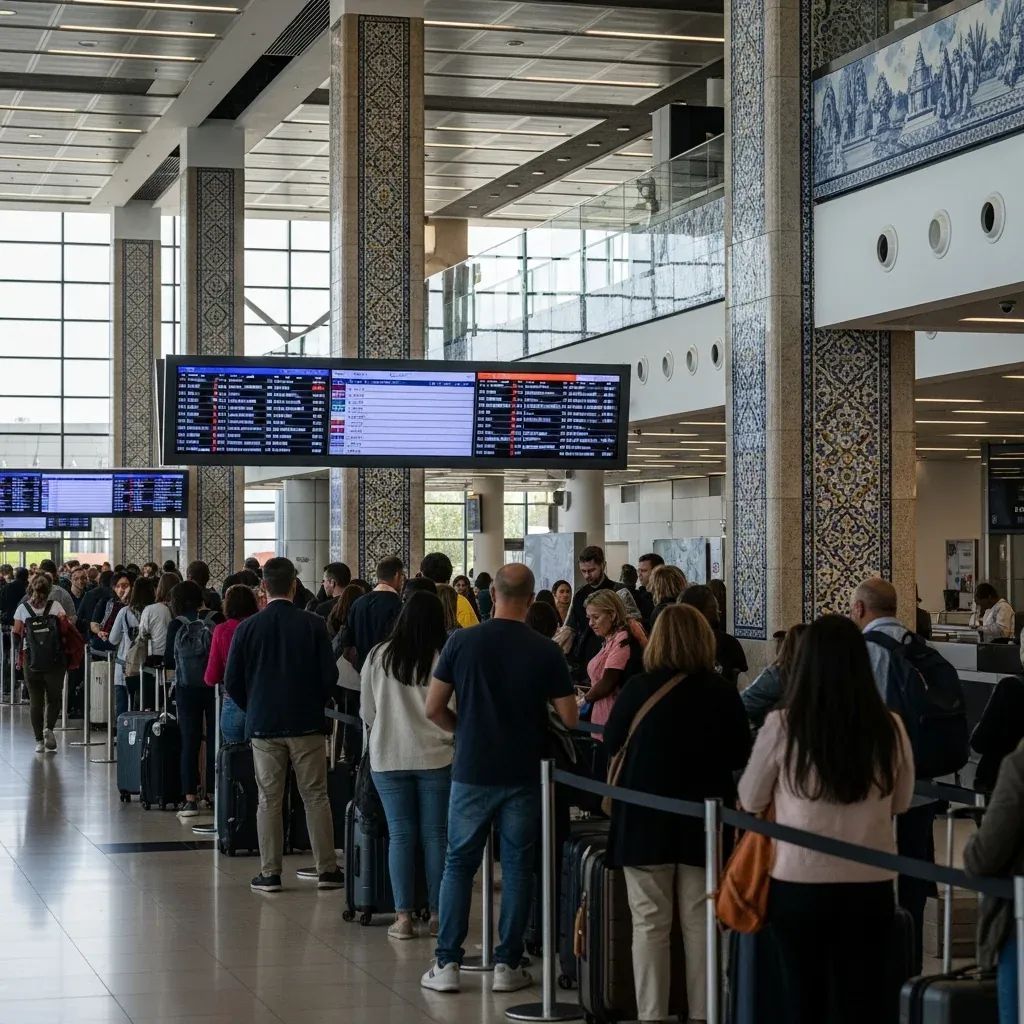
Passenger queues at Portuguese airports show no sign of shrinking. Fresh figures for November 2025 confirm that the country’s run of record-breaking air traffic is still alive, even as most Europeans ease off post-pandemic travel sprees.
At-a-Glance: What Matters
• 5 million travellers used national terminals in November, up 5 % year-on-year.
• Lisbon kept almost 1 in every 2 passengers, but Porto and Madeira stole the growth spotlight.
• The United Kingdom remains Portugal’s top feeder market; France slipped but still ranks second.
• Cargo growth flatlined, hinting that the export boom may be cooling.
• Airport capacity—especially in Lisbon—faces a make-or-break decade as big expansion projects collide with environmental scrutiny.
Momentum Carries Through the Shoulder Season
Portugal’s airports processed just under 69 M passengers between January and November 2025, a gain of 4.7 % compared with the same stretch of 2024. The November surge—traditionally a quiet month—suggests that Portugal’s tourism upswing is broadening beyond summer holidays and city-break weekends. ANA Aeroportos executives say average load factors on incoming flights hovered above 85 %, an implicit vote of confidence from airlines betting on winter sun in the Algarve and year-round digital-nomad inflows to Lisbon.
Regional Breakdown: Lisbon Reigns, But the North Roars
Humberto Delgado retained its crown with 33.5 M passengers in eleven months, equal to 48.6 % of all Portuguese traffic. Yet the capital’s growth rate was the most modest: +2.9 %. Further north, Francisco Sá Carneiro Airport in Porto notched up 15.7 M travellers, a robust +6.1 % boost powered by low-cost carriers and a wave of Brazilian diaspora visits.
On the holiday front, Faro crossed the 10 M-passenger threshold and Madeira shot up 13 % to 4.4 M, thanks to Ryanair’s decision to base extra “Gamechanger” 737s on the island. The Azores closed September with 2.7 M flyers, a tidy 3.1 % climb despite their remote Atlantic perch.
Who Is Flying In?
Britons again top Portugal’s arrivals board, supplying close to 1 in 5 seats. Disembarkations from the UK climbed 2.3 % in the first eleven months, mirroring a similar uptick in outbound Portuguese holiday-makers. France held onto second place even after a 2 % slide, while Spain, Germany and Italy rounded out the top five. Analysts attribute France’s softness to high living-cost headlines and intense competition from domestic rail.
New Routes that Moved the Needle
Airlines were busy planting flags throughout 2025:• TAP debuted Lisbon–Los Angeles and Porto–Boston, widening Portugal’s direct reach to both US coasts.• easyJet added Lisbon–Palermo, Lisbon–Tirana and a flurry of Porto leisure links, while Ryanair expanded aggressively in Faro and Madeira.• Long-haul newcomers such as Azul’s Porto–Recife and Air Canada’s Porto–Montreal underlined the airport authority’s push to de-concentrate traffic away from congested Lisbon.
How Portugal Compares in the EU League Table
Eurocontrol’s network grew about 4 % in 2025; Portugal kept pace at +4.7 %. That performance is middle-of-the-pack—ahead of heavyweight hubs like Frankfurt or Heathrow, but behind Eastern European star performers such as Kraków or Bratislava. For local tourism bodies, matching the continental average is no small feat when slot shortages in Lisbon limit new capacity.
Infrastructure Stress Test
Lisbon’s stop-gap face-lift continues: €250 M is being poured into Terminal 1 to add 10 extra jet bridges by late 2026, while the central hall gets a Portuguese-flavoured makeover heavy on natural light and azulejo motifs. Even so, the site’s maximum hourly movements will only rise from 38 to 45, barely enough for summer peaks.
Further ahead, the long-delayed Luís Vaz de Camões Airport in Alcochete is pencilled in for 2037, with an eye-watering price tag of €8.5 B. To foot the bill, concession-holder ANA wants Lisboa’s passenger fees to edge up from 2026 onward and its licence extended until 2092. Environmental groups such as ZERO have already warned of increased noise and emissions over Lisbon’s eastern marshlands; the government promises an “accelerated” impact-assessment task force.
Cargo: A Pause After the Post-Covid Boom
While passenger numbers keep climbing, freight volumes are stuck in neutral. National terminals handled less than 0.5 % more tonnage in the first eleven months, a steep comedown from +14.7 % a year earlier. Around 77.6 % of goods still funnel through Lisbon, but forwarding agents note a shift toward belly-hold capacity on newer long-haul routes, a positive sign for high-value perishables and pharma exports.
What to Watch in Early 2026
Official 2026 traffic data: INE’s first bulletin is expected in late March; early industry whispers point to another single-digit uptick.
Porto expansion task force: the government plans to outline runway-extension scenarios before summer recess.
Alcochete environmental dossier: ANA must lodge the first tranche in January, kick-starting permitting battles likely to dominate headlines.
Winter schedule punctuality: after leading Europe in delays last year, Portuguese airports face a reputational test as airlines roll out denser timetables.
For travellers, the headline is simple: expect busier terminals, broader route maps and higher ticket taxes—all while the country races to build the capacity it should have ordered a decade ago.


