

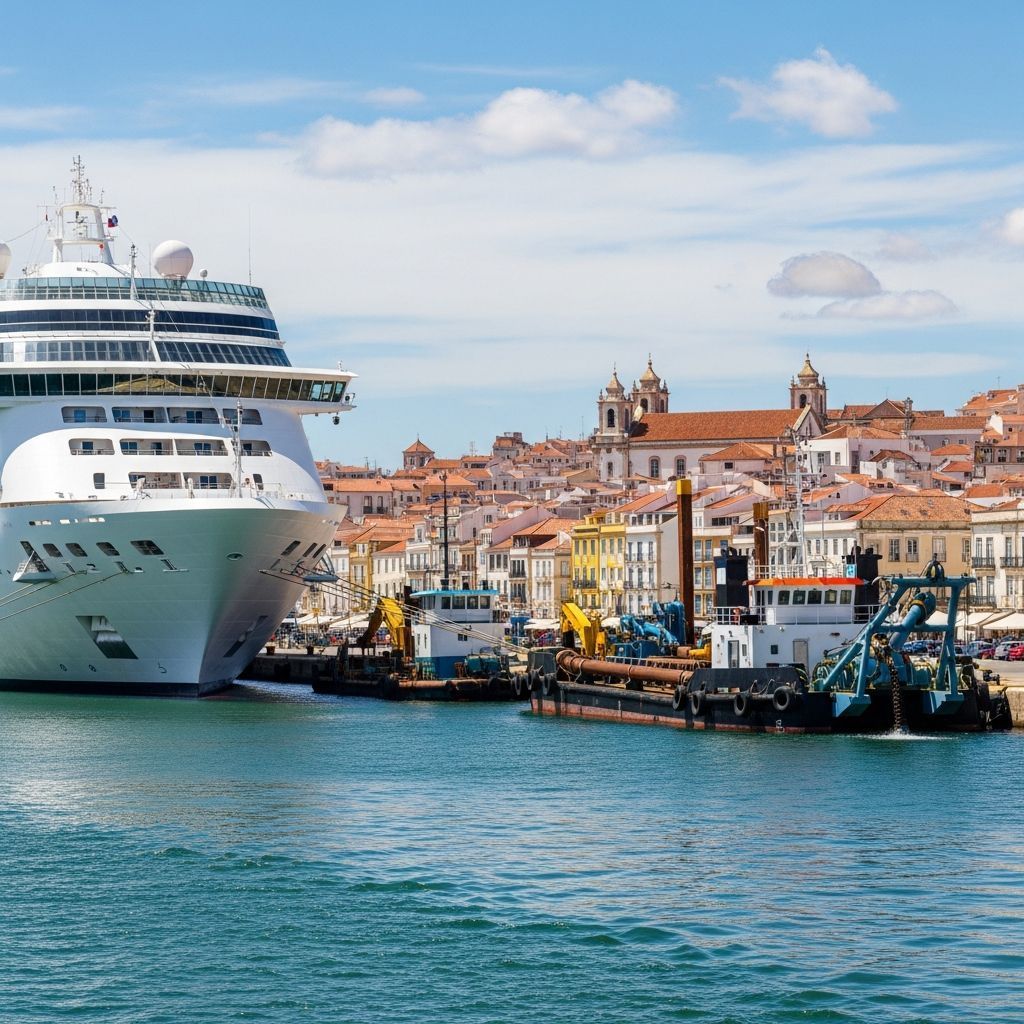
If you live in the Algarve, prepare for a significant shift in your region's tourism landscape. The Portimão port complex in the Algarve has reopened to cruise vessels after an accelerated dredging operation removed sediment buildup, a development that could inject tens of millions of euros into the southern Portugal economy by unlocking access for ships carrying up to 2,000 passengers each.
Why This Matters:
• Capacity jump: Vessels up to 220 meters—roughly the length of two football pitches—can now dock, up from the 200-meter limit that had been strangling growth.
• Economic multiplier: Based on national cruise tourism figures, each additional call generates an estimated €400,000 in direct spending on excursions, meals, and local services.
• Job creation: The national cruise sector sustained 9,800 jobs in 2024; Portimão's expansion is expected to add several hundred positions specifically in the Algarve, primarily in transport, hospitality, retail, and tour guiding—sectors accessible to both Portuguese speakers and expats with service experience.
• Timeline acceleration: Work finished in March—three months ahead of the June deadline—allowing the port to maximize the remainder of the 2026 season and fully prepare for 2027.
The €2.5M Intervention That Changed the Game
The Administração dos Portos de Sines e do Algarve (APS), the state-owned operator managing Portugal's southern maritime gateways, deployed two high-capacity dredgers starting February 28 to restore the approach channel and turning basin to -8 meters below the hydrographic datum. Sediment accumulation—known locally as assoreamento—had progressively reduced navigable depth, forcing cruise lines to skip Portimão or send smaller vessels.
The operation cost approximately €2.5M and ran continuously through March, finishing weeks before the initial forecast. APS emphasized that the work was not merely cosmetic but a question of operational safety: without adequate clearance, ships risk grounding during tidal fluctuations or adverse weather.
The dredged seabed now accommodates vessels with an 8-meter draft and gross tonnage up to 50,000 GT, a threshold that captures most mid-size cruise ships operated by lines like MSC, Costa, and Holland America. The port's berthing infrastructure—a 430-meter cruise quay—was already in place, meaning the bottleneck was purely depth-related.
What This Means for Algarve Residents and Businesses
For anyone living or working in the region, the upgrade translates into measurable economic activity. In 2025, Portimão logged 56 cruise calls and 23,996 passengers, representing year-on-year increases of 40% and 70%, respectively. For 2026, APS projects roughly 100 calls, climbing to 117 in 2027.
Each cruise day typically injects between €300,000 and €500,000 into the local economy through shore excursions, restaurant meals, taxi and bus fares, souvenir purchases, and tour bookings. Over the course of a hundred calls, that compounds to an estimated €40M to €50M annually—enough to sustain hundreds of seasonal and permanent jobs in a region where tourism accounts for nearly a quarter of GDP.
Restaurant owners in Portimão's historic center and Lagos should anticipate midday surges; transport operators may need to expand fleets to handle tender shuttles and guided tours; and retailers selling ceramics, cork goods, and regional wines stand to benefit from concentrated passenger traffic. The multiplier effect extends inland: vineyard tours, cliff walks along the Ponta da Piedade, and visits to Silves Castle all feature prominently in shore-excursion catalogs.
Competitive Position: Still a Tier Below Lisbon and Porto
Despite the upgrade, Portimão remains a secondary cruise hub when benchmarked against Portugal's heavyweights. The Port of Lisbon maintains a main channel depth of -15.5 meters and over 1,500 meters of berthing space with drafts between -8 and -12 meters, allowing it to accommodate the world's largest cruise ships—330-meter giants displacing 113,000 tons. The capital's dedicated cruise terminal, opened in 2017, routinely handles vessels from Royal Caribbean's Oasis class and Carnival's Vista class, which dwarf anything Portimão can physically receive.
Similarly, the Port of Leixões in Porto operates two terminals: the newer South Terminal offers a 340-meter quay with -10 meters of depth, suitable for ships up to 300 meters and capable of processing 2,500 passengers during turnaround operations. Funchal in Madeira boasts multiple quays with depths reaching -11 meters, positioning it as a transatlantic stopover.
Across Europe, Barcelona and Civitavecchia process millions of cruise passengers annually, equipped with multiple terminals designed for simultaneous mega-ship operations. Southampton's dual-tide advantage allows the largest container and cruise vessels port access 80% of the time.
Portimão's niche lies in serving medium-tonnage expeditionary and boutique lines that prioritize access to Portugal's southern coast over sheer passenger volume. The port is not competing for the 5,000-passenger mega-ships; instead, it targets vessels in the 1,500 to 2,500-passenger range seeking authentic regional experiences rather than mass-market itineraries.
Living With Cruise Tourism: What Residents Should Expect
If you live in Portimão's historic center or Lagos, expect concentrated footfall on cruise days—typically between 10 AM and 5 PM. Restaurants may see demand spikes during lunch hours, and parking near the waterfront will be tighter. Traffic congestion on the EN125 and routes to popular sites like Sagres and Benagil caves will increase, particularly on days with multiple ships.
For job seekers, tour companies, transport operators, and hospitality businesses typically hire in advance of the season. English, German, and French language skills are valuable but not always required—many positions exist in food service, retail, and logistics. Check with local tourism associations and the APS website for operator lists.
Property owners near cruise routes may see increased foot traffic but also potential noise and congestion. The port authority has committed to resident consultation on land-side improvements to minimize disruption.
Environmental Trade-Offs and Ongoing Monitoring
Dredging operations in the Arade River estuary carry ecological consequences, even if temporary. The primary concerns include increased water turbidity during sediment resuspension, which can stress benthic organisms and remobilize heavy metals and organic contaminants already present from decades of industrial and agricultural runoff.
Studies conducted prior to the intervention identified hydro-morphological reconfiguration of the estuary's final stretch, with long-term sediment transport likely to maintain a mobile substrate dominated by fine sands and, in upstream sections, silty sands. Benthic invertebrate communities typically recover within months, though the process is slower than for fish populations.
The Arade estuary is also an archaeological hotspot, with submerged artifacts dating to the Roman and Moorish periods. APS coordinated with the Direção-Geral do Património Cultural to map and retrieve significant finds before dredging commenced, a legally mandated step that added logistical complexity.
Disposal of dredged material followed environmental protocols: sandy sediments were deposited along the coastline to counteract erosion, while finer, potentially contaminated material was placed in designated offshore zones subject to ongoing monitoring. APS has committed to tracking water quality and sediment chemistry under the EU Water Framework Directive, with the obligation to implement corrective measures if degradation persists beyond projected recovery timelines.
The port authority is also advancing a decarbonization roadmap, including shore-power infrastructure to allow docked vessels to shut down auxiliary engines, reducing particulate and greenhouse gas emissions in the urban waterfront.
What Comes Next: Tenders, Ferries, and Land-Side Upgrades
The completed dredging is only the first phase of a broader modernization. APS has outlined plans to rehabilitate the RO-RO quay for ferry services and to enable simultaneous berthing of two tenders—the small boats that ferry passengers from anchored ships to shore when quay space is unavailable. This flexibility is critical during peak season, when multiple vessels may arrive on the same day.
Land-side access improvements are also on the agenda. The current route from the cruise terminal to downtown Portimão involves narrow streets ill-suited to coach traffic, creating bottlenecks and friction with residents. Proposals under review include a dedicated shuttle corridor and expanded parking for tour buses, measures intended to smooth passenger flow and minimize disruption.
For Algarve stakeholders—hoteliers hedging against seasonality, restaurateurs seeking midweek traffic, and municipal governments chasing tax revenue—the port's evolution represents a hedge against over-reliance on summer beach tourism. Cruise passengers, while spending less per capita than overnight visitors, arrive in concentrated waves that fill restaurants during shoulder months and support year-round employment.
The question now is execution: whether the projected call volumes materialize, whether environmental safeguards hold, and whether the region can absorb the influx without the infrastructure strain and resident backlash that have plagued Barcelona and Dubrovnik. For the moment, Portimão has the depth. The test is whether it can handle the tide.


