

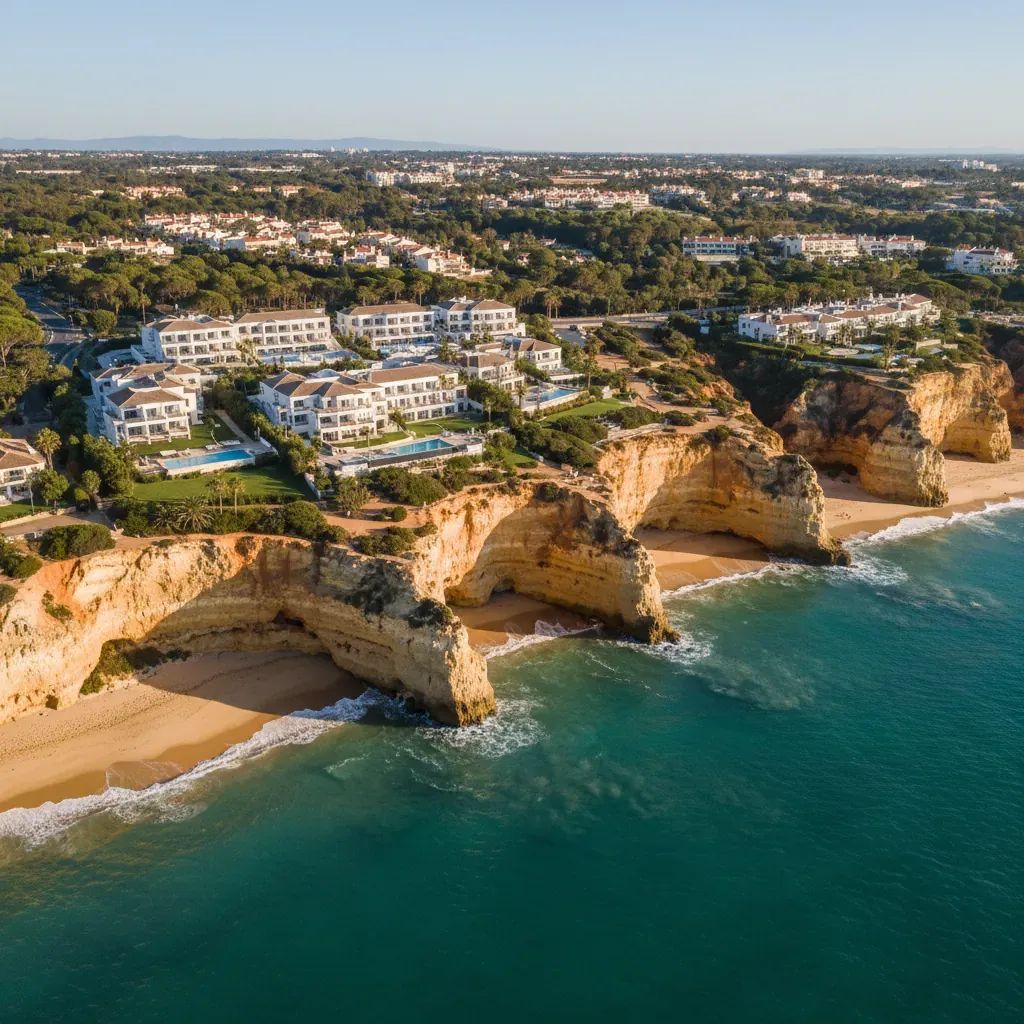
The Portugal Algarve region continues to strengthen its economic positioning as the country's tourism powerhouse, posting revenue gains that outstrip visitor volume increases—a signal that the southern coastal zone is extracting more value from each guest despite weather disruptions and traditional off-peak months.
Recent figures from the Portugal National Statistics Institute (INE), the country's official statistics agency, show the Algarve logged a 4.1% rise in tourism revenue in February 2026 while overnight stays climbed just 0.5%. That gap matters: it means hotels, restaurants, and activity operators are commanding higher per-visitor spending, even during a period when storms and cooler temperatures typically dampen demand.
Why This Matters
• Longer stays translate to bigger spend: Visitors are staying an average of 3.82 nights in the Algarve, versus a national average of just 2.37 nights—amplifying the economic ripple through local businesses.
• Domestic travelers are holding the line: Portuguese residents increased their overnight stays by 6.3%, cushioning the region against external market volatility.
• Shift toward higher-value experiences: The Algarve is moving toward premium offerings and year-round appeal rather than relying solely on volume-based tourism.
Domestic Market Anchors the Off-Season
The Portugal domestic tourism market stepped up in the first quarter, with resident guest numbers rising 1% and overnight stays surging 6.3%. This internal demand proved especially valuable during the Carnival period, when many Portuguese families opted for short breaks within the country. The phenomenon of Carnival-week travel, combined with targeted promotions for residents, helped smooth the typical January-February dip that plagues Mediterranean destinations.
André Gomes, president of Turismo do Algarve, told local media the data validates the region's multi-year push to flatten seasonality. "The domestic market dynamics, paired with the calendar effect, have enabled sustained growth," he said, adding that the focus is shifting from counting heads to measuring economic impact per stay.
That shift is deliberate. With real estate prices in coastal towns like Lagos remaining elevated and wage pressures mounting across hospitality, operators need higher margins to stay viable. The focus on attracting visitors with higher spending capacity supports sustainable growth for local businesses.
The €8.8M Strategy for Year-Round Appeal
To cement its status as a 12-month destination, the Região de Turismo do Algarve (RTA) is deploying more than €8.8M in 2026 on initiatives that stretch beyond beach umbrellas and golf courses. The investment plan prioritizes sustainability, innovation, and market diversification, aiming to pull in visitors during the shoulder months with motorsport events, wine tourism trails, and nature excursions in the interior hill towns.
The region is banking on the Algarve 2030 program, which funnels approximately €780M in European Union funds toward digital transformation, green economy projects, and competitiveness upgrades. Officials point to economic expansion into technology and communications sectors as evidence that the Algarve is developing a more diversified economic base beyond tourism.
In October, the region will host Journeys Algarve 2026, an invitation-only gathering for 40 international luxury travel buyers. It's a calculated move to position the Algarve as a premium destination. The region will also serve as the national guest of honor at the BTL – Bolsa de Turismo de Lisboa 2026, giving it a showcase platform in front of domestic and international tour operators.
Fighting Seasonality with Measurable Results
The anti-seasonality campaign is delivering measurable results. Between 2015 and 2025, the share of overnight stays concentrated in peak summer months fell from 45% to 40%—a five-percentage-point redistribution that translates into steadier employment and better cash flow for small businesses. In 2025, only 38.1% of guests and 40.8% of overnight stays occurred during the traditional high season, the lowest concentration on record for the Algarve.
Water conservation is another pillar. Hotels and resorts enrolled in the Save Water initiative have cut consumption by roughly 12%, and the program is now expanding to restaurants and municipal facilities. With climate scientists warning of more frequent droughts in southern Portugal, resource efficiency is an operational necessity.
Accessibility improvements are also underway, with expanded programs offering wheelchair access, adapted facilities, and services designed to appeal to aging European populations and families with mobility-impaired members—segments that travel off-peak and stay longer.
For Property Owners and Buyers
For expatriates and foreign property buyers, the Algarve's economic resilience underpins real estate values. Demand continues to outpace supply in most segments, with North American buyers showing heightened interest in 2025 and early 2026, drawn by political stability and lifestyle appeal. Prices in coastal municipalities are climbing at a moderate pace—no longer the double-digit leaps of 2021–2022—but steady appreciation is expected through 2026.
For Local Workers
For local workers, the push toward higher-value tourism could mean wage gains, especially in skilled roles like tour guiding, hospitality management, and tech-enabled services. However, the region's reliance on tourism also means vulnerability to external shocks: trade disputes, energy price spikes, or another pandemic wave could reverse gains quickly.
For Entrepreneurs and Business Owners
Entrepreneurs and small-business owners should note the funding landscape. The Algarve 2030 envelope includes grants and low-interest loans for digital adoption, energy retrofits, and product innovation. Sectors like wine tourism, adventure sports, and rural guesthouses are explicitly targeted, with the RTA and municipal chambers offering co-promotion in exchange for alignment with sustainability standards.
Broader Economic Context Beyond the Beach
While tourism dominates headlines, the Algarve economy is diversifying—albeit slowly. The agrifood sector received support through the AGROPYME AVANZA AAA program, which backed 41 firms over three years. A new export plan for Algarve citrus aims at Spain, France, Germany, and Canada by the end of 2026, though producers warn that rising input costs and the potential EU-Mercosur trade deal could squeeze margins.
Fishing and aquaculture face tighter European Union quotas, and the regional fleet is aging. Sardine fishing with purse-seine boats reopened in early 2026 after a December closure, but long-term prospects remain uncertain. Clam and oyster farms are expanding as a partial offset, tapping demand for premium seafood in Lisbon and international markets.
Real estate and construction remain buoyant, supported by foreign capital and the Golden Visa successor schemes. Interior and eastern Algarve municipalities—Tavira, Castro Marim, Alcoutim—are seeing renewed interest as buyers priced out of Lagos and Albufeira look for alternatives.
Competitive Positioning Against Mediterranean Rivals
Portugal as a whole is forecast to grow between 1.9% and 2.3% in 2026, outpacing the Eurozone average. The Algarve and the Portugal North region posted 2.3% real GDP growth in 2024, ahead of the Alentejo's 1.1%.
Across the Mediterranean, Spain logged a 4% increase in international arrivals in 2025 and expects tourist spending to reach $127.7 billion, driven by high-volume markets like the UK and Germany. France is projected to reclaim the European arrival crown. Both countries are grappling with "overtourism" protests and new visitor taxes, which could redirect some travelers toward quieter alternatives like the Algarve.
The World Travel Awards named the Algarve "Best Beach Destination in the World" for the third time, a marketing asset that resonates with tour operators and travel media. Satisfaction surveys in 2025 found that 95.2% of visitors would recommend the region, and 83.8% expressed intent to return within five years—loyalty metrics that support premium pricing strategies.
Risks on the Horizon
Geopolitical instability, inflation persistence, and climate volatility remain wildcards. Extreme weather events—heatwaves, wildfires, or unseasonal storms—can dent bookings and strain infrastructure. The European tourism sector as a whole faces headwinds from tighter consumer budgets and trade friction, particularly if transatlantic routes or UK travel patterns shift.
Locally, housing affordability is a flashpoint. Rising short-term rental inventory and foreign buyer competition have priced many Algarve residents out of traditional neighborhoods, fueling social tension and calls for stricter regulation. Any policy changes—caps on Airbnb licenses, higher property transfer taxes, or residency requirements—could cool investor sentiment.
The Bottom Line
The Algarve's ability to grow revenue faster than visitor volume marks a significant shift in regional strategy. With an average stay nearly 40% longer than the national norm and a domestic market willing to fill off-peak capacity, the region has built resilience against the boom-bust cycles that plague single-season destinations. The €8.8M investment in diversification, coupled with EU structural funds and economic expansion initiatives, indicates the Algarve is developing a more sustainable tourism model.
For those living in or investing in Portugal, the Algarve's performance is a bellwether. If a region this dependent on tourism can shift toward quality and resilience, it offers a template for other parts of the country. The data from February 2026—modest overnight growth, solid revenue gains, strong domestic participation—indicates the model is holding, even when the sun doesn't shine.


