
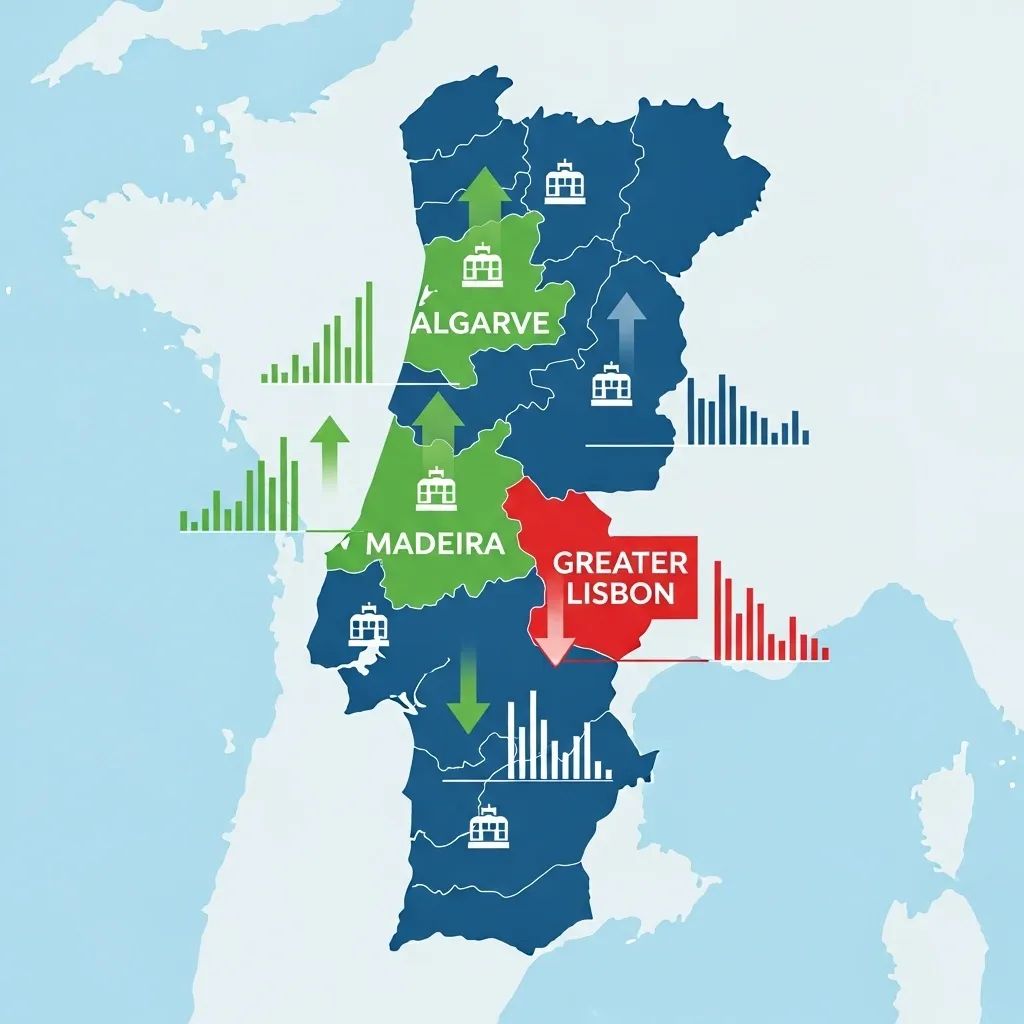
A shy bump in takings is not the full story of Portugal’s tourist-accommodation market this November: headline revenue nudged up, yet income per room slid, and the map of winners and losers looks very different from the national average.
Quick Takeaways
• €393.5 M in total revenue, up 2.1% year-on-year.
• RevPAR fell 2.2% to €47.1, while ADR slipped 0.1% to €97.8.
• Algarve (+12.5%) and Madeira (+10.6%) posted the strongest gains; Greater Lisbon saw revenue shrink 4.3%.
• Tourist beds welcomed 2.18 M guests (+0.8%) and logged 5.06 M overnight stays (+1%).
• Domestic demand (+1.4%) outpaced the rise in foreign nights (+0.8%).
Revenue climbs, room returns retreat
Inflows into hotels, guest-houses and holiday apartments improved only modestly in November, reaching €393.5 M according to the latest INE bulletin. By contrast, average earnings per available room continued a two-month slide. Industry analysts blame an unfavourable calendar—Easter fell early this year—plus heavy price competition in shoulder-season city breaks. The diverging trend is prompting operators to rethink winter discount strategies, especially in urban markets where intense supply from short-let platforms is biting hardest.
Algarve and Madeira buck the chill
While national numbers are lukewarm, regional figures tell a brighter story in the south and the Atlantic islands. The Algarve’s 12.5% leap in takings translates into roughly €56 M, fuelled by a double-digit spike in Portuguese visitors escaping the first winter rains. Madeira, buoyed by cruise stopovers and a strong events calendar, lifted revenue 10.6% to €60.5 M. In sharp contrast, Greater Lisbon—still the country’s heavyweight at €145.2 M—lost ground for the second consecutive month, suggesting that city breaks alone cannot offset softer corporate travel at year-end.
Home-grown tourists steady the ship
The resilience of internal tourism continues to insulate the sector from external shocks. Nationwide, resident travellers accounted for 1.7 M overnight stays, a 1.4% rise that exceeded the growth in foreign bookings. That pattern was even more pronounced in the Alentejo and the North, where locals have been snapping up off-season deals. Hoteliers interviewed by Público cite loyalty programmes and tax-deductible staycations as decisive draws for families wary of higher airfares abroad.
Canada surprises, France retreats
Among overseas markets, Canada delivered the standout performance, expanding 14.8% year-on-year—partly thanks to extra Toronto-Lisbon flights launched last spring. The picture was gloomier for France, traditionally Portugal’s second-largest feeder, which posted a 10.5% drop in nights amid tougher economic conditions and stiff competition from domestic French resorts reclaiming post-pandemic business.
Experts see a pivot toward greener, smarter growth
Sector insiders contacted by Expresso argue the mixed November figures are less a warning sign and more a symptom of transition. “We’re entering an era where success will be measured in value added, not just heads in beds,” says Rui Ventura of Turismo Centro. Operators are turning to:
Low-impact experiences—bike trails, wine harvests, and dark-sky tourism—tailored to year-round travellers.
Digital guest journeys, from AI-driven itinerary builders to chat-check-in, aimed at squeezing higher spend per visitor.
Route diversification, with secondary airports such as Faro and Funchal lobbying carriers for North American and Nordic links.
Outlook: another record year still within reach
Despite the slower November, accumulated revenue for January-November already sits at €6.82 B, 7.2% above the same period in 2024—a figure that eclipses the whole of last year. Barring an external shock, Portugal remains on course to post its strongest tourism billings ever in 2025. The open question, insiders warn, is not demand but how cleverly the sector can manage success without eroding margins—or the landscapes that make visitors come in the first place.


