

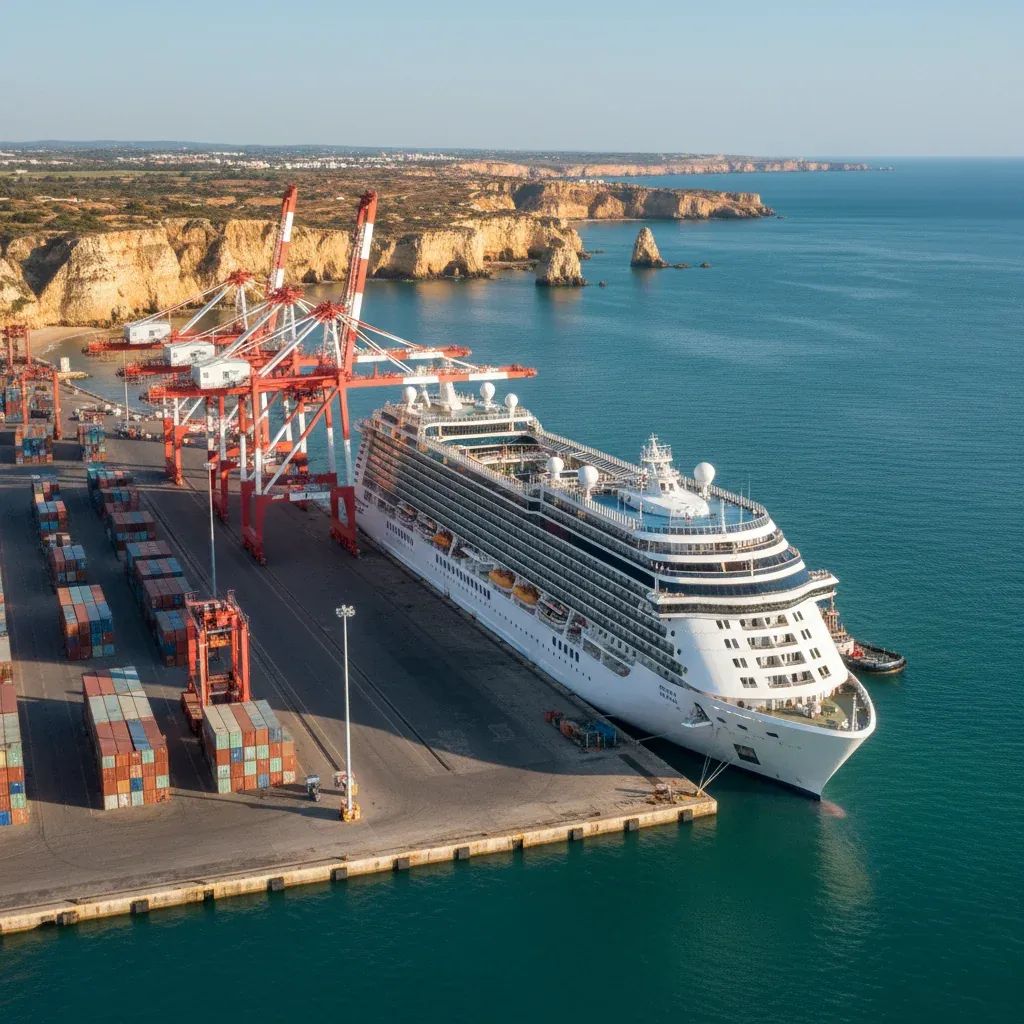
Portimão's waterfront is undergoing its most significant maritime upgrade in over a decade. The Portugal Port Authority for Sines and Algarve has mobilized heavy dredging equipment to deepen the harbor's seabed, a project that will fundamentally alter how the southern coast competes for cruise tourism revenue. What was once marginal capacity is becoming a credible entry point for the Atlantic cruise circuit—and potentially millions of euros in additional spending across the Algarve region.
Key Takeaways
• Safety threshold: Dredging operations ensure 8-meter minimum depths (measured from lowest tide), allowing mid-sized vessels up to 220 meters long to navigate safely year-round.
• Passenger surge ahead: Portimão expects roughly 23,996 visitors annually from cruise ships, with projections climbing to approximately 100 ship calls in 2026 and 117 in 2027—a massive leap from 56 calls and 70% passenger growth in 2025.
• Economic engine: Cruise tourism generated €940M nationally in 2024, with individual travelers spending €50–70 per visit—meaningful revenue for local retailers, restaurants, and tour operators despite brief port stays.
The Technical Reality Behind the Numbers
The dredging operation that commenced in early March 2026 is fundamentally an exercise in operational mathematics. Most mid-range cruise ships—the workhorses that carry 1,200 to 2,500 passengers—draw between 7 and 7.5 meters of water. Without a safety buffer, they cannot enter Portimão's harbor at low tide, forcing operators to either delay arrival, reroute entirely, or—in the worst scenario—skip the port altogether. The APS administration has targeted a -8-meter baseline measured from hydrographic zero, the official minimum tide level. This seemingly modest adjustment has profound commercial implications.
The intervention extends beyond simple dredging. Crews are simultaneously undertaking structural rehabilitation of the Ro-Ro pier, enabling two support vessels (tenders) to dock simultaneously. This matters operationally: when larger ships anchor offshore rather than berthing directly, they shuttle passengers to shore via these smaller ferries. The ability to handle dual tender operations cuts passenger processing time and reduces bottlenecks during peak disembarkation periods.
Landside access improvements are equally critical. Local business representatives have long complained about congestion when multiple coach companies attempt to drop passengers simultaneously. The port is widening circulation routes and improving signage—unglamorous work, but essential for the visitor experience that determines whether passengers recommend the port to cruise operators planning future itineraries.
Why This Matters for Local Economies
Cruise tourism operates on a simple economics model: high volume, modest per-capita spending. The typical cruise passenger allocates €50–70 per port visit compared to €100-plus for independent travelers staying multiple nights. Yet scale compensates for lower individual spending. When Portimão hosts 56 ship calls annually, each averaging 400+ passengers, that translates into roughly 22,400 visitors whose spending filters through local taxi services, casual dining establishments, and souvenir retailers. The 2025 data told this story: 70% passenger growth from 2024 levels, reaching nearly 24,000 visitors—a demographic inflection worth noting.
The national cruise sector's €940M economic footprint in 2024 supported 9,800 jobs and generated €150M in direct spending by passengers and crew. For the Algarve—a region dependent on seasonal tourism—cruise calls offer valuable shoulder-season economic activity (April–May and September–October) when hotel occupancy typically dips. The tax revenue, employment hours, and retail transactions accumulate across a fragmented economy of independent operators: boat captains offering scenic tours, restaurant staff managing rapid table turnover, and shop owners stocking inventory timed to expected passenger arrival windows.
However, this revenue stream depends entirely on consistent port calls. If Portimão's infrastructure cannot accommodate larger vessels or process passengers efficiently, cruise lines simply opt for competitor ports. This is not theoretical risk. Málaga, Cádiz, and Huelva—three Spanish ports within reasonable sailing distance—have made comparable or greater infrastructure investments and actively compete for identical itineraries.
Portimão's Strategic Position Within National Harbor Hierarchy
Portugal operates three primary cruise terminals, and the hierarchy is unmistakable. Lisbon's Santa Apolónia Terminal, inaugurated in 2017 and designed by architect Carrilho da Graça, operates a 1,490-meter quay with capacity to accommodate the world's largest cruise liners. The terminal features 13,800 m² of passenger facilities across three levels, automated gangways spanning 600 meters, and a 12-meter draft that eliminates tidal constraints entirely. In 2024, Lisbon processed 763,652 passengers, cementing its role as the nation's primary cruise hub. The capital is also implementing an Onshore Power Supply (OPS) system—estimated at €18.3M for the initial phase, with completion expected by 2029—allowing berthed ships to plug into the electrical grid and eliminate diesel generator operation during port stays.
Porto's Leixões Terminal, which opened in 2015 and was designed by architect Luís Pedro Silva, handles over 225,000 passengers annually (growing 30% year-on-year in 2025) and features a 340-meter quay capable of receiving the largest contemporary vessels. The port authority has committed over €931M in strategic investment through 2035, including marina relocation, berth electrification, and expanded customs infrastructure. Both Lisbon and Leixões have received international recognition from industry bodies like Seatrade Cruise International.
Portimão enters this competitive landscape from a fundamentally different position. The terminal's 430-meter quay can accommodate vessels up to 230 meters—sufficient for mid-tier ships but precluding flagship mega-ships that generate premium revenue. The 3.6M-euro dredging investment is substantial for a regional port but modest compared to Lisbon's €100M+ terminal development or Porto's multi-billion-euro strategic plan. Portimão's strategic advantage lies elsewhere: lower operational costs, faster passenger processing due to compact terminal footprint, and a distinct market segment composed of smaller boutique vessels and overflow from saturated northern ports.
The National Strategy Underpinning Regional Investment
Portimão's harbor improvements exist within a broader institutional framework. The Ports 5+ Strategy, approved by the Portugal Cabinet on July 24, 2025, establishes five strategic pillars: increased investment and growth, decarbonization, intermodal connectivity, digitalization, and integrated security. The cruise segment sits directly within the growth pillar, with national projections forecasting passenger volumes will expand from approximately 2.3M in 2024 to 3M by 2035—a 30% increase spread across all Portuguese maritime terminals.
The strategy allocates a €4B investment envelope across all Portuguese commercial ports, with 75% of funding anticipated from private concessions. Roughly 15 new concession contracts are slated for tender by 2035. Portimão's current dredging initiative is publicly financed, but port administrators have signaled openness to private terminal operator partnerships if passenger volumes justify dedicated facilities and specialized management.
This national growth projection assumes sustained demand for European cruise products, expanded fly-cruise packages via Faro Airport (65 kilometers east of Portimão), and new routing patterns linking the Canary Islands to northern Europe with Portuguese stopovers. Portimão's geographic position makes it operationally logical as either an overnight turnaround port or a seasonal repositioning hub for ships transitioning between Atlantic and Mediterranean sailing routes.
Competitive Pressure and the Spanish Alternative
The Algarve's cruise aspirations do not operate in isolation. Across the Spanish border, Málaga processed over 500,000 cruise passengers in 2024, significantly outpacing all Portuguese ports individually and benefiting from integrated rail connections to Seville and Granada. Cádiz and Huelva, while smaller, have made comparable infrastructure investments and maintain comparable Mediterranean climate advantages.
The Portugal Port Authority is banking on a differentiated value proposition: lower per-call operational fees compared to Spanish competitors, expedited customs processing, and proximity to distinctive attractions—the Benagil sea caves, the Ria Formosa protected wetland, and underdeveloped coastal segments that contrast sharply with crowded tourist zones in Spain. Port administrators have floated the concept of transnational shore excursion packages pairing Portimão calls with overland excursions into Seville, effectively creating hybrid Portuguese-Spanish tourism products that distinguish the port from direct Spanish competitors.
The 2026 Execution Window
The dredging work is scheduled for mid-2026 completion, creating a critical six-month window for the APS administration to market Portimão's expanded capacity to cruise operators and line managers. The annual Seatrade Cruise Global trade convention in April represents the primary venue for contract negotiations—where port representatives pitch itineraries to cruise line procurement officers. Success in that venue directly translates to the projected 100 ship calls in 2026 and 117 calls in 2027.
Execution on landside improvements will directly determine whether these projections materialize or fall short. Congestion complaints, slow passenger processing, or inadequate ground transportation coordination can rapidly tarnish a port's operational reputation. Conversely, seamless experiences generate the word-of-mouth recommendations that cascade through cruise line decision-making.
If the 100-call target is achieved, expect secondary investment priorities to emerge: expanded baggage handling systems, duty-free retail offerings, and potentially a dedicated berth for expedition-class vessels targeting naturalist shore excursions. The infrastructure foundation is being laid; whether market demand follows depends on execution quality and the Algarve's ability to convert port arrivals into memorable experiences that passengers recommend through industry networks.


